
The Zincali, by George Borrow
Transcribed from the 1901 John Murray edition by David Price,best magnetic tiles for 3 year olds under 25 dollarsemail [email protected]
THE ZINCALI
AN ACCOUNT OF THE
GYPSIES OF SPAIN
BY GEORGE BORROW
AUTHOROF
‘THE BIBLE IN SPAIN’
‘LAVENGRO’
ETC.
‘For that whichis unclean by nature,
thou canst entertain no hope; no washing
will turn the Gypsy white.’—Ferdousi
NEW IMPRESSION
LONDON
JOHN MURRAY, ALBEMARLE STREET
1901
p. ivEdinburgh: T. and A. Constable, Printers to Her Majesty
p. vTO
THE RIGHT HONOURABLE
THE EARL OF CLARENDON, G.C.B.
KEEPER OFHER MAJESTY’S PRIVY SEAL
ETC., ETC.,ETC.
My Lord,
I feel it not only a gratification but an honour to bepermitted to dedicate these volumes[0] to your Lordship, the moreparticularly as they are connected with Spain, a countryin which it was so frequently my fortune to experience suchprompt and salutary aid from your Lordship in the high capacityof representative of our Gracious British Sovereign.
The remembrance of the many obligations under which yourLordship has placed me, by your energetic and effectualinterference in time of need, will ever in heartfeltgratitude cause me to remain, with unfeigned sentiments ofrespect,
My Lord,
Your most devotedServant,
GEORGE BORROW.
p.viiPREFACE
It is with some diffidence that theauthor ventures to offer the present work to the public.
The greater part of it has been written under very peculiarcircumstances, such as are not in general deemed at allfavourable for literary composition: at considerable intervals,during a period of nearly five years passed in Spain—inmoments snatched from more important pursuits—chiefly inventas and posádas, whilst wandering through the countryin the arduous and unthankful task of distributing the Gospelamong its children.
Owing to the causes above stated, he is aware that his workmust not unfrequently appear somewhat disjointed and unconnected,and the style rude and unpolished: he has, nevertheless,permitted the tree to remain where he felled it, having, indeed,subsequently enjoyed too little leisure to make much effectualalteration.
At the same time he flatters himself that the work is notdestitute of certain qualifications to entitle it toapprobation. The author’s acquaintance with the Gypsyrace in general dates from a p. viiivery early period of his life,which considerably facilitated his intercourse with thePeninsular portion, to the elucidation of whose history andcharacter the present volumes are more particularlydevoted. Whatever he has asserted, is less the result ofreading than of close observation, he having long since come tothe conclusion that the Gypsies are not a people to be studied inbooks, or at least in such books as he believes have hithertobeen written concerning them.
Throughout he has dealt more in facts than in theories, ofwhich he is in general no friend. True it is, that no racein the world affords, in many points, a more extensive field fortheory and conjecture than the Gypsies, who are certainly a verymysterious people come from some distant land, no mortal knowswhy, and who made their first appearance in Europe at a darkperiod, when events were not so accurately recorded as at thepresent time.
But if he has avoided as much as possible touching uponsubjects which must always, to a certain extent, remain shroudedin obscurity; for example, the original state and condition ofthe Gypsies, and the causes which first brought them into Europe;he has stated what they are at the present day, what he knowsthem to be from a close scrutiny of their ways and habits, forwhich, perhaps, no one ever enjoyed better opportunities; and hehas, moreover, given—not a few words culled expressly forthe purpose of supporting a p. ixtheory, but one entire dialect oftheir language, collected with much trouble and difficulty; andto this he humbly calls the attention of the learned, who, bycomparing it with certain languages, may decide as to thecountries in which the Gypsies have lived or travelled.
With respect to the Gypsy rhymes in the second volume, hewishes to make one observation which cannot be too frequentlyrepeated, and which he entreats the reader to bear in mind: theyare Gypsy compositions, and have little merit save so faras they throw light on the manner of thinking and speaking of theGypsy people, or rather a portion of them, and as to what theyare capable of effecting in the way of poetry. It will,doubtless, be said that the rhymes are trash;—evenwere it so, they are original, and on that account, in aphilosophic point of view, are more valuable than the mostbrilliant compositions pretending to describe Gypsy life, butwritten by persons who are not of the Gypsy sect. Suchcompositions, however replete with fiery sentiments, andallusions to freedom and independence, are certain to be taintedwith affectation. Now in the Gypsy rhymes there is noaffectation, and on that very account they are different in everyrespect from the poetry of those interesting personages whofigure, under the names of Gypsies, Gitános, Bohemians,etc., in novels and on the boards of the theatre.
It will, perhaps, be objected to the present work, p. xthat itcontains little that is edifying in a moral or Christian point ofview: to such an objection the author would reply, that theGypsies are not a Christian people, and that their morality is ofa peculiar kind, not calculated to afford much edification towhat is generally termed the respectable portion ofsociety. Should it be urged that certain individuals havefound them very different from what they are represented in thesevolumes, he would frankly say that he yields no credit to thepresumed fact, and at the same time he would refer to thevocabulary contained in the second volume, whence it will appearthat the words hoaxand hocushave been immediatelyderived from the language of the Gypsies, who, there is goodreason to believe, first introduced the system into Europe, towhich those words belong.
The author entertains no ill-will towards the Gypsies; whyshould he, were he a mere carnal reasoner? He has knownthem for upwards of twenty years, in various countries, and theynever injured a hair of his head, or deprived him of a shred ofhis raiment; but he is not deceived as to the motive of theirforbearance: they thought him a Rom, and on thissupposition they hurt him not, their love of ‘theblood’ being their most distinguishingcharacteristic. He derived considerable assistance fromthem in Spain, as in various instances they officiated ascolporteurs in the distribution of the Gospel: but on thataccount he is p.xinot prepared to say that they entertained any love forthe Gospel or that they circulated it for the honour ofTebléque the Saviour. Whatever they did for theGospel in Spain, was done in the hope that he whom they conceivedto be their brother had some purpose in view which was tocontribute to the profit of the Calés, or Gypsies, and toterminate in the confusion and plunder of the Busné, orGentiles. Convinced of this, he is too little of anenthusiast to rear, on such a foundation, any fantastic edificeof hope which would soon tumble to the ground.
The cause of truth can scarcely be forwarded by enthusiasm,which is almost invariably the child of ignorance anderror. The author is anxious to direct the attention of thepublic towards the Gypsies; but he hopes to be able to do sowithout any romantic appeals in their behalf, by concealing thetruth, or by warping the truth until it becomes falsehood. In the following pages he has depicted the Gypsies as he hasfound them, neither aggravating their crimes nor gilding themwith imaginary virtues. He has not expatiated on‘their gratitude towards good people, who treat them kindlyand take an interest in their welfare’; for he believesthat of all beings in the world they are the least susceptible ofsuch a feeling. Nor has he ever done them injustice byattributing to them licentious habits, from which they are,perhaps, more free than any race in the creation.
p.xiiPREFACE TO THE SECOND EDITION
I cannot permit the second editionof this work to go to press without premising it with a fewwords.
When some two years ago I first gave The Zincalito theworld, it was, as I stated at the time, with considerablehesitation and diffidence: the composition of it and thecollecting of Gypsy words had served as a kind of relaxation tome whilst engaged in the circulation of the Gospel inSpain. After the completion of the work, I had not theslightest idea that it possessed any peculiar merit, or wascalculated to make the slightest impression upon the readingworld. Nevertheless, as every one who writes feels a kindof affection, greater or less, for the productions of his pen, Iwas averse, since the book was written, to suffer it to perish ofdamp in a lumber closet, or by friction in my travellingwallet. I committed it therefore to the press, with afriendly ‘Farewell, little book; I have done for you all Ican, and much more than you deserve.’
My expectations at this time were widely different from thoseof my namesake George in the Vicar of Wakefieldwhen hepublished his paradoxes. I p. xiiitook it as a matter of course thatthe world, whether learned or unlearned, would say to my bookwhat they said to his paradoxes, as the eventshowed,—nothing at all. To my utter astonishment,however, I had no sooner returned to my humble retreat, where Ihoped to find the repose of which I was very much in need, than Iwas followed by the voice not only of England but of the greaterpart of Europe, informing me that I had achieved a feat—awork in the nineteenth century with some pretensions tooriginality. The book was speedily reprinted in America,portions of it were translated into French and Russian, and afresh edition demanded.
In the midst of all this there sounded upon my ears a voicewhich I recognised as that of the Mæcenas of Britishliterature: ‘Borromeo, don’t believe all you hear,nor think that you have accomplished anything so veryextraordinary: a great portion of your book is very sorry trashindeed—Gypsy poetry, dry laws, and compilations from dullSpanish authors: it has good points, however, which show that youare capable of something much better: try your handagain—avoid your besetting sins; and when you haveaccomplished something which will really do credit to —Street, it will be time enough to think of another delivery ofthese Gypsies.’
Mistos amande: ‘I am content,’ I replied; andsitting down I commenced the Bible in Spain. At p. xivfirst Iproceeded slowly—sickness was in the land, and the face ofnature was overcast—heavy rain-clouds swam in theheavens,—the blast howled amid the pines which nearlysurround my lonely dwelling, and the waters of the lake whichlies before it, so quiet in general and tranquil, were fearfullyagitated. ‘Bring lights hither, O Hayim Ben Attar,son of the miracle!’ And the Jew of Fez brought inthe lights, for though it was midday I could scarcely see in thelittle room where I was writing. . . .
A dreary summer and autumn passed by, and were succeeded by asgloomy a winter. I still proceeded with the Bible inSpain. The winter passed, and spring came with cold drywinds and occasional sunshine, whereupon I arose, shouted, andmounting my horse, even Sidi Habismilk, I scoured all thesurrounding district, and thought but little of the Bible inSpain.
So I rode about the country, over the heaths, and through thegreen lanes of my native land, occasionally visiting friends at adistance, and sometimes, for variety’s sake, I stayed athome and amused myself by catching huge pike, which lie perdue incertain deep ponds skirted with lofty reeds, upon my land, and towhich there is a communication from the lagoon by a deep andnarrow watercourse.—I had almost forgotten the Bible inSpain.
Then came the summer with much heat and p. xvsunshine, andthen I would lie for hours in the sun and recall the sunny days Ihad spent in Andalusia, and my thoughts were continuallyreverting to Spain, and at last I remembered that the Bible inSpainwas still unfinished; whereupon I arose and said:‘This loitering profiteth nothing’—and Ihastened to my summer-house by the side of the lake, and there Ithought and wrote, and every day I repaired to the same place,and thought and wrote until I had finished the Bible inSpain.
And at the proper season the Bible in Spainwas givento the world; and the world, both learned and unlearned, wasdelighted with the Bible in Spain, and the highestauthority [1] said, ‘This is a much better bookthan the Gypsies’; and the next great authority [2] said, ‘something betwixt Le Sageand Bunyan.’ ‘A far more entertaining work thanDon Quixote,’ exclaimed a literary lady. ‘Another Gil Blas,’ said the cleverest writerin Europe. [3] ‘Yes,’ exclaimed thecool sensible Spectator, [4] ‘a GilBlasin water-colours.’
And when I heard the last sentence, I laughed, and shouted,‘Kosko pennese pal!’ [5] It pleased me better than all therest. Is there not a text in a certain old book which says:Woe unto you when all men shall speak well of you! Thoseare awful words, brothers; woe is me!
p.xvi‘Revenons à nosBohémiens!’ Now the Bible in Spainisoff my hands, I return to ‘these Gypsies’; andhere you have, most kind, lenient, and courteous public, a freshdelivery of them. In the present edition, I have attendedas much as possible to the suggestions of certain individuals,for whose opinion I cannot but entertain the highestrespect. I have omitted various passages from Spanishauthors, which the world has objected to as being quite out ofplace, and serving for no other purpose than to swell out thework. In lieu thereof, I have introduced some originalmatter relative to the Gypsies, which is, perhaps, morecalculated to fling light over their peculiar habits thananything which has yet appeared. To remodel the work,however, I have neither time nor inclination, and must thereforeagain commend it, with all the imperfections which still cling toit, to the generosity of the public.
A few words in conclusion. Since the publication of thefirst edition, I have received more than one letter, in which thewriters complain that I, who seem to know so much of what hasbeen written concerning the Gypsies, [6] should have taken nonotice of a theory entertained by many, namely, that they are ofJewish origin, and that they are neither more nor less than thedescendants of the p. xviitwo lost tribes of Israel. Now I am not going to enter into a discussion upon this point,for I know by experience, that the public cares nothing fordiscussions, however learned and edifying, but will take thepresent opportunity to relate a little adventure of mine, whichbears not a little upon this matter.
So it came to pass, that one day I was scampering over aheath, at some distance from my present home: I was mounted uponthe good horse Sidi Habismilk, and the Jew of Fez, swifter thanthe wind, ran by the side of the good horse Habismilk, when whatshould I see at a corner of the heath but the encampment ofcertain friends of mine; and the chief of that camp, even Mr.Petulengro, stood before the encampment, and his adopteddaughter, Miss Pinfold, stood beside him.
Myself.—‘Kosko divvus [7], Mr. Petulengro! I am glad to seeyou: how are you getting on?’
Mr. Petulengro.—‘How am I getting on? aswell as I can. What will you have for that nokengro [8]?’
Thereupon I dismounted, and delivering the reins of the goodhorse to Miss Pinfold, I took the Jew of Fez, even Hayim BenAttar, by the hand, and went up to Mr. Petulengro, exclaiming,‘Sure ye are two brothers.’ Anon the Gypsypassed his p.xviiihand over the Jew’s face, and stared him in theeyes: then turning to me he said, ‘We are not dui palor [9]; this man is no Roman; I believe him tobe a Jew; he has the face of one; besides, if he were a Rom, evenfrom Jericho, he could rokra a few words in Rommany.’
Now the Gypsy had been in the habit of seeing German andEnglish Jews, who must have been separated from their Africanbrethren for a term of at least 1700 years; yet he recognised theJew of Fez for what he was—a Jew, and without hesitationdeclared that he was ‘no Roman.’ The Jews,therefore, and the Gypsies have each their peculiar anddistinctive countenance, which, to say nothing of the differenceof language, precludes the possibility of their having ever beenthe same people.
March1, 1843.
NOTICE TO THE FOURTH EDITION
This edition has been carefullyrevised by the author, and some few insertions have beenmade. In order, however, to give to the work a more popularcharacter, the elaborate vocabulary of the Gypsy tongue, andother parts relating to the Gypsy language and literature, havebeen omitted. Those who take an interest in these subjectsare referred to the larger edition in two vols. [10]
p.xixCONTENTS
INTRODUCTION | |
On the Gypsies in general—Name andLanguage—The Russian Gypsies—Gypsies atMoscow—Hungarian Gypsies—Wallachia andMoldavia—English Gypsies, or Rommany—GypsyFortune-tellers—Gypsy Jockeys—GypsyWill—Thurtell—Gypsy Clans—Names ofFamilies—Gypsy Law—Pazorrhus—ThePatteran—Baptismal Papers—Gypsies of theEast—Artifice of Timour—Bishop of Forli | 1 |
THEZINCALI | |
PART I | |
CHAPTER I | |
Of the Spanish Gypsies ingeneral—Names—Arrival—EgyptianPenitents—Peculiarities of Spain—Provinces which theGypsies principally frequented | 41 |
CHAPTER II | |
Manner of Life—Predatory Habits—TheTraveller—Jews and Gypsies—The Forge—TheSparks—Gypsy Counts—Martin del Rio—Facility inspeaking Languages—Proverbs | 48 |
p. xxCHAPTERIII | |
Excesses of the Gitános—The Bookseller ofLogroño | 61 |
CHAPTER IV | |
Gypsy Colonies in various Towns of Spain | 71 |
CHAPTER V | |
Cannibalism—The Forest—Anecdotes—Food ofthe Gypsies—Child-stealing—Connection of theGitános with the Moors of Barbary | 76 |
CHAPTER VI | |
Barbary and its Tribes—Beni Aros—Sidi Hamed auMuza—The Children of the Dar-Bushi-Fal, a Sect of Thievesand Sorcerers, probably of Gypsy Origin | 85 |
CHAPTER VII | |
Chiromancy—Torreblanca—Gitánas—TheGitána of Seville—La Buena Ventura—TheDance—The Song—Tricks of the Gitánas—TheWidow—Occult Powers | 98 |
CHAPTER VIII | |
The Evil Eye—Credulity of Eastern Nations on thissubject—Remedies for the Evil Eye—TheTalmud—Superstitions of the North | 115 |
CHAPTER IX | |
Exodus of the Jews: that of the Gypsies—Indifferenceof the Gitános with respect toReligion—Ezekiel—Tale of EgyptianDescent—Quiñones—Melchior of p.xxiGuelama—Religious Tolerance—The Inquisitorof Cordova—Gitános and Moriscos | 122 |
CHAPTER X | |
The Expulsion of the Gitános; a Discourse addressedby Dr. Sancho de Moncada to Philip the Third | 137 |
CHAPTER XI | |
Various Laws issued against the Spanish Gypsies, from thetime of Ferdinand and Isabella to the latter part of theEighteenth Century, embracing a period of nearly Three HundredYears | 151 |
CHAPTER XII | |
Carlos Tercero—His Law respecting theGitános | 166 |
PART II | |
CHAPTER I | |
Badajoz—The Gypsies—The WitheredArm—Gypsy Law—Trimming andShearing—Metempsychosis—Paco andAntonio—Antonio and the Magyar—TheChai—Pharaoh—The Steeds of the Egyptians | 177 |
CHAPTER II | |
Madrid—Gypsy Women—Granada—GypsySmiths—PepeConde—Seville—Triana—Cordova—Horses—TheEsquilador—Characteristic Epistle—Catalonia, etc. | 194 |
p. xxiiCHAPTERIII | |
General Remarks on the Present State of theGitános—Inefficiency of the Old Laws—Prospectsof the Gitános—Partial Reformation—Decline ofthe Gypsy Sect—Fair of Leon—Love of Race—Gypsyexecuted—Numerical Decrease | 207 |
CHAPTER IV | |
Illustrations of Gypsy Character—The Gypsy Innkeeperof Tarifa—The Gypsy Soldier of Valdepeñas | 221 |
CHAPTER V | |
Various Points connected with theGitános—Dress—PhysicalCharacteristics—The Gypsy Glance—Extracts from aSpanish work | 243 |
CHAPTER VI | |
Certain Tricks and Practices of the GypsyFemales—The Bahi—Hokkano Baro—UstilarPastésas—Shoplifting—Drao—TheLoadstone—The Root of the Good Baron | 252 |
CHAPTER VII | |
The Marriage Festival—Eastern Jews—TheirWeddings | 266 |
CHAPTER VIII | |
Attempts made to enlighten the Gitános—TheInward Monitor—The One-eyed Gitána—Pépaand Chicharóna—The Gypsy Congregation | 274 |
p. xxiiiPARTIII | |
CHAPTER I | |
The Poetry of the Gitános | 287 |
CHAPTER II | |
Spurious Gypsy Poetry of Andalusia | 298 |
Brijindope.—The Deluge | 304 |
The Pestilence | 310 |
On the Language of the Gitános | 313 |
Robber Language | 335 |
The Term ‘Busno’ | 354 |
Specimens of Gypsy Dialects | 357 |
Vocabulary of their Language | 365 |
APPENDIX | |
Miscellanies in the Gitáno Language | 415 |
The English Dialect of the Rommany | 428 |
p.xxivLIST OF ILLUSTRATIONS
Gypsy’s Marriage Dance (photogravure) | Frontispiece |
The Rearguard of the Marching Gypsies | To face page50 |
Travellers attacked by the Gitános | 52 |
A Song of Egypt | 108 |
The Gypsy Smith of Granada | 196 |
The Murder of Pindamonas by Pepe Conde | 198 |
Roasting Chestnuts by the side of the Guadalquiver | 200 |
A Gypsy Family | 222 |
p. 1THEGYPSIES
INTRODUCTION
Throughout my life the Gypsy racehas always had a peculiar interest for me. Indeed I canremember no period when the mere mention of the name of Gypsy didnot awaken within me feelings hard to be described. Icannot account for this—I merely state a fact.
Some of the Gypsies, to whom I have stated this circumstance,have accounted for it on the supposition that the soul which atpresent animates my body has at some former period tenanted thatof one of their people; for many among them are believers inmetempsychosis, and, like the followers of Bouddha, imagine thattheir souls, by passing through an infinite number of bodies,attain at length sufficient purity to be admitted to a state ofperfect rest and quietude, which is the only idea of heaven theycan form.
Having in various and distant countries lived in habits ofintimacy with these people, I have come to the followingconclusions respecting them: that wherever they are found, theirmanners and customs are virtually the same, though somewhatmodified by circumstances, and that the language they speakamongst themselves, and of which they are particularly anxious tokeep others in ignorance, is in all countries one and the same,but has been subjected more or less to modification; and lastly,that their countenances exhibit a decided family resemblance, butare darker or fairer according to the temperature of the climate,but invariably darker, at least in Europe, than those of thenatives of the countries in which they dwell, for example,England and Russia, Germany and Spain.
The names by which they are known differ with the country,though, with one or two exceptions, not materially for example,they are styled in Russia, Zigáni; in Turkey and Persia,Zingarri; and in Germany, Zigeuner; all which words apparentlyspring from the same etymon, which there is no improbability insupposing to be ‘Zincali,’ a term by which thesepeople, especially those of Spain, sometimes designatethemselves, and the meaning of which is believed to be, Theblack men of Zend or Ind. In England and Spain they arecommonly known as Gypsies and Gitános, from a generalbelief that they were originally Egyptians, to which the twowords are tantamount; and in France as Bohemians, from thecircumstance that Bohemia was one of the first countries incivilised Europe where they made their appearance.
But they generally style themselves and the language whichthey speak, Rommany. This word, of which I shall ultimatelyhave more to say, is of Sanscrit origin, and signifies, TheHusbands, or that which pertaineth unto them. From whatevermotive this appellation may have originated, it is perhaps moreapplicable than any other to a sect or caste like them, who haveno love and no affection beyond their own race; who are capableof making great sacrifices for each other, and who gladly preyupon all the rest of the human species, whom they detest, and bywhom they are hated and despised. It will perhaps not beout of place to observe here, that there is no reason forsupposing that the word Roma or Rommany is derived from theArabic word which signifies Greece or Grecians, as some peoplenot much acquainted with the language of the race in questionhave imagined.
I have no intention at present to say anything about theirorigin. Scholars have asserted that the language which theyspeak proves them to be of Indian stock, and undoubtedly a greatnumber of their words are Sanscrit. My own opinion uponthis subject will be found in a subsequent article. I shallhere content myself with observing that from whatever countrythey come, whether from India or Egypt, there can be no doubtthat they are human beings and have immortal souls; and it is inthe humble hope of drawing the attention of the Christianphilanthropist towards them, especially that degraded and unhappyportion of them, the Gitános of Spain, that the presentlittle work has been undertaken. But before proceeding tospeak of the latter, it will perhaps not be amiss to afford someaccount of the Rommany as I have seen them in other countries;for there is scarcely a part of the habitable world where theyare not to be found: their tents are alike pitched on the heathsof Brazil and the ridges of the Himalayan hills, and theirlanguage is heard at Moscow and Madrid, in the streets of Londonand Stamboul.
THE ZIGÁNI, OR RUSSIAN GYPSIES
They are found in all parts of Russia, with the exception ofthe government of St. Petersburg, from which they have beenbanished. In most of the provincial towns they are to befound in a state of half-civilisation, supporting themselves bytrafficking in horses, or by curing the disorders incidental tothose animals; but the vast majority reject this manner of life,and traverse the country in bands, like the ancient Hamaxobioi;the immense grassy plains of Russia affording pasturage for theirherds of cattle, on which, and the produce of the chase, theychiefly depend for subsistence. They are, however, notdestitute of money, which they obtain by various means, butprincipally by curing diseases amongst the cattle of themujíks or peasantry, and by telling fortunes, and notunfrequently by theft and brigandage.
Their power of resisting cold is truly wonderful, as it is notuncommon to find them encamped in the midst of the snow, inslight canvas tents, when the temperature is twenty-five orthirty degrees below the freezing-point according toRéaumur; but in the winter they generally seek the shelterof the forests, which afford fuel for their fires, and abound ingame.
The race of the Rommany is by nature perhaps the mostbeautiful in the world; and amongst the children of the RussianZigáni are frequently to be found countenances to dojustice to which would require the pencil of a second Murillo;but exposure to the rays of the burning sun, the biting of thefrost, and the pelting of the pitiless sleet and snow, destroystheir beauty at a very early age; and if in infancy theirpersonal advantages are remarkable, their ugliness at an advancedage is no less so, for then it is loathsome, and evenappalling.
A hundred years, could I live so long, would not efface frommy mind the appearance of an aged Ziganskie Attaman, or Captainof Zigáni, and his grandson, who approached me on themeadow before Novo Gorod, where stood the encampment of anumerous horde. The boy was of a form and face which mighthave entitled him to represent Astyanax, and Hector of Troy mighthave pressed him to his bosom, and called him his pride; but theold man was, perhaps, such a shape as Milton has alluded to, butcould only describe as execrable—he wanted but the dart andkingly crown to have represented the monster who opposed theprogress of Lucifer, whilst careering in burning arms andinfernal glory to the outlet of his hellish prison.
But in speaking of the Russian Gypsies, those of Moscow mustnot be passed over in silence. The station to which theyhave attained in society in that most remarkable of cities is sofar above the sphere in which the remainder of their race passtheir lives, that it may be considered as a phenomenon in Gypsyhistory, and on that account is entitled to particularnotice.
Those who have been accustomed to consider the Gypsy as awandering outcast, incapable of appreciating the blessings of asettled and civilised life, or—if abandoning vagabondpropensities, and becoming stationary—as one who neverascends higher than the condition of a low trafficker, will besurprised to learn, that amongst the Gypsies of Moscow there arenot a few who inhabit stately houses, go abroad in elegantequipages, and are behind the higher orders of the Russiansneither in appearance nor mental acquirements. To the powerof song alone this phenomenon is to be attributed. Fromtime immemorial the female Gypsies of Moscow have been muchaddicted to the vocal art, and bands or quires of them have sungfor pay in the halls of the nobility or upon the boards of thetheatre. Some first-rate songsters have been produced amongthem, whose merits have been acknowledged, not only by theRussian public, but by the most fastidious foreign critics. Perhaps the highest compliment ever paid to a songster was paidby Catalani herself to one of these daughters of Roma. Itis well known throughout Russia that the celebrated Italian wasso enchanted with the voice of a Moscow Gypsy (who, after theformer had displayed her noble talent before a splendid audiencein the old Russian capital, stepped forward and poured forth oneof her national strains), that she tore from her own shoulders ashawl of cashmire, which had been presented to her by the Pope,and, embracing the Gypsy, insisted on her acceptance of thesplendid gift, saying, that it had been intended for thematchless songster, which she now perceived she herself wasnot.
The sums obtained by many of these females by the exercise oftheir art enable them to support their relatives in affluence andluxury: some are married to Russians, and no one who has visitedRussia can but be aware that a lovely and accomplished countess,of the noble and numerous family of Tolstoy, is by birth aZigána, and was originally one of the principalattractions of a Rommany choir at Moscow.
But it is not to be supposed that the whole of the Gypsyfemales at Moscow are of this high and talented description; themajority of them are of far lower quality, and obtain theirlivelihood by singing and dancing at taverns, whilst theirhusbands in general follow the occupation of horse-dealing.
Their favourite place of resort in the summer time is MarinaRotze, a species of sylvan garden about two versts from Moscow,and thither, tempted by curiosity, I drove one fineevening. On my arrival the Zigánas came flocking outfrom their little tents, and from the tractir or inn which hasbeen erected for the accommodation of the public. Standingon the seat of the calash, I addressed them in a loud voice inthe English dialect of the Rommany, of which I have someknowledge. A shrill scream of wonder was instantly raised,and welcomes and blessings were poured forth in floods of musicalRommany, above all of which predominated the cry of Kakcamenna tute prala—or, How we love you,brother!—for at first they mistook me for one of theirwandering brethren from the distant lands, come over the greatpanee or ocean to visit them.
After some conversation they commenced singing, and favouredme with many songs, both in Russian and Rommany: the former weremodern popular pieces, such as are accustomed to be sung on theboards of the theatre; but the latter were evidently of greatantiquity, exhibiting the strongest marks of originality, themetaphors bold and sublime, and the metre differing from anythingof the kind which it has been my fortune to observe in Orientalor European prosody.
One of the most remarkable, and which commences thus:
‘Za mateia rosherroro odolata
Bravintata,’
(or, Her head is aching with grief, as if she had tasted wine)describes the anguish of a maiden separated from her lover, andwho calls for her steed:
‘Tedjav manga gurraoro’—
that she may depart in quest of the lord of her bosom, andshare his joys and pleasures.
A collection of these songs, with a translation andvocabulary, would be no slight accession to literature, and wouldprobably throw more light on the history of this race thananything which has yet appeared; and, as there is no want of zealand talent in Russia amongst the cultivators of every branch ofliterature, and especially philology, it is only surprising thatsuch a collection still remains a desideratum.
The religion which these singular females externally professedwas the Greek, and they mostly wore crosses of copper or gold;but when I questioned them on this subject in their nativelanguage, they laughed, and said it was only to please theRussians. Their names for God and his adversary are Devaland Bengel, which differ little from the Spanish Un-debel andBengi, which signify the same. I will now say somethingof
THE HUNGARIAN GYPSIES, OR CZIGÁNY
Hungary, though a country not a tenth part so extensive as thehuge colossus of the Russian empire, whose tzar reigns over ahundred lands, contains perhaps as many Gypsies, it not beinguncommon to find whole villages inhabited by this race; theylikewise abound in the suburbs of the towns. In Hungary thefeudal system still exists in all its pristine barbarity; in nocountry does the hard hand of this oppression bear so heavy uponthe lower classes—not even in Russia. The peasants ofRussia are serfs, it is true, but their condition is enviablecompared with that of the same class in the other country; theyhave certain rights and privileges, and are, upon the whole,happy and contented, whilst the Hungarians are ground topowder. Two classes are free in Hungary to do almost whatthey please—the nobility and—the Gypsies; the formerare above the law—the latter below it: a toll is wrung fromthe hands of the hard-working labourers, that most meritoriousclass, in passing over a bridge, for example at Pesth, which isnot demanded from a well-dressed person—nor from theCzigány, who have frequently no dress at all—andwhose insouciance stands in striking contrast with the tremblingsubmission of the peasants. The Gypsy, wherever you findhim, is an incomprehensible being, but nowhere more than inHungary, where, in the midst of slavery, he is free, thoughapparently one step lower than the lowest slave. The habitsof the Hungarian Gypsies are abominable; their hovels appearsinks of the vilest poverty and filth, their dress is at bestrags, their food frequently the vilest carrion, and occasionally,if report be true, still worse—on which point, whenspeaking of the Spanish Gitános, we shall havesubsequently more to say: thus they live in filth, in rags, innakedness, and in merriness of heart, for nowhere is there moreof song and dance than in an Hungarian Gypsy village. Theyare very fond of music, and some of them are heard to touch theviolin in a manner wild, but of peculiar excellence. Parties of them have been known to exhibit even at Paris.
In Hungary, as in all parts, they are addicted tohorse-dealing; they are likewise tinkers, and smiths in a smallway. The women are fortune-tellers, of course—bothsexes thieves of the first water. They roam where theylist—in a country where all other people are held understrict surveillance, no one seems to care about theseParias. The most remarkable feature, however, connectedwith the habits of the Czigány, consists in their foreignexcursions, having plunder in view, which frequently endure forthree or four years, when, if no mischance has befallen them,they return to their native land—rich; where they squanderthe proceeds of their dexterity in mad festivals. Theywander in bands of twelve and fourteen through France, even toRome. Once, during my own wanderings in Italy, I rested atnightfall by the side of a kiln, the air being piercingly cold;it was about four leagues from Genoa. Presently arrivedthree individuals to take advantage of the warmth—a man, awoman, and a lad. They soon began to discourse—and Ifound that they were Hungarian Gypsies; they spoke of what theyhad been doing, and what they had amassed—I think theymentioned nine hundred crowns. They had companions in theneighbourhood, some of whom they were expecting; they took nonotice of me, and conversed in their own dialect; I did notapprove of their propinquity, and rising, hastened away.
When Napoleon invaded Spain there were not a few HungarianGypsies in his armies; some strange encounters occurred on thefield of battle between these people and the SpanishGitános, one of which is related in the second part of thepresent work. When quartered in the Spanish towns, theCzigány invariably sought out their peninsular brethren,to whom they revealed themselves, kissing and embracing mostaffectionately; the Gitános were astonished at theproficiency of the strangers in thievish arts, and looked uponthem almost in the light of superior beings: ‘They knew thewhole reckoning,’ is still a common expression amongstthem. There was a Czigánian soldier for some time atCordoba, of whom the Gitános of the place still frequentlydiscourse, whilst smoking their cigars during winter nights overtheir braséros.
The Hungarian Gypsies have a peculiar accent when speaking thelanguage of the country, by which they can be instantlydistinguished; the same thing is applicable to the Gitánosof Spain when speaking Spanish. In no part of the world isthe Gypsy language preserved better than in Hungary.
The following short prayer to the Virgin, which I havefrequently heard amongst the Gypsies of Hungary and Transylvania,will serve as a specimen of their language:—
Gula Devla, da me saschipo. Swuntuna Devla,da me bacht t’ aldaschis cari me jav; te ferin man, Devla,sila ta niapaschiata, chungalé manuschendar, ke me javandé drom ca hin man traba; ferin man, Devia; ma mek manDevla, ke manga man tre Devies-key.
Sweet Goddess, give me health. Holy Goddess, give meluck and grace wherever I go; and help me, Goddess, powerful andimmaculate, from ugly men, that I may go in the road to the placeI purpose: help me, Goddess; forsake me not, Goddess, for I prayfor God’s sake.
WALLACHIA AND MOLDAVIA
In Wallachia and Moldavia, two of the eastern-most regions ofEurope, are to be found seven millions of people callingthemselves Roumouni, and speaking a dialect of the Latin tonguemuch corrupted by barbarous terms, so called. They aresupposed to be in part descendants of Roman soldiers, Rome in thedays of her grandeur having established immense military coloniesin these parts. In the midst of these people exist vastnumbers of Gypsies, amounting, I am disposed to think, to atleast two hundred thousand. The land of the Roumouni,indeed, seems to have been the hive from which the West of Europederived the Gypsy part of its population. Far be it from meto say that the Gypsies sprang originally fromRoumouni-land. All I mean is, that it was their grandresting-place after crossing the Danube. They enteredRoumouni-land from Bulgaria, crossing the great river, and fromthence some went to the north-east, overrunning Russia, others tothe west of Europe, as far as Spain and England. That theearly Gypsies of the West, and also those of Russia, came fromRoumouni-land, is easily proved, as in all the western Gypsydialects, and also in the Russian, are to be found wordsbelonging to the Roumouni speech; for example, primavera, spring;cheros, heaven; chorab, stocking; chismey,boots;—Roum—primivari, cherul, chorapul,chismé. One might almost be tempted to suppose thatthe term Rommany, by which the Gypsies of Russia and the Westcall themselves, was derived from Roumouni, were it not for onefact, which is, that Romanus in the Latin tongue merely means anative of Rome, whilst the specific meaning of Rome still remainsin the dark; whereas in Gypsy Rom means a husband, Rommany thesect of the husbands; Romanesti if married. Whether bothwords were derived originally from the same source, as I believesome people have supposed, is a question which, with my presentlights, I cannot pretend to determine.
THE ENGLISH GYPSIES
No country appears less adapted for that wandering life, whichseems so natural to these people, than England. Thosewildernesses and forests, which they are so attached to, are notto be found there; every inch of land is cultivated, and itsproduce watched with a jealous eye; and as the laws againsttrampers, without the visible means of supporting themselves, areexceedingly severe, the possibility of the Gypsies existing as adistinct race, and retaining their original free and independenthabits, might naturally be called in question by those who hadnot satisfactorily verified the fact. Yet it is a truththat, amidst all these seeming disadvantages, they not only existthere, but in no part of the world is their life more inaccordance with the general idea that the Gypsy is like Cain, awanderer of the earth; for in England the covered cart and thelittle tent are the houses of the Gypsy, and he seldom remainsmore than three days in the same place.
At present they are considered in some degree as a privilegedpeople; for, though their way of life is unlawful, it is connivedat; the law of England having discovered by experience, that itsutmost fury is inefficient to reclaim them from their inveteratehabits.
Shortly after their first arrival in England, which is upwardsof three centuries since, a dreadful persecution was raisedagainst them, the aim of which was their utter extermination; thebeing a Gypsy was esteemed a crime worthy of death, and thegibbets of England groaned and creaked beneath the weight ofGypsy carcases, and the miserable survivors were literallyobliged to creep into the earth in order to preserve theirlives. But these days passed by; their persecutors becameweary of pursuing them; they showed their heads from the holesand caves where they had hidden themselves, they ventured forth,increased in numbers, and, each tribe or family choosing aparticular circuit, they fairly divided the land amongstthem.
In England, the male Gypsies are all dealers in horses, andsometimes employ their idle time in mending the tin and copperutensils of the peasantry; the females tell fortunes. Theygenerally pitch their tents in the vicinity of a village or smalltown by the road side, under the shelter of the hedges andtrees. The climate of England is well known to befavourable to beauty, and in no part of the world is theappearance of the Gypsies so prepossessing as in that country;their complexion is dark, but not disagreeably so; their facesare oval, their features regular, their foreheads rather low, andtheir hands and feet small. The men are taller than theEnglish peasantry, and far more active. They all speak theEnglish language with fluency, and in their gait and demeanourare easy and graceful; in both points standing in strikingcontrast with the peasantry, who in speech are slow and uncouth,and in manner dogged and brutal.
The dialect of the Rommany, which they speak, though mixedwith English words, may be considered as tolerably pure, from thefact that it is intelligible to the Gypsy race in the heart ofRussia. Whatever crimes they may commit, their vices arefew, for the men are not drunkards, nor are the women harlots;there are no two characters which they hold in so muchabhorrence, nor do any words when applied by them convey so muchexecration as these two.
The crimes of which these people were originally accused werevarious, but the principal were theft, sorcery, and causingdisease among the cattle; and there is every reason for supposingthat in none of these points they were altogether guiltless.
With respect to sorcery, a thing in itself impossible, notonly the English Gypsies, but the whole race, have ever professedit; therefore, whatever misery they may have suffered on thataccount, they may be considered as having called it down upontheir own heads.
Dabbling in sorcery is in some degree the province of thefemale Gypsy. She affects to tell the future, and toprepare philtres by means of which love can be awakened in anyindividual towards any particular object; and such is thecredulity of the human race, even in the most enlightenedcountries, that the profits arising from these practices aregreat. The following is a case in point: two females,neighbours and friends, were tried some years since, in England,for the murder of their husbands. It appeared that theywere in love with the same individual, and had conjointly, atvarious times, paid sums of money to a Gypsy woman to work charmsto captivate his affections. Whatever little effect thecharms might produce, they were successful in their principalobject, for the person in question carried on for some time acriminal intercourse with both. The matter came to theknowledge of the husbands, who, taking means to break off thisconnection, were respectively poisoned by their wives. Tillthe moment of conviction these wretched females betrayed neitheremotion nor fear, but then their consternation was indescribable;and they afterwards confessed that the Gypsy, who had visitedthem in prison, had promised to shield them from conviction bymeans of her art. It is therefore not surprising that inthe fifteenth and sixteenth centuries, when a belief in sorcerywas supported by the laws of all Europe, these people wereregarded as practisers of sorcery, and punished as such, when,even in the nineteenth, they still find people weak enough toplace confidence in their claims to supernatural power.
The accusation of producing disease and death amongst thecattle was far from groundless. Indeed, however strange andincredible it may sound in the present day to those who areunacquainted with this caste, and the peculiar habits of theRommanees, the practice is still occasionally pursued in Englandand many other countries where they are found. From thispractice, when they are not detected, they derive considerableadvantage. Poisoning cattle is exercised by them in twoways: by one, they merely cause disease in the animals, with theview of receiving money for curing them upon offering theirservices; the poison is generally administered by powders cast atnight into the mangers of the animals: this way is only practisedupon the larger cattle, such as horses and cows. By theother, which they practise chiefly on swine, speedy death isalmost invariably produced, the drug administered being of ahighly intoxicating nature, and affecting the brain. Theythen apply at the house or farm where the disaster has occurredfor the carcase of the animal, which is generally given themwithout suspicion, and then they feast on the flesh, which is notinjured by the poison, which only affects the head.
The English Gypsies are constant attendants at the racecourse;what jockey is not? Perhaps jockeyism originated with them,and even racing, at least in England. Jockeyism properlyimplies the management of a whip, and the word jockey isneither more nor less than the term slightly modified, by whichthey designate the formidable whips which they usually carry, andwhich are at present in general use amongst horse-traffickers,under the title of jockey whips. They are likewise fond ofresorting to the prize-ring, and have occasionally even attainedsome eminence, as principals, in those disgraceful andbrutalising exhibitions called pugilistic combats. Ibelieve a great deal has been written on the subject of theEnglish Gypsies, but the writers have dwelt too much ingeneralities; they have been afraid to take the Gypsy by thehand, lead him forth from the crowd, and exhibit him in the area;he is well worth observing. When a boy of fourteen, I waspresent at a prize-fight; why should I hide the truth? Ittook place on a green meadow, beside a running stream, close bythe old church of E-, and within a league of the ancient town ofN-, the capital of one of the eastern counties. Theterrible Thurtell was present, lord of the concourse; forwherever he moved he was master, and whenever he spoke, even whenin chains, every other voice was silent. He stood on themead, grim and pale as usual, with his bruisers around. Heit was, indeed, who got upthe fight, as he had previouslydone twenty others; it being his frequent boast that he had firstintroduced bruising and bloodshed amidst rural scenes, andtransformed a quiet slumbering town into a den of Jews andmetropolitan thieves. Some time before the commencement ofthe combat, three men, mounted on wild-looking horses, camedashing down the road in the direction of the meadow, in themidst of which they presently showed themselves, their horsesclearing the deep ditches with wonderful alacrity. ‘That’s Gypsy Will and his gang,’ lisped aHebrew pickpocket; ‘we shall have anotherfight.’ The word Gypsy was always sufficient toexcite my curiosity, and I looked attentively at thenewcomers.
I have seen Gypsies of various lands, Russian, Hungarian, andTurkish; and I have also seen the legitimate children of mostcountries of the world; but I never saw, upon the whole, threemore remarkable individuals, as far as personal appearance wasconcerned, than the three English Gypsies who now presentedthemselves to my eyes on that spot. Two of them haddismounted, and were holding their horses by the reins. Thetallest, and, at the first glance, the most interesting of thetwo, was almost a giant, for his height could not have been lessthan six feet three. It is impossible for the imaginationto conceive anything more perfectly beautiful than were thefeatures of this man, and the most skilful sculptor of Greecemight have taken them as his model for a hero and a god. The forehead was exceedingly lofty,—a rare thing in aGypsy; the nose less Roman than Grecian,—fine yet delicate;the eyes large, overhung with long drooping lashes, giving themalmost a melancholy expression; it was only when the lashes wereelevated that the Gypsy glance was seen, if that can be called aglance which is a strange stare, like nothing else in thisworld. His complexion was a beautiful olive; and his teethwere of a brilliancy uncommon even amongst these people, who haveall fine teeth. He was dressed in a coarse waggoner’sslop, which, however, was unable to conceal altogether theproportions of his noble and Herculean figure. He might beabout twenty-eight. His companion and his captain, GypsyWill, was, I think, fifty when he was hanged, ten yearssubsequently (for I never afterwards lost sight of him), in thefront of the jail of Bury St. Edmunds. I have still presentbefore me his bushy black hair, his black face, and his big blackeyes fixed and staring. His dress consisted of a loose bluejockey coat, jockey boots and breeches; in his hand was a hugejockey whip, and on his head (it struck me at the time for itssingularity) a broad-brimmed, high-peaked Andalusian hat, or atleast one very much resembling those generally worn in thatprovince. In stature he was shorter than his more youthfulcompanion, yet he must have measured six feet at least, and wasstronger built, if possible. What brawn!—whatbone!—what legs!—what thighs! The third Gypsy,who remained on horseback, looked more like a phantom than anything human. His complexion was the colour of pale dust,and of that same colour was all that pertained to him, hat andclothes. His boots were dusty of course, for it wasmidsummer, and his very horse was of a dusty dun. Hisfeatures were whimsically ugly, most of his teeth were gone, andas to his age, he might be thirty or sixty. He was somewhatlame and halt, but an unequalled rider when once upon his steed,which he was naturally not very solicitous to quit. Isubsequently discovered that he was considered the wizard of thegang.
I have been already prolix with respect to these Gypsies, butI will not leave them quite yet. The intended combatants atlength arrived; it was necessary to clear the ring,—alwaysa troublesome and difficult task. Thurtell went up to thetwo Gypsies, with whom he seemed to be acquainted, and with hissurly smile, said two or three words, which I, who was standingby, did not understand. The Gypsies smiled in return, andgiving the reins of their animals to their mounted companion,immediately set about the task which the king of the flash-menhad, as I conjecture, imposed upon them; this they soonaccomplished. Who could stand against such fellows and suchwhips? The fight was soon over—then there was apause. Once more Thurtell came up to the Gypsies and saidsomething—the Gypsies looked at each other and conversed;but their words then had no meaning for my ears. The tallGypsy shook his head—‘Very well,’ said theother, in English. ‘I will—that’sall.’
Then pushing the people aside, he strode to the ropes, overwhich he bounded into the ring, flinging his Spanish hat highinto the air.
Gypsy Will.—‘The best man in England fortwenty pounds!’
Thurtell.—‘I am backer!’
Twenty pounds is a tempting sum, and there men that day uponthe green meadow who would have shed the blood of their ownfathers for the fifth of the price. But the Gypsy was notan unknown man, his prowess and strength were notorious, and noone cared to encounter him. Some of the Jews looked eagerfor a moment; but their sharp eyes quailed quickly before hissavage glances, as he towered in the ring, his huge formdilating, and his black features convulsed with excitement. The Westminster bravoes eyed the Gypsy askance; but thecomparison, if they made any, seemed by no means favourable tothemselves. ‘Gypsy! rum chap.—Uglycustomer,—always in training.’ Such were theexclamations which I heard, some of which at that period of mylife I did not understand.
No man would fight the Gypsy.—Yes! a strong countryfellow wished to win the stakes, and was about to fling up hishat in defiance, but he was prevented by his friends,with—‘Fool! he’ll kill you!’
As the Gypsies were mounting their horses, I heard the dustyphantom exclaim—
‘Brother, you are an arrant ring-maker and ahorse-breaker; you’ll make a hempen ring to break your ownneck of a horse one of these days.’
They pressed their horses’ flanks, again leaped over theditches, and speedily vanished, amidst the whirlwinds of dustwhich they raised upon the road.
The words of the phantom Gypsy were ominous. Gypsy Willwas eventually executed for a murder committed in his earlyyouth, in company with two English labourers, one of whomconfessed the fact on his death-bed. He was the head of theclan Young, which, with the clan Smith, still haunts two of theeastern counties.
SOME FURTHER PARTICULARS RESPECTING THE ENGLISH GYPSIES
It is difficult to say at what period the Gypsies or Rommanymade their first appearance in England. They had become,however, such a nuisance in the time of Henry the Eighth, Philipand Mary, and Elizabeth, that Gypsyism was denounced by variousroyal statutes, and, if persisted in, was to be punished asfelony without benefit of clergy; it is probable, however, thatthey had overrun England long before the period of the earliestof these monarchs. The Gypsies penetrate into allcountries, save poor ones, and it is hardly to be supposed that afew leagues of intervening salt water would have kept a race soenterprising any considerable length of time, after their arrivalon the continent of Europe, from obtaining a footing in thefairest and richest country of the West.
It is easy enough to conceive the manner in which the Gypsieslived in England for a long time subsequent to their arrival:doubtless in a half-savage state, wandering about from place toplace, encamping on the uninhabited spots, of which there werethen so many in England, feared and hated by the population, wholooked upon them as thieves and foreign sorcerers, occasionallycommitting acts of brigandage, but depending chiefly forsubsistence on the practice of the ‘arts of Egypt,’in which cunning and dexterity were far more necessary thancourage or strength of hand.
It would appear that they were always divided into clans ortribes, each bearing a particular name, and to which a particulardistrict more especially belonged, though occasionally they wouldexchange districts for a period, and, incited by theircharacteristic love of wandering, would travel far andwide. Of these families each had a sher-engro, or head man,but that they were ever united under one Rommany Krallis, orGypsy King, as some people have insisted, there is not theslightest ground for supposing.
It is possible that many of the original Gypsy tribes are nolonger in existence: disease or the law may have made sad havocamong them, and the few survivors have incorporated themselveswith other families, whose name they have adopted. Two orthree instances of this description have occurred within thesphere of my own knowledge: the heads of small families have beencut off, and the subordinate members, too young and inexperiencedto continue Gypsying as independent wanderers, have been adoptedby other tribes.
The principal Gypsy tribes at present in existence are theStanleys, whose grand haunt is the New Forest; the Lovells, whoare fond of London and its vicinity; the Coopers, who callWindsor Castle their home; the Hernes, to whom the north country,more especially Yorkshire, belongeth; and lastly, my brethren,the Smiths,—to whom East Anglia appears to have beenallotted from the beginning.
All these families have Gypsy names, which seem, however, tobe little more than attempts at translation of the Englishones:—thus the Stanleys are called Bar-engres [25], which means stony-fellows, orstony-hearts; the Coopers, Wardo-engres, or wheelwrights; theLovells, Camo-mescres, or amorous fellows the Hernes (GermanHaaren) Balors, hairs, or hairy men; while the Smiths are calledPetul-engres, signifying horseshoe fellows, or blacksmiths.
It is not very easy to determine how the Gypsies becamepossessed of some of these names: the reader, however, will haveobserved that two of them, Stanley and Lovell, are the names oftwo highly aristocratic English families; the Gypsies who bearthem perhaps adopted them from having, at their first arrival,established themselves on the estates of those great people; orit is possible that they translated their original Gypsyappellations by these names, which they deemed synonymous. Much the same may be said with respect to Herne, an ancientEnglish name; they probably sometimes officiated as coopers orwheelwrights, whence the cognomination. Of the termPetul-engro, or Smith, however, I wish to say something inparticular.
There is every reason for believing that this last is agenuine Gypsy name, brought with them from the country from whichthey originally came; it is compounded of two words, signifying,as has been already observed, horseshoe fellows, or people whosetrade is to manufacture horseshoes, a trade which the Gypsies plyin various parts of the world,—for example, in Russia andHungary, and more particularly about Granada in Spain, as willsubsequently be shown. True it is, that at present thereare none amongst the English Gypsies who manufacture horseshoes;all the men, however, are tinkers more or less, and the wordPetul-engro is applied to the tinker also, though the propermeaning of it is undoubtedly what I have already statedabove. In other dialects of the Gypsy tongue, this cognomenexists, though not exactly with the same signification; forexample, in the Hungarian dialect, Pindoro, which isevidently a modification of Petul-engro, is applied to a Gypsy ingeneral, whilst in Spanish Pepindorio is the Gypsy word forAntonio. In some parts of Northern Asia, the Gypsies callthemselves Wattul [26], which seems to be one and the same asPetul.
Besides the above-named Gypsy clans, there are other smallerones, some of which do not comprise more than a dozenindividuals, children included. For example, the Bosviles,the Browns, the Chilcotts, the Grays, Lees, Taylors, and Whites;of these the principal is the Bosvile tribe.
After the days of the great persecution in England against theGypsies, there can be little doubt that they lived a right merryand tranquil life, wandering about and pitching their tentswherever inclination led them: indeed, I can scarcely conceiveany human condition more enviable than Gypsy life must have beenin England during the latter part of the seventeenth, and thewhole of the eighteenth century, which were likewise the happydays for Englishmen in general; there was peace and plenty in theland, a contented population, and everything went well. Yes, those were brave times for the Rommany chals, to which theold people often revert with a sigh: the poor Gypsies, say they,were then allowed to sove abri(sleep abroad) where theylisted, to heat their kettles at the foot of the oaks, and nopeople grudged the poor persons one night’s use of a meadowto feed their cattle in. Tugnis amande, our heart isheavy, brother,—there is no longer Gypsy law in theland,—our people have become negligent,—they are buthalf Rommany,—they are divided and care fornothing,—they do not even fear Pazorrhus, brother.
Much the same complaints are at present made by the SpanishGypsies. Gypsyism is certainly on the decline in bothcountries. In England, a superabundant population, and, oflate, a very vigilant police, have done much to modify Gypsylife; whilst in Spain, causes widely different have produced astill greater change, as will be seen further on.
Gypsy law does not flourish at present in England, and stillless in Spain, nor does Gypsyism. I need not explain herewhat Gypsyism is, but the reader may be excused for asking whatis Gypsy law. Gypsy law divides itself into the threefollowing heads or precepts:—
Separate not from the husbands.
Be faithful to the husbands.
Pay your debts to the husbands.
By the first section the Rom or Gypsy is enjoined to live withhis brethren, the husbands, and not with the gorgios [28] or gentiles; he is to live in a tent,as is befitting a Rom and a wanderer, and not in a house, whichties him to one spot; in a word, he is in every respect toconform to the ways of his own people, and to eschew those ofgorgios, with whom he is not to mix, save to tell themhoquepenes(lies), and to chore them.
The second section, in which fidelity is enjoined, was moreparticularly intended for the women: be faithful to theRoms, ye juwas, and take not up with the gorgios,whether they be raioror bauor(gentlemen orfellows). This was a very important injunction, so much so,indeed, that upon the observance of it depended the veryexistence of the Rommany sect,—for if the female Gypsyadmitted the gorgio to the privilege of the Rom, the race of theRommany would quickly disappear. How well this injunctionhas been observed needs scarcely be said; for the Rommany havebeen roving about England for three centuries at least, and arestill to be distinguished from the gorgios in feature andcomplexion, which assuredly would not have been the case if thejuwas had not been faithful to the Roms. The gorgio saysthat the juwa is at his disposal in all things, because she tellshim fortunes and endures his free discourse; but the Rom, when hehears the boast, laughs within his sleeve, and whispers tohimself, Let him try.
The third section, which relates to the paying of debts, ishighly curious. In the Gypsy language, the state of beingin debt is called Pazorrhus, and the Rom who did not seekto extricate himself from that state was deemed infamous, andeventually turned out of the society. It has been asserted,I believe, by various gorgio writers, that the Roms haveeverything in common, and that there is a common stock out ofwhich every one takes what he needs; this is quite a mistake,however: a Gypsy tribe is an epitome of the world; every onekeeps his own purse and maintains himself and children to thebest of his ability, and every tent is independent of theother. True it is that one Gypsy will lend to another inthe expectation of being repaid, and until that happen theborrower is pazorrhus, or indebted. Even at the presenttime, a Gypsy will make the greatest sacrifices rather thanremain pazorrhus to one of his brethren, even though he be ofanother clan; though perhaps the feeling is not so strong as ofold, for time modifies everything; even Jews and Gypsies areaffected by it. In the old time, indeed, the Gypsy law wasso strong against the debtor, that provided he could not repayhis brother husband, he was delivered over to him as his slavefor a year and a day, and compelled to serve him as a hewer ofwood, a drawer of water, or a beast of burden; but those timesare past, the Gypsies are no longer the independent people theywere of yore,—dark, mysterious, and dreaded wanderers,living apart in the deserts and heaths with which England at onetime abounded. Gypsy law has given place to common law; butthe principle of honour is still recognised amongst them, andbase indeed must the Gypsy be who would continue pazorrhusbecause Gypsy law has become too weak to force him to liquidate adebt by money or by service.
Such was Gypsy law in England, and there is every probabilitythat it is much the same in all parts of the world where theGypsy race is to be found. About the peculiar practices ofthe Gypsies I need not say much here; the reader will find in theaccount of the Spanish Gypsies much that will afford him an ideaof Gypsy arts in England. I have already alluded tochiving drav, or poisoning, which is still much practisedby the English Gypsies, though it has almost entirely ceased inSpain; then there is chiving luvvu adrey puvo, or puttingmoney within the earth, a trick by which the females deceive thegorgios, and which will be more particularly described in theaffairs of Spain: the men are adepts at cheating the gorgios bymeans of nok-engroesand poggado-bavengroes(glandered and broken-winded horses). But, leaving thesubject of their tricks and Rommany arts, by no means anagreeable one, I will take the present opportunity of saying afew words about a practice of theirs, highly characteristic of awandering people, and which is only extant amongst those of therace who still continue to wander much; for example, the RussianGypsies and those of the Hungarian family, who stroll throughItaly on plundering expeditions: I allude to the patteranor trail.
It is very possible that the reader during his country walksor rides has observed, on coming to four cross-roads, two orthree handfuls of grass lying at a small distance from each otherdown one of these roads; perhaps he may have supposed that thisgrass was recently plucked from the roadside by frolicsomechildren, and flung upon the ground in sport, and this maypossibly have been the case; it is ten chances to one, however,that no children’s hands plucked them, but that they werestrewed in this manner by Gypsies, for the purpose of informingany of their companions, who might be straggling behind, theroute which they had taken; this is one form of the patteran ortrail. It is likely, too, that the gorgio reader may haveseen a cross drawn at the entrance of a road, the long part orstem of it pointing down that particular road, and he may havethought nothing of it, or have supposed that some saunteringindividual like himself had made the mark with his stick: not so,courteous gorgio; ley tiro solloholomus opré lesti, youmay take your oath upon itthat it was drawn by a Gypsyfinger, for that mark is another of the Rommany trails; there isno mistake in this. Once in the south of France, when I wasweary, hungry, and penniless, I observed one of these lastpatterans, and following the direction pointed out, arrived atthe resting-place of ‘certain Bohemians,’ by whom Iwas received with kindness and hospitality, on the faith of noother word of recommendation than patteran. There is alsoanother kind of patteran, which is more particularly adapted forthe night; it is a cleft stick stuck at the side of the road,close by the hedge, with a little arm in the cleft pointing downthe road which the band have taken, in the manner of a signpost;any stragglers who may arrive at night where cross-roads occursearch for this patteran on the left-hand side, and speedilyrejoin their companions.
By following these patterans, or trails, the first Gypsies ontheir way to Europe never lost each other, though wanderingamidst horrid wildernesses and dreary defiles. Rommanymatters have always had a peculiar interest for me; nothing,however, connected with Gypsy life ever more captivated myimagination than this patteran system: many thanks to the Gypsiesfor it; it has more than once been of service to me.
The English Gypsies at the present day are far from being anumerous race; I consider their aggregate number, from theopportunities which I have had of judging, to be considerablyunder ten thousand: it is probable that, ere the conclusion ofthe present century, they will have entirely disappeared. They are in general quite strangers to the commonest rudiments ofeducation; few even of the most wealthy can either read orwrite. With respect to religion, they call themselvesmembers of the Established Church, and are generally anxious tohave their children baptized, and to obtain a copy of theregister. Some of their baptismal papers, which they carryabout with them, are highly curious, going back for a period ofupwards of two hundred years. With respect to the essentialpoints of religion, they are quite careless and ignorant; if theybelieve in a future state they dread it not, and if they manifestwhen dying any anxiety, it is not for the soul, but the body: ahandsome coffin, and a grave in a quiet country churchyard, areinvariably the objects of their last thoughts; and it is probablethat, in their observance of the rite of baptism, they areprincipally influenced by a desire to enjoy the privilege ofburial in consecrated ground. A Gypsy family never speak oftheir dead save with regret and affection, and any request of thedying individual is attended to, especially with regard tointerment; so much so, that I have known a corpse conveyed adistance of nearly one hundred miles, because the deceasedexpressed a wish to be buried in a particular spot.
Of the language of the English Gypsies, some specimens will begiven in the sequel; it is much more pure and copious than theSpanish dialect. It has been asserted that the EnglishGypsies are not possessed of any poetry in their own tongue; butthis is a gross error; they possess a great many songs andballads upon ordinary subjects, without any particular merit,however, and seemingly of a very modern date.
THE GYPSIES OF THE EAST, OR ZINGARRI
What has been said of the Gypsies of Europe is, to aconsiderable extent, applicable to their brethren in the East,or, as they are called, Zingarri; they are either found wanderingamongst the deserts or mountains, or settled in towns, supportingthemselves by horse-dealing or jugglery, by music and song. In no part of the East are they more numerous than in Turkey,especially in Constantinople, where the females frequently enterthe harems of the great, pretending to cure children of‘the evil eye,’ and to interpret the dreams of thewomen. They are not unfrequently seen in the coffee-houses,exhibiting their figures in lascivious dances to the tune ofvarious instruments; yet these females are by no means unchaste,however their manners and appearance may denote the contrary, andeither Turk or Christian who, stimulated by their songs andvoluptuous movements, should address them with proposals of adishonourable nature, would, in all probability, meet with adecided repulse.
Among the Zingarri are not a few who deal in precious stones,and some who vend poisons; and the most remarkable individualwhom it has been my fortune to encounter amongst the Gypsies,whether of the Eastern or Western world, was a person who dealtin both these articles. He was a native of Constantinople,and in the pursuit of his trade had visited the most remote andremarkable portions of the world. He had traversed aloneand on foot the greatest part of India; he spoke several dialectsof the Malay, and understood the original language of Java, thatisle more fertile in poisons than even ‘far Iolchos andSpain.’ From what I could learn from him, it appeared thathis jewels were in less request than his drugs, though he assuredme that there was scarcely a Bey or Satrap in Persia or Turkeywhom he had not supplied with both. I have seen thisindividual in more countries than one, for he flits over theworld like the shadow of a cloud; the last time at Granada inSpain, whither he had come after paying a visit to hisGitáno brethren in the presidio of Ceuta.
Few Eastern authors have spoken of the Zingarri,notwithstanding they have been known in the East for manycenturies; amongst the few, none has made more curious mention ofthem than Arabschah, in a chapter of his life of Timour orTamerlane, which is deservedly considered as one of the threeclassic works of Arabian literature. This passage, which,while it serves to illustrate the craft, if not the valour of theconqueror of half the world, offers some curious particulars asto Gypsy life in the East at a remote period, will scarcely beconsidered out of place if reproduced here, and the following isas close a translation of it as the metaphorical style of theoriginal will allow.
‘There were in Samarcand numerous familiesof Zingarri of various descriptions: some were wrestlers, othersgladiators, others pugilists. These people were much atvariance, so that hostilities and battling were continuallyarising amongst them. Each band had its chief andsubordinate officers; and it came to pass that Timour and thepower which he possessed filled them with dread, for they knewthat he was aware of their crimes and disorderly way oflife. Now it was the custom of Timour, on departing uponhis expeditions, to leave a viceroy in Samarcand; but no soonerhad he left the city, than forth marched these bands, and givingbattle to the viceroy, deposed him and took possession of thegovernment, so that on the return of Timour he found orderbroken, confusion reigning, and his throne overturned, and thenhe had much to do in restoring things to their former state, andin punishing or pardoning the guilty; but no sooner did he departagain to his wars, and to his various other concerns, than theybroke out into the same excesses, and this they repeated no lessthan three times, and he at length laid a plan for their utterextermination, and it was the following:—He commencedbuilding a wall, and he summoned unto him the people small andgreat, and he allotted to every man his place, and to everyworkman his duty, and he stationed the Zingarri and theirchieftains apart; and in one particular spot he placed a band ofsoldiers, and he commanded them to kill whomsoever he should sendto them; and having done so, he called to him the heads of thepeople, and he filled the cup for them and clothed them insplendid vests; and when the turn came to the Zingarri, helikewise pledged one of them, and bestowed a vest upon him, andsent him with a message to the soldiers, who, as soon as hearrived, tore from him his vest, and stabbed him, pouring forththe gold of his heart into the pan of destruction, [36] and in this way they continued untilthe last of them was destroyed; and by that blow he exterminatedtheir race, and their traces, and from that time forward therewere no more rebellions in Samarcand.’
It has of late years been one of the favourite theories of thelearned, that Timour’s invasion of Hindostan, and thecruelties committed by his savage hordes in that part of theworld, caused a vast number of Hindoos to abandon their nativeland, and that the Gypsies of the present day are the descendantsof those exiles who wended their weary way to the West. Now, provided the above passage in the work of Arabschah beentitled to credence, the opinion that Timour was the cause ofthe expatriation and subsequent wandering life of these people,must be abandoned as untenable. At the time he is stated bythe Arabian writer to have annihilated the Gypsy hordes ofSamarcand, he had but just commenced his career of conquest anddevastation, and had not even directed his thoughts to theinvasion of India; yet at this early period of the history of hislife, we find families of Zingarri established at Samarcand,living much in the same manner as others of the race havesubsequently done in various towns of Europe and the East; butsupposing the event here narrated to be a fable, or at best afloating legend, it appears singular that, if they left theirnative land to escape from Timour, they should never havementioned in the Western world the name of that scourge of thehuman race, nor detailed the history of their flight andsufferings, which assuredly would have procured them sympathy;the ravages of Timour being already but too well known inEurope. That they came from India is much easier to provethan that they fled before the fierce Mongol.
Such people as the Gypsies, whom the Bishop of Forli in theyear 1422, only sixteen years subsequent to the invasion ofIndia, describes as a ‘raging rabble, of brutal and animalpropensities,’ [37] are not such asgenerally abandon their country on foreign invasion.
p. 41THEZINCALI
PART I
CHAPTER I
Gitános, or Egyptians, isthe name by which the Gypsies have been most generally known inSpain, in the ancient as well as in the modern period, butvarious other names have been and still are applied to them; forexample, New Castilians, Germans, and Flemings; the first ofwhich titles probably originated after the name of Gitánohad begun to be considered a term of reproach and infamy. They may have thus designated themselves from an unwillingness toutter, when speaking of themselves, the detested expression‘Gitáno,’ a word which seldom escapes theirmouths; or it may have been applied to them first by theSpaniards, in their mutual dealings and communication, as a termless calculated to wound their feelings and to beget a spirit ofanimosity than the other; but, however it might have originated,New Castilian, in course of time, became a term of little lessinfamy than Gitáno; for, by the law of Philip the Fourth,both terms are forbidden to be applied to them under severepenalties.
That they were called Germans, may be accounted for, either bythe supposition that their generic name of Rommany wasmisunderstood and mispronounced by the Spaniards amongst whomthey came, or from the fact of their having passed throughGermany in their way to the south, and bearing passports andletters of safety from the various German states. The titleof Flemings, by which at the present day they are known invarious parts of Spain, would probably never have been bestowedupon them but from the circumstance of their having beendesignated or believed to be Germans,—as German and Flemingare considered by the ignorant as synonymous terms.
Amongst themselves they have three words to distinguish themand their race in general: Zíncalo, Romanó, andChai; of the first two of which something has been alreadysaid.
They likewise call themselves ‘Cales,’ by whichappellation indeed they are tolerably well known by theSpaniards, and which is merely the plural termination of thecompound word Zíncalo, and signifies, The black men. Chai is a modification of the word Chal, which, by theGitános of Estremadura, is applied to Egypt, and in manyparts of Spain is equivalent to ‘Heaven,’ and whichis perhaps a modification of ‘Cheros,’ the word forheaven in other dialects of the Gypsy language. Thus Chaimay denote, The men of Egypt, or, The sons of Heaven. Itis, however, right to observe, that amongst the Gitános,the word Chai has frequently no other signification than thesimple one of ‘children.’
It is impossible to state for certainty the exact year oftheir first appearance in Spain; but it is reasonable to presumethat it was early in the fifteenth century; as in the year 1417numerous bands entered France from the north-east of Europe, andspeedily spread themselves over the greatest part of thatcountry. Of these wanderers a French author has left thefollowing graphic description: [43]
‘On the 17th of April 1427, appeared inParis twelve penitents of Egypt, driven from thence by theSaracens; they brought in their company one hundred and twentypersons; they took up their quarters in La Chapelle, whither thepeople flocked in crowds to visit them. They had their earspierced, from which depended a ring of silver; their hair wasblack and crispy, and their women were filthy to a degree, andwere sorceresses who told fortunes.’
Such were the people who, after traversing France and scalingthe sides of the Pyrenees, poured down in various bands upon thesunburnt plains of Spain. Wherever they had appeared theyhad been looked upon as a curse and a pestilence, and with muchreason. Either unwilling or unable to devote themselves toany laborious or useful occupation, they came like flights ofwasps to prey upon the fruits which their more industriousfellow-beings amassed by the toil of their hands and the sweat oftheir foreheads; the natural result being, that wherever theyarrived, their fellow-creatures banded themselves againstthem. Terrible laws were enacted soon after theirappearance in France, calculated to put a stop to their fraudsand dishonest propensities; wherever their hordes were found,they were attacked by the incensed rustics or by the armed handof justice, and those who were not massacred on the spot, orcould not escape by flight, were, without a shadow of a trial,either hanged on the next tree, or sent to serve for life in thegalleys; or if females or children, either scourged ormutilated.
The consequence of this severity, which, considering themanners and spirit of the time, is scarcely to be wondered at,was the speedy disappearance of the Gypsies from the soil ofFrance.
Many returned by the way they came, to Germany, Hungary, andthe woods and forests of Bohemia; but there is little doubt thatby far the greater portion found a refuge in the Peninsula, acountry which, though by no means so rich and fertile as the onethey had quitted, nor offering so wide and ready a field for theexercise of those fraudulent arts for which their race had becomeso infamously notorious, was, nevertheless, in many respects,suitable and congenial to them. If there were less gold andsilver in the purses of the citizens to reward the dexteroushandler of the knife and scissors amidst the crowd in themarket-place; if fewer sides of fatted swine graced the amplechimney of the labourer in Spain than in the neighbouringcountry; if fewer beeves bellowed in the plains, and fewer sheepbleated upon the hills, there were far better opportunitiesafforded of indulging in wild independence. Should thehalberded bands of the city be ordered out to quell, seize, orexterminate them; should the alcalde of the village cause thetocsin to be rung, gathering together the villanos for a similarpurpose, the wild sierra was generally at hand, which, with itswinding paths, its caves, its frowning precipices, and raggedthickets, would offer to them a secure refuge where they mightlaugh to scorn the rage of their baffled pursuers, and from whichthey might emerge either to fresh districts or to those whichthey had left, to repeat their ravages when opportunityserved.
After crossing the Pyrenees, a very short time elapsed beforethe Gypsy hordes had bivouacked in the principal provinces ofSpain. There can indeed be little doubt, that shortly aftertheir arrival they made themselves perfectly acquainted with allthe secrets of the land, and that there was scarcely a nook orretired corner within Spain, from which the smoke of their fireshad not arisen, or where their cattle had not grazed. People, however, so acute as they have always proverbially been,would scarcely be slow in distinguishing the provinces mostadapted to their manner of life, and most calculated to affordthem opportunities of practising those arts to which they weremainly indebted for their subsistence; the savage hills ofBiscay, of Galicia, and the Asturias, whose inhabitants werealmost as poor as themselves, which possessed no superior breedof horses or mules from amongst which they might pick and purloinmany a gallant beast, and having transformed by their dexterousscissors, impose him again upon his rightful master for a highprice,—such provinces, where, moreover, provisions werehard to be obtained, even by pilfering hands, could scarcely besupposed to offer strong temptations to these roving visitors tosettle down in, or to vex and harass by a long sojourn.
Valencia and Murcia found far more favour in their eyes; a farmore fertile soil, and wealthier inhabitants, were bettercalculated to entice them; there was a prospect of plunder, andlikewise a prospect of safety and refuge, should the dogs ofjustice be roused against them. If there were the populoustown and village in those lands, there was likewise the lonewaste, and uncultivated spot, to which they could retire whendanger threatened them. Still more suitable to them musthave been La Mancha, a land of tillage, of horses, and of mules,skirted by its brown sierra, ever eager to afford its shelter totheir dusky race. Equally suitable, Estremadura and NewCastile; but far, far more, Andalusia, with its three kingdoms,Jaen, Granada, and Seville, one of which was still possessed bythe swarthy Moor,—Andalusia, the land of the proud steedand the stubborn mule, the land of the savage sierra and thefruitful and cultivated plain: to Andalusia they hied, in bandsof thirties and sixties; the hoofs of their asses might be heardclattering in the passes of the stony hills; the girls might beseen bounding in lascivious dance in the streets of many a town,and the beldames standing beneath the eaves telling the‘buena ventura’ to many a credulous female dupe; themen the while chaffered in the fair and market-place with thelabourers and chalanes, casting significant glances on eachother, or exchanging a word or two in Rommany, whilst they placedsome uncouth animal in a particular posture which served toconceal its ugliness from the eyes of the chapman. Yes, ofall provinces of Spain, Andalusia was the most frequented by theGitáno race, and in Andalusia they most abound at thepresent day, though no longer as restless independent wanderersof the fields and hills, but as residents in villages and towns,especially in Seville.
p.48CHAPTER II
Having already stated to the readerat what period and by what means these wanderers introducedthemselves into Spain, we shall now say something concerningtheir manner of life.
It would appear that, for many years after their arrival inthe Peninsula, their manners and habits underwent no change; theywere wanderers, in the strictest sense of the word, and livedmuch in the same way as their brethren exist in the present dayin England, Russia, and Bessarabia, with the exception perhaps ofbeing more reckless, mischievous, and having less respect for thelaws; it is true that their superiority in wickedness in thesepoints may have been more the effect of the moral state of thecountry in which they were, than of any other operatingcause.
Arriving in Spain with a predisposition to every species ofcrime and villainy, they were not likely to be improved orreclaimed by the example of the people with whom they were aboutto mix; nor was it probable that they would entertain muchrespect for laws which, from time immemorial, have principallyserved, not to protect the honest and useful members of society,but to enrich those entrusted with the administration ofthem. Thus, if they came thieves, it is not probable thatthey would become ashamed of the title of thief in Spain, wherethe officers of justice were ever willing to shield an offenderon receiving the largest portion of the booty obtained. Ifon their arrival they held the lives of others in very lowestimation, could it be expected that they would become gentle aslambs in a land where blood had its price, and the shedder wasseldom executed unless he was poor and friendless, and unable tocram with ounces of yellow gold the greedy hands of the pursuersof blood,—the alguazil and escribano? therefore, if theSpanish Gypsies have been more bloody and more wolfishly eager inthe pursuit of booty than those of their race in most otherregions, the cause must be attributed to their residence in acountry unsound in every branch of its civil polity, where righthas ever been in less esteem, and wrong in less disrepute, thanin any other part of the world.
However, if the moral state of Spain was not calculated tohave a favourable effect on the habits and pursuits of theGypsies, their manners were as little calculated to operatebeneficially, in any point of view, on the country where they hadlately arrived. Divided into numerous bodies, frequentlyformidable in point of number, their presence was an evil and acurse in whatever quarter they directed their steps. Asmight be expected, the labourers, who in all countries are themost honest, most useful, and meritorious class, were theprincipal sufferers; their mules and horses were stolen, carriedaway to distant fairs, and there disposed of, perhaps, toindividuals destined to be deprived p. 50of them in a similar manner; whilsttheir flocks of sheep and goats were laid under requisition toassuage the hungry cravings of these thievish cormorants.
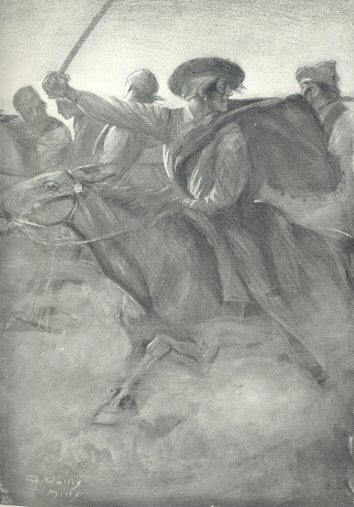
It was not uncommon for a large band or tribe to encamp in thevicinity of a remote village scantily peopled, and to remainthere until, like a flight of locusts, they had consumedeverything which the inhabitants possessed for their support; oruntil they were scared away by the approach of justice, or by anarmy of rustics assembled from the surrounding country. Then would ensue the hurried march; the women and children,mounted on lean but spirited asses, would scour along the plainsfleeter than the wind; ragged and savage-looking men, wieldingthe scourge and goad, would scamper by their side or closebehind, whilst perhaps a small party on strong horses, armed withrusty matchlocks or sabres, would bring up the rear, threateningthe distant foe, and now and then saluting them with a hoarseblast from the Gypsy horn:—
‘O, when I sit my courser bold,
My bantling in my rear,
And in my hand my musket hold—
O how they quake with fear!’
Let us for a moment suppose some unfortunate traveller,mounted on a handsome mule or beast of some value, meeting,unarmed and alone, such a rabble rout at the close of eve, in thewildest part, for example, of La Mancha; we will suppose that heis journeying from Seville to Madrid, and that he has left at aconsiderable distance behind him the gloomy and horrible passesof the Sierra Morena; his bosom, which for some time past hasbeen contracted with dreadful forebodings, is beginning toexpand; his blood, which has been congealed in his veins, isbeginning to circulate warmly and freely; he is fondlyanticipating the still distant posada and savoury omelet. The sun is sinking rapidly behind the savage and uncouth hills inhis rear; he has reached the bottom of a small valley, where runsa rivulet at which he allows his tired animal to drink; he isabout to ascend the side of the hill; his eyes are turnedupwards; suddenly he beholds strange and uncouth forms at the topof the ascent—the sun descending slants its rays upon redcloaks, with here and there a turbaned head, or long streaminghair. The traveller hesitates, but reflecting that he is nolonger in the mountains, and that in the open road there is nodanger of banditti, he advances. In a moment he is in themidst of the Gypsy group, in a moment there is a general halt;fiery eyes are turned upon him replete with an expression whichonly the eyes of the Roma possess, then ensues a jabber in alanguage or jargon which is strange to the ears of the traveller;at last an ugly urchin springs from the crupper of a haltingmule, and in a lisping accent entreats charity in the name of theVirgin and the Majoro. The traveller, with a falteringhand, produces his purse, and is proceeding to loosen itsstrings, but he accomplishes not his purpose, for, struckviolently by a huge knotted club in an unseen hand, he tumblesheadlong from his mule. Next morning a naked corse,besmeared with brains and p. 52blood, is found by an arriéro;and within a week a simple cross records the event, according tothe custom of Spain.
‘Below there in the dusky pass
Was wrought a murder dread;
The murdered fell upon the grass,
Away the murderer fled.’
To many, such a scene, as above described, will appear purelyimaginary, or at least a mass of exaggeration, but many suchanecdotes are related by old Spanish writers of these people;they traversed the country in gangs; they were what the Spanishlaw has styled Abigeos and Salteadores de Camino, cattle-stealersand highwaymen; though, in the latter character, they never roseto any considerable eminence. True it is that they wouldnot hesitate to attack or even murder the unarmed and defencelesstraveller, when they felt assured of obtaining booty with littleor no risk to themselves; but they were not by constitutionadapted to rival those bold and daring banditti of whom so manyterrible anecdotes are related in Spain and Italy, and who haveacquired their renown by the dauntless daring which they haveinvariably displayed in the pursuit of plunder.
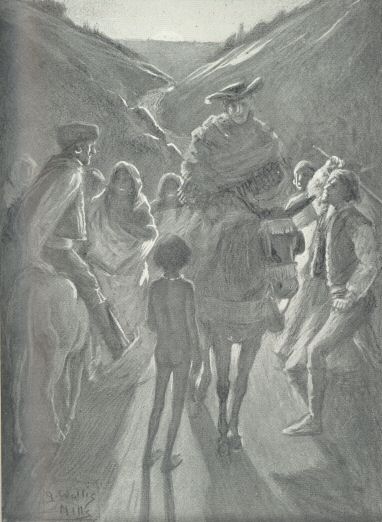
Besides trafficking in horses and mules, and now and thenattacking and plundering travellers upon the highway, the Gypsiesof Spain appear, from a very early period, to have pliedoccasionally the trade of the blacksmith, and to have worked iniron, forming rude implements of domestic and agricultural use,which they disposed of, either for provisions or money, in theneighbourhood of those places where they had taken up theirtemporary residence. As their bands were composed ofnumerous individuals, there is no improbability in assuming thatto every member was allotted that branch of labour in which hewas most calculated to excel. The most important, and thatwhich required the greatest share of cunning and address, wasundoubtedly that of the chalan or jockey, who frequented thefairs with the beasts which he had obtained by various means, butgenerally by theft. Highway robbery, though occasionallycommitted by all jointly or severally, was probably the peculiardepartment of the boldest spirits of the gang; whilst wieldingthe hammer and tongs was abandoned to those who, though possessedof athletic forms, were perhaps, like Vulcan, lame, or from someparticular cause, moral or physical, unsuited for the other twovery respectable avocations. The forge was generally placedin the heart of some mountain abounding in wood; the gaunt smithsfelled a tree, perhaps with the very axes which their own sturdyhands had hammered at a former period; with the wood thusprocured they prepared the charcoal which their labourdemanded. Everything is in readiness; the bellows puffuntil the coal is excited to a furious glow; the metal, hot,pliant, and ductile, is laid on the anvil, round which stands theCyclop group, their hammers upraised; down they descendsuccessively, one, two, three, the sparks are scattered on everyside. The sparks—
‘More than a hundred lovely daughters I seeproduced at one time, fiery as roses: in one moment they expiregracefully circumvolving.’ [54]
The anvil rings beneath the thundering stroke, hour succeedshour, and still endures the hard sullen toil.
One of the most remarkable features in the history of Gypsiesis the striking similarity of their pursuits in every region ofthe globe to which they have penetrated; they are not merelyalike in limb and in feature, in the cast and expression of theeye, in the colour of the hair, in their walk and gait, buteverywhere they seem to exhibit the same tendencies, and to huntfor their bread by the same means, as if they were not of thehuman but rather of the animal species, and in lieu of reasonwere endowed with a kind of instinct which assists them to a verylimited extent and no farther.
In no part of the world are they found engaged in thecultivation of the earth, or in the service of a regular master;but in all lands they are jockeys, or thieves, or cheats; and ifever they devote themselves to any toil or trade, it is assuredlyin every material point one and the same. We have foundthem above, in the heart of a wild mountain, hammering iron, andmanufacturing from it instruments either for their own use orthat of the neighbouring towns and villages. They may beseen employed in a similar manner in the plains of Russia, or inthe bosom of its eternal forests; and whoever inspects the sitewhere a horde of Gypsies has encamped, in the grassy lanesbeneath the hazel bushes of merry England, is generally sure tofind relics of tin and other metal, avouching that they havethere been exercising the arts of the tinker or smith. Perhaps nothing speaks more forcibly for the antiquity of thissect or caste than the tenacity with which they have uniformlypreserved their peculiar customs since the period of theirbecoming generally known; for, unless their habits had become apart of their nature, which could only have been effected by astrict devotion to them through a long succession of generations,it is not to be supposed that after their arrival in civilisedEurope they would have retained and cherished them precisely inthe same manner in the various countries where they found anasylum.
Each band or family of the Spanish Gypsies had its Captain,or, as he was generally designated, its Count. Don Juan deQuiñones, who, in a small volume published in 1632, haswritten some details respecting their way of life, says:‘They roam about, divided into families and troops, each ofwhich has its head or Count; and to fill this office they choosethe most valiant and courageous individual amongst them, and theone endowed with the greatest strength. He must at the sametime be crafty and sagacious, and adapted in every respect togovern them. It is he who settles their differences anddisputes, even when they are residing in a place where there is aregular justice. He heads them at night when they go out toplunder the flocks, or to rob travellers on the highway; andwhatever they steal or plunder they divide amongst them, alwaysallowing the captain a third part of the whole.’
These Counts, being elected for such qualities as promised tobe useful to their troop or family, were consequently liable tobe deposed if at any time their conduct was not calculated toafford satisfaction to their subjects. The office was nothereditary, and though it carried along with it partialprivileges, was both toilsome and dangerous. Should theplans for plunder, which it was the duty of the Count to form,miscarry in the attempt to execute them; should individuals ofthe gang fall into the hand of justice, and the Count be unableto devise a method to save their lives or obtain their liberty,the blame was cast at the Count’s door, and he was inconsiderable danger of being deprived of his insignia ofauthority, which consisted not so much in ornaments or in dress,as in hawks and hounds with which the Señor Count took thediversion of hunting when he thought proper. As the groundwhich he hunted over was not his own, he incurred some danger ofcoming in contact with the lord of the soil, attended, perhaps,by his armed followers. There is a tradition (ratherapocryphal, it is true), that a Gitáno chief, oncepursuing this amusement, was encountered by a real Count, who isstyled Count Pepe. An engagement ensued between the twoparties, which ended in the Gypsies being worsted, and theirchief left dying on the field. The slain chief leaves ason, who, at the instigation of his mother, steals the infantheir of his father’s enemy, who, reared up amongst theGypsies, becomes a chief, and, in process of time, hunting overthe same ground, slays Count Pepe in the very spot where theblood of the Gypsy had been poured out. This tradition isalluded to in the following stanza:—
‘I have a gallant mare in stall;
My mother gave that mare
That I might seek Count Pepe’s hall
And steal his son and heir.’
Martin Del Rio, in his Tractatus de Magia, speaks ofthe Gypsies and their Counts to the following effect:‘When, in the year 1584, I was marching in Spain with theregiment, a multitude of these wretches were infesting thefields. It happened that the feast of Corpus Domini wasbeing celebrated, and they requested to be admitted into thetown, that they might dance in honour of the sacrifice, as wascustomary; they did so, but about midday a great tumult aroseowing to the many thefts which the women committed, whereuponthey fled out of the suburbs, and assembled about St.Mark’s, the magnificent mansion and hospital of the knightsof St. James, where the ministers of justice attempting to seizethem were repulsed by force of arms; nevertheless, all of asudden, and I know not how, everything was hushed up. Atthis time they had a Count, a fellow who spoke the Castilianidiom with as much purity as if he had been a native of Toledo;he was acquainted with all the ports of Spain, and all thedifficult and broken ground of the provinces. He knew theexact strength of every city, and who were the principal peoplein each, and the exact amount of their property; there wasnothing relating to the state, however secret, that he was notacquainted with; nor did he make a mystery of his knowledge, butpublicly boasted of it.’
From the passage quoted above, we learn that theGitános in the ancient times were considered as foreignerswho prowled about the country; indeed, in many of the laws whichat various times have been promulgated against them, they arespoken of as Egyptians, and as such commanded to leave Spain, andreturn to their native country; at one time they undoubtedly wereforeigners in Spain, foreigners by birth, foreigners by languagebut at the time they are mentioned by the worthy Del Rio, theywere certainly not entitled to the appellation. True it isthat they spoke a language amongst themselves, unintelligible tothe rest of the Spaniards, from whom they differed considerablyin feature and complexion, as they still do; but if being born ina country, and being bred there, constitute a right to beconsidered a native of that country, they had as much claim tothe appellation of Spaniards as the worthy author himself. Del Rio mentions, as a remarkable circumstance, the fact of theGypsy Count speaking Castilian with as much purity as a native ofToledo, whereas it is by no means improbable that the individualin question was a native of that town; but the truth is, at thetime we are speaking of, they were generally believed to be notonly foreigners, but by means of sorcery to have acquired thepower of speaking all languages with equal facility; and Del Rio,who was a believer in magic, and wrote one of the most curiousand erudite treatises on the subject ever penned, had perhapsadopted that idea, which possibly originated from their speakingmost of the languages and dialects of the Peninsula, which theypicked up in their wanderings. That the Gypsy chief was sowell acquainted with every town of Spain, and the broken anddifficult ground, can cause but little surprise, when we reflectthat the life which the Gypsies led was one above all otherscalculated to afford them that knowledge. They werecontinually at variance with justice; they were frequentlyobliged to seek shelter in the inmost recesses of the hills; andwhen their thievish pursuits led them to the cities, theynaturally made themselves acquainted with the names of theprincipal individuals, in hopes of plundering them. Doubtless the chief possessed all this species of knowledge in asuperior degree, as it was his courage, acuteness, and experiencealone which placed him at the head of his tribe, though Del Riofrom this circumstance wishes to infer that the Gitánoswere spies sent by foreign foes, and with some simplicityinquires, ‘Quo ant cui rei hæc curiosa exploratio?nonne compescenda vagamundorum hæc curiositas, etiam sisolum peregrini et inculpatæ vitæ.’
With the Counts rested the management and direction of theseremarkable societies; it was they who determined their marches,counter-marches, advances, and retreats; what was to be attemptedor avoided; what individuals were to be admitted into thefellowship and privileges of the Gitános, or who were tobe excluded from their society; they settled disputes and sat injudgment over offences. The greatest crimes, according tothe Gypsy code, were a quarrelsome disposition, and revealing thesecrets of the brotherhood. By this code the members wereforbidden to eat, drink, or sleep in the house of a Busno, whichsignifies any person who is not of the sect of the Gypsies, or tomarry out of that sect; they were likewise not to teach thelanguage of Roma to any but those who, by birth or inauguration,belonged to that sect; they were enjoined to relieve theirbrethren in distress at any expense or peril; they were to use apeculiar dress, which is frequently alluded to in the Spanishlaws, but the particulars of which are not stated; and they wereto cultivate the gift of speech to the utmost possible extent,and never to lose anything which might be obtained by a loose anddeceiving tongue, to encourage which they had many excellentproverbs, for example—
‘The poor fool who closes his mouth neverwinneth a dollar.’
‘The river which runneth with sound bears along with itstones and water.’
p.61CHAPTER III
The Gitános not unfrequentlymade their appearance in considerable numbers, so as to be ableto bid defiance to any force which could be assembled againstthem on a sudden; whole districts thus became a prey to them, andwere plundered and devastated.
It is said that, in the year 1618, more than eight hundred ofthese wretches scoured the country between Castile and Aragon,committing the most enormous crimes. The royal councildespatched regular troops against them, who experienced somedifficulty in dispersing them.
But we now proceed to touch upon an event which forms an erain the history of the Gitános of Spain, and which forwildness and singularity throws all other events connected withthem and their race, wherever found, entirely into the shade.
THE BOOKSELLER OF LOGROÑO
About the middle of the sixteenth century, there resided oneFrancisco Alvarez in the city of Logroño, the chief townof Rioja, a province which borders on Aragon. He was a manabove the middle age, sober, reserved, and in general absorbed inthought; he lived near the great church, and obtained alivelihood by selling printed books and manuscripts in a smallshop. He was a very learned man, and was continuallyreading in the books which he was in the habit of selling, andsome of these books were in foreign tongues and characters, soforeign, indeed, that none but himself and some of his friends,the canons, could understand them; he was much visited by theclergy, who were his principal customers, and took much pleasurein listening to his discourse.
He had been a considerable traveller in his youth, and hadwandered through all Spain, visiting the various provinces andthe most remarkable cities. It was likewise said that hehad visited Italy and Barbary. He was, however, invariablysilent with respect to his travels, and whenever the subject wasmentioned to him, the gloom and melancholy increased whichusually clouded his features.
One day, in the commencement of autumn, he was visited by apriest with whom he had long been intimate, and for whom he hadalways displayed a greater respect and liking than for any otheracquaintance. The ecclesiastic found him even more sad thanusual, and there was a haggard paleness upon his countenancewhich alarmed his visitor. The good priest madeaffectionate inquiries respecting the health of his friend, andwhether anything had of late occurred to give him uneasiness;adding at the same time, that he had long suspected that somesecret lay heavy upon his mind, which he now conjured him toreveal, as life was uncertain, and it was very possible that hemight be quickly summoned from earth into the presence of hisMaker.
The bookseller continued for some time in gloomy meditation,till at last he broke silence in these words:—‘It istrue I have a secret which weighs heavy upon my mind, and which Iam still loth to reveal; but I have a presentiment that my end isapproaching, and that a heavy misfortune is about to fall uponthis city: I will therefore unburden myself, for it were now asin to remain silent.
‘I am, as you are aware, a native of this town, which Ifirst left when I went to acquire an education at Salamanca; Icontinued there until I became a licentiate, when I quitted theuniversity and strolled through Spain, supporting myself ingeneral by touching the guitar, according to the practice ofpenniless students; my adventures were numerous, and I frequentlyexperienced great poverty. Once, whilst making my way fromToledo to Andalusia through the wild mountains, I fell in withand was made captive by a band of the people calledGitános, or wandering Egyptians; they in general livedamongst these wilds, and plundered or murdered every person whomthey met. I should probably have been assassinated by them,but my skill in music perhaps saved my life. I continuedwith them a considerable time, till at last they persuaded me tobecome one of them, whereupon I was inaugurated into theirsociety with many strange and horrid ceremonies, and having thusbecome a Gitáno, I went with them to plunder andassassinate upon the roads.
‘The Count or head man of these Gitános had anonly daughter, about my own age; she was very beautiful, but, atthe same time, exceedingly strong and robust; this Gitánawas given to me as a wife or cadjee, and I lived with her severalyears, and she bore me children.
‘My wife was an arrant Gitána, and in her all thewickedness of her race seemed to be concentrated. At lasther father was killed in an affray with the troopers of theHermandad, whereupon my wife and myself succeeded to theauthority which he had formerly exercised in the tribe. Wehad at first loved each other, but at last the Gitánolife, with its accompanying wickedness, becoming hateful to myeyes, my wife, who was not slow in perceiving my altereddisposition, conceived for me the most deadly hatred;apprehending that I meditated withdrawing myself from thesociety, and perhaps betraying the secrets of the band, sheformed a conspiracy against me, and, at one time, being oppositethe Moorish coast, I was seized and bound by the otherGitános, conveyed across the sea, and delivered as a slaveinto the hands of the Moors.
‘I continued for a long time in slavery in various partsof Morocco and Fez, until I was at length redeemed from my stateof bondage by a missionary friar who paid my ransom. Withhim I shortly after departed for Italy, of which he was anative. In that country I remained some years, until alonging to revisit my native land seized me, when I returned toSpain and established myself here, where I have since lived byvending books, many of which I brought from the strange landswhich I visited. I kept my history, however, a profoundsecret, being afraid of exposing myself to the laws in forceagainst the Gitános, to which I should instantly becomeamenable, were it once known that I had at any time been a memberof this detestable sect.
‘My present wretchedness, of which you have demanded thecause, dates from yesterday; I had been on a short journey to theAugustine convent, which stands on the plain in the direction ofSaragossa, carrying with me an Arabian book, which a learned monkwas desirous of seeing. Night overtook me ere I couldreturn. I speedily lost my way, and wandered about until Icame near a dilapidated edifice with which I was acquainted; Iwas about to proceed in the direction of the town, when I heardvoices within the ruined walls; I listened, and recognised thelanguage of the abhorred Gitános; I was about to fly, whena word arrested me. It was Drao, which in their tonguesignifies the horrid poison with which this race are in the habitof destroying the cattle; they now said that the men ofLogroño should rue the Drao which they had beencasting. I heard no more, but fled. What increased myfear was, that in the words spoken, I thought I recognised thepeculiar jargon of my own tribe; I repeat, that I believe somehorrible misfortune is overhanging this city, and that my owndays are numbered.’
The priest, having conversed with him for some time uponparticular points of the history that he had related, took hisleave, advising him to compose his spirits, as he saw no reasonwhy he should indulge in such gloomy forebodings.
The very next day a sickness broke out in the town ofLogroño. It was one of a peculiar kind; unlike mostothers, it did not arise by slow and gradual degrees, but at onceappeared in full violence, in the shape of a terrificepidemic. Dizziness in the head was the first symptom: thenconvulsive retchings, followed by a dreadful struggle betweenlife and death, which generally terminated in favour of the grimdestroyer. The bodies, after the spirit which animated themhad taken flight, were frightfully swollen, and exhibited a darkblue colour, checkered with crimson spots. Nothing washeard within the houses or the streets, but groans of agony; noremedy was at hand, and the powers of medicine were exhausted invain upon this terrible pest; so that within a few days thegreatest part of the inhabitants of Logroño hadperished. The bookseller had not been seen since thecommencement of this frightful visitation.
Once, at the dead of night, a knock was heard at the door ofthe priest, of whom we have already spoken; the priest himselfstaggered to the door, and opened it,—he was the only onewho remained alive in the house, and was himself slowlyrecovering from the malady which had destroyed all the otherinmates; a wild spectral-looking figure presented itself to hiseye—it was his friend Alvarez. Both went into thehouse, when the bookseller, glancing gloomily on the wastedfeatures of the priest, exclaimed, ‘You too, I see, amongstothers, have cause to rue the Drao which the Gitános havecast. Know,’ he continued, ‘that in order toaccomplish a detestable plan, the fountains of Logroñohave been poisoned by emissaries of the roving bands, who are nowassembled in the neighbourhood. On the first appearance ofthe disorder, from which I happily escaped by tasting the waterof a private fountain, which I possess in my own house, Iinstantly recognised the effects of the poison of theGitános, brought by their ancestors from the isles of theIndian sea; and suspecting their intentions, I disguised myselfas a Gitáno, and went forth in the hope of being able toact as a spy upon their actions. I have been successful,and am at present thoroughly acquainted with their designs. They intended, from the first, to sack the town, as soon as itshould have been emptied of its defenders.
‘Midday, to-morrow, is the hour in which they havedetermined to make the attempt. There is no time to belost; let us, therefore, warn those of our townsmen who stillsurvive, in order that they may make preparations for theirdefence.’
Whereupon the two friends proceeded to the chief magistrate,who had been but slightly affected by the disorder; he heard thetale of the bookseller with horror and astonishment, andinstantly took the best measures possible for frustrating thedesigns of the Gitános; all the men capable of bearingarms in Logroño were assembled, and weapons of everydescription put in their hands. By the advice of thebookseller all the gates of the town were shut, with theexception of the principal one; and the little band of defenders,which barely amounted to sixty men, was stationed in the greatsquare, to which, he said, it was the intention of theGitános to penetrate in the first instance, and then,dividing themselves into various parties, to sack theplace. The bookseller was, by general desire, constitutedleader of the guardians of the town.
It was considerably past noon; the sky was overcast, andtempest clouds, fraught with lightning and thunder, were hangingblack and horrid over the town of Logroño. Thelittle troop, resting on their arms, stood awaiting the arrivalof their unnatural enemies; rage fired their minds as theythought of the deaths of their fathers, their sons, and theirdearest relatives, who had perished, not by the hand of God, but,like infected cattle, by the hellish arts of Egyptiansorcerers. They longed for their appearance, determined towreak upon them a bloody revenge; not a word was uttered, andprofound silence reigned around, only interrupted by theoccasional muttering of the thunder-clouds. Suddenly,Alvarez, who had been intently listening, raised his hand with asignificant gesture; presently, a sound was heard—arustling like the waving of trees, or the rushing of distantwater; it gradually increased, and seemed to proceed from thenarrow street which led from the principal gate into thesquare. All eyes were turned in that direction. . . .
That night there was repique or ringing of bells in the towersof Logroño, and the few priests who had escaped from thepestilence sang litanies to God and the Virgin for the salvationof the town from the hands of the heathen. The attempt ofthe Gitános had been most signally defeated, and the greatsquare and the street were strewn with their corpses. Oh!what frightful objects: there lay grim men more black thanmulattos, with fury and rage in their stiffened features; wildwomen in extraordinary dresses, their hair, black and long as thetail of the horse, spread all dishevelled upon the ground; andgaunt and naked children grasping knives and daggers in theirtiny hands. Of the patriotic troop not one appeared to havefallen; and when, after their enemies had retreated with howlingsof fiendish despair, they told their numbers, only one man wasmissing, who was never seen again, and that man was Alvarez.
In the midst of the combat, the tempest, which had for a longtime been gathering, burst over Logroño, in lightning,thunder, darkness, and vehement hail.
A man of the town asserted that the last time he had seenAlvarez, the latter was far in advance of his companions,defending himself desperately against three powerful youngheathen, who seemed to be acting under the direction of a tallwoman who stood nigh, covered with barbaric ornaments, andwearing on her head a rude silver crown. [69]
Such is the tale of the Bookseller of Logroño, and suchis the narrative of the attempt of the Gitános to sack thetown in the time of pestilence, which is alluded to by manySpanish authors, but more particularly by the learned Franciscode Cordova, in his Didascalia, one of the most curious andinstructive books within the circle of universal literature.
p.71CHAPTER IV
The Moors, after their subjugation,and previous to their expulsion from Spain, generally residedapart, principally in the suburbs of the towns, where they kepteach other in countenance, being hated and despised by theSpaniards, and persecuted on all occasions. By this meansthey preserved, to a certain extent, the Arabic language, thoughthe use of it was strictly forbidden, and encouraged each otherin the secret exercise of the rites of the Mohammedan religion,so that, until the moment of their final expulsion, theycontinued Moors in almost every sense of the word. Suchplaces were called Morerias, or quarters of the Moors.
In like manner there were Gitanerias, or quarters of theGitános, in many of the towns of Spain; and in more thanone instance particular barrios or districts are still known bythis name, though the Gitános themselves have long sincedisappeared. Even in the town of Oviedo, in the heart ofthe Asturias, a province never famous for Gitános, thereis a place called the Gitaneria, though no Gitáno has beenknown to reside in the town within the memory of man, nor indeedbeen seen, save, perhaps, as a chance visitor at a fair.
The exact period when the Gitános first formed thesecolonies within the towns is not known; the laws, however, whichcommanded them to abandon their wandering life under penalty ofbanishment and death, and to become stationary in towns, may haveinduced them first to take such a step. By the first ofthese laws, which was made by Ferdinand and Isabella as far backas the year 1499, they are commanded to seek out for themselvesmasters. This injunction they utterly disregarded. Some of them for fear of the law, or from the hope of betteringtheir condition, may have settled down in the towns, cities, andvillages for a time, but to expect that a people, in whose bosomswas so deeply rooted the love of lawless independence, wouldsubject themselves to the yoke of servitude, from any motivewhatever, was going too far; as well might it have been expected,according to the words of the great poet of Persia, that theywould have washed their skins white.
In these Gitanerias, therefore, many Gypsy families resided,but ever in the Gypsy fashion, in filth and in misery, withlittle of the fear of man, and nothing of the fear of God beforetheir eyes. Here the swarthy children basked naked in thesun before the doors; here the women prepared love draughts, ortold the buena ventura; and here the men plied the trade of theblacksmith, a forbidden occupation, or prepared for sale, bydisguising them, animals stolen by themselves or theiraccomplices. In these places were harboured the strangeGitános on their arrival, and here were discussed in theRommany language, which, like the Arabic, was forbidden undersevere penalties, plans of fraud and plunder, which were perhapsintended to be carried into effect in a distant province and adistant city.
The great body, however, of the Gypsy race in Spain continuedindependent wanderers of the plains and the mountains, and indeedthe denizens of the Gitanerias were continually sallying forth,either for the purpose of reuniting themselves with the wanderingtribes, or of strolling about from town to town, and from fair tofair. Hence the continual complaints in the Spanish lawsagainst the Gitános who have left their places ofdomicile, from doing which they were interdicted, even as theywere interdicted from speaking their language and following theoccupations of the blacksmith and horse-dealer, in which theystill persist even at the present day.
The Gitanerias at evening fall were frequently resorted to byindividuals widely differing in station from the inmates of theseplaces—we allude to the young and dissolute nobility andhidalgos of Spain. This was generally the time of mirth andfestival, and the Gitános, male and female, danced andsang in the Gypsy fashion beneath the smile of the moon. The Gypsy women and girls were the principal attractions to thesevisitors; wild and singular as these females are in theirappearance, there can be no doubt, for the fact has beenfrequently proved, that they are capable of exciting passion ofthe most ardent description, particularly in the bosoms of thosewho are not of their race, which passion of course becomes themore violent when the almost utter impossibility of gratifying itis known. No females in the world can be more licentious inword and gesture, in dance and in song, than the Gitánas;but there they stop: and so of old, if their titled visitorspresumed to seek for more, an unsheathed dagger or gleaming knifespeedily repulsed those who expected that the gem most dearamongst the sect of the Roma was within the reach of a Busno.
Such visitors, however, were always encouraged to a certainpoint, and by this and various other means the Gitánosacquired connections which frequently stood them in good stead inthe hour of need. What availed it to the honest labourersof the neighbourhood, or the citizens of the town, to makecomplaints to the corregidor concerning the thefts and fraudscommitted by the Gitános, when perhaps the sons of thatvery corregidor frequented the nightly dances at the Gitaneria,and were deeply enamoured with some of the dark-eyedsinging-girls? What availed making complaints, when perhapsa Gypsy sibyl, the mother of those very girls, had free admissionto the house of the corregidor at all times and seasons, andspaed the good fortune to his daughters, promising them countsand dukes, and Andalusian knights in marriage, or preparedphiltres for his lady by which she was always to reign supreme inthe affections of her husband? And, above all, what availedit to the plundered party to complain that his mule or horse hadbeen stolen, when the Gitáno robber, perhaps the husbandof the sibyl and the father of the black-eyed Gitanillas, was atthat moment actually in treaty with my lord the corregidorhimself for supplying him with some splendid thick-maned,long-tailed steed at a small price, to be obtained, as the readermay well suppose, by an infraction of the laws? The favourand protection which the Gitános experienced from peopleof high rank is alluded to in the Spanish laws, and can only beaccounted for by the motives above detailed.
The Gitanerias were soon considered as public nuisances, onwhich account the Gitános were forbidden to live togetherin particular parts of the town, to hold meetings, and even tointermarry with each other; yet it does not appear that theGitanerias were ever suppressed by the arm of the law, as manystill exist where these singular beings ‘marry and aregiven in marriage,’ and meet together to discuss theiraffairs, which, in their opinion, never flourish unless those oftheir fellow-creatures suffer. So much for the Gitanerias,or Gypsy colonies in the towns of Spain.
p.76CHAPTER V
‘Los Gitános son muymalos!—the Gypsies are very bad people,’ said theSpaniards of old times. They are cheats; they arehighwaymen; they practise sorcery; and, lest the catalogue oftheir offences should be incomplete, a formal charge ofcannibalism was brought against them. Cheats they havealways been, and highwaymen, and if not sorcerers, they havealways done their best to merit that appellation, by arrogatingto themselves supernatural powers; but that they were addicted tocannibalism is a matter not so easily proved.
Their principal accuser was Don Juan de Quiñones, who,in the work from which we have already had occasion to quote,gives several anecdotes illustrative of their cannibalpropensities. Most of these anecdotes, however, are sohighly absurd, that none but the very credulous could ever havevouchsafed them the slightest credit. This author isparticularly fond of speaking of a certain juez, or judge, calledDon Martin Fajardo, who seems to have been an arrantGypsy-hunter, and was probably a member of the ancient family ofthe Fajardos, which still flourishes in Estremadura, and withindividuals of which we are acquainted. So it came to passthat this personage was, in the year 1629, at Jaraicejo, inEstremadura, or, as it is written in the little book in question,Zaraizejo, in the capacity of judge; a zealous one he undoubtedlywas.
A very strange place is this same Jaraicejo, a small ruinoustown or village, situated on a rising ground, with a very wildcountry all about it. The road from Badajoz to Madridpasses through it; and about two leagues distant, in thedirection of Madrid, is the famous mountain pass ofMirabéte, from the top of which you enjoy a mostpicturesque view across the Tagus, which flows below, as far asthe huge mountains of Plasencia, the tops of which are generallycovered with snow.
So this Don Martin Fajardo, judge, being at Jaraicejo, laidhis claw upon four Gitános, and having nothing, as itappears, to accuse them of, except being Gitános, put themto the torture, and made them accuse themselves, which they did;for, on the first appeal which was made to the rack, theyconfessed that they had murdered a female Gypsy in the forest ofLas Gamas, and had there eaten her. . . .
I am myself well acquainted with this same forest of LasGamas, which lies between Jaraicejo and Trujillo; it abounds withchestnut and cork trees, and is a place very well suited eitherfor the purpose of murder or cannibalism. It will be aswell to observe that I visited it in company with a band ofGitános, who bivouacked there, and cooked their supper,which however did not consist of human flesh, but of apuchéra, the ingredients of which were beef, bacon,garbanzos, and berdolaga, or field-pease andpurslain,—therefore I myself can bear testimony that thereis such a forest as Las Gamas, and that it is frequentedoccasionally by Gypsies, by which two points are established byfar the most important to the history in question, or so at leastit would be thought in Spain, for being sure of the forest andthe Gypsies, few would be incredulous enough to doubt the factsof the murder and cannibalism. . . .
On being put to the rack a second time, the Gitánosconfessed that they had likewise murdered and eaten a femalepilgrim in the forest aforesaid; and on being tortured yet again,that they had served in the same manner, and in the same forest,a friar of the order of San Francisco, whereupon they werereleased from the rack and executed. This is one of theanecdotes of Quiñones.
And it came to pass, moreover, that the said Fajardo, being inthe town of Montijo, was told by the alcalde, that a certaininhabitant of that place had some time previous lost a mare; andwandering about the plains in quest of her, he arrived at a placecalled Arroyo el Puerco, where stood a ruined house, on enteringwhich he found various Gitános employed in preparing theirdinner, which consisted of a quarter of a human body, which wasbeing roasted before a huge fire: the result, however, we are nottold; whether the Gypsies were angry at being disturbed in theircookery, or whether the man of the mare departed unobserved.
Quiñones, in continuation, states in his book that helearned (he does not say from whom, but probably from Fajardo)that there was a shepherd of the city of Gaudix, who once losthis way in the wild sierra of Gadol: night came on, and the windblew cold: he wandered about until he descried a light in thedistance, towards which he bent his way, supposing it to be afire kindled by shepherds: on arriving at the spot, however, hefound a whole tribe of Gypsies, who were roasting the half of aman, the other half being hung on a cork-tree: the Gypsieswelcomed him very heartily, and requested him to be seated at thefire and to sup with them; but he presently heard them whisper toeach other, ‘this is a fine fat fellow,’ from whichhe suspected that they were meditating a design upon his body:whereupon, feeling himself sleepy, he made as if he were seekinga spot where to lie, and suddenly darted headlong down themountain-side, and escaped from their hands without breaking hisneck.
These anecdotes scarcely deserve comment; first we have thestatement of Fajardo, the fool or knave who tortures wretches,and then puts them to death for the crimes with which they havetaxed themselves whilst undergoing the agony of the rack,probably with the hope of obtaining a moment’s respite;last comes the tale of the shepherd, who is invited by Gypsies ona mountain at night to partake of a supper of human flesh, andwho runs away from them on hearing them talk of the fatness ofhis own body, as if cannibal robbers detected in their orgies bya single interloper would have afforded him a chance ofescaping. Such tales cannot be true. [79]
Cases of cannibalism are said to have occurred in Hungaryamongst the Gypsies; indeed, the whole race, in that country, hasbeen accused of cannibalism, to which we have alluded whilstspeaking of the Chingany: it is very probable, however, that theywere quite innocent of this odious practice, and that theaccusation had its origin in popular prejudice, or in the fact oftheir foul feeding, and their seldom rejecting carrion or offalof any description.
The Gazette of Frankfort for the year 1782, Nos. 157 and 207,states that one hundred and fifty Gypsies were imprisoned chargedwith this practice; and that the Empress Teresa sentcommissioners to inquire into the facts of the accusation, whodiscovered that they were true; whereupon the empress published alaw to oblige all the Gypsies in her dominions to becomestationary, which, however, had no effect.
Upon this matter we can state nothing on our ownknowledge.
After the above anecdotes, it will perhaps not be amiss todevote a few lines to the subject of Gypsy food and diet. Ibelieve that it has been asserted that the Romas, in all parts ofthe world, are perfectly indifferent as to what they eat,provided only that they can appease their hunger; and that theyhave no objection to partake of the carcasses of animals whichhave died a natural death, and have been left to putrefy by theroadside; moreover, that they use for food all kinds of reptilesand vermin which they can lay their hands upon.
In this there is a vast deal of exaggeration, but at the sametime it must be confessed that, in some instances, the habits ofthe Gypsies in regard to food would seem, at the first glance, tofavour the supposition. This observation chiefly holds goodwith respect to those of the Gypsy race who still continue in awandering state, and who, doubtless, retain more of the ways andcustoms of their forefathers than those who have adopted astationary life. There can be no doubt that the wanderersamongst the Gypsy race are occasionally seen to feast uponcarcasses of cattle which have been abandoned to the birds of theair, yet it would be wrong, from this fact, to conclude that theGypsies were habitual devourers of carrion. Carrion it istrue they may occasionally devour, from want of better food, butmany of these carcasses are not in reality the carrion which theyappear, but are the bodies of animals which the Gypsies havethemselves killed by casting drao, in hope that the flesh mayeventually be abandoned to them. It is utterly useless towrite about the habits of the Gypsies, especially of thewandering tribes, unless you have lived long and intimately withthem; and unhappily, up to the present time, all the books whichhave been published concerning them have been written by thosewho have introduced themselves into their society for a fewhours, and from what they have seen or heard consider themselvescompetent to give the world an idea of the manners and customs ofthe mysterious Rommany: thus, because they have been known to begthe carcass of a hog which they themselves have poisoned, it hasbeen asserted that they prefer carrion which has perished ofsickness to the meat of the shambles; and because they have beenseen to make a ragout of boror (snails), and to roast ahotchiwitchu or hedgehog, it has been supposed that reptiles ofevery description form a part of their cuisine. It is hightime to undeceive the Gentiles on these points. Know, then,O Gentile, whether thou be from the land of the Gorgios [82a] or the Busné [82b], that the very Gypsies who consider aragout of snails a delicious dish will not touch an eel, becauseit bears resemblance to a snake; and that those who willfeast on a roasted hedgehog could be induced by no money to tastea squirrel, a delicious and wholesome species of game, living onthe purest and most nutritious food which the fields and forestscan supply. I myself, while living among the Roms ofEngland, have been regarded almost in the light of a cannibal forcooking the latter animal and preferring it to hotchiwitchubarbecued, or ragout of boror. ‘You are but halfRommany, brother,’ they would say, ‘and you feedgorgiko-nes (like a Gentile), even as you talk. Tchachipen (in truth), if we did not know you to be of theMecralliskoe rat (royal blood) of Pharaoh, we should bejustified in driving you forth as a juggel-mush (dog man),one more fitted to keep company with wild beasts and Gorgios thangentle Rommanys.’
No person can read the present volume without perceiving, at aglance, that the Romas are in most points an anomalous people; intheir morality there is much of anomaly, and certainly not lessin their cuisine.
‘Los Gitános son muy malos; llevan niñoshurtados a Berberia. The Gypsies are very bad people; theysteal children and carry them to Barbary, where they sell them tothe Moors’—so said the Spaniards in old times. There can be little doubt that even before the fall of thekingdom of Granada, which occurred in the year 1492, theGitános had intercourse with the Moors of Spain. Andalusia, which has ever been the province where theGitáno race has most abounded since its arrival, was,until the edict of Philip the Third, which banished more than amillion of Moriscos from Spain, principally peopled by Moors, whodiffered from the Spaniards both in language and religion. By living even as wanderers amongst these people, theGitános naturally became acquainted with their tongue, andwith many of their customs, which of course much facilitated anyconnection which they might subsequently form with theBarbaresques. Between the Moors of Barbary and theSpaniards a deadly and continued war raged for centuries, bothbefore and after the expulsion of the Moriscos from Spain. The Gitános, who cared probably as little for one nationas the other, and who have no sympathy and affection beyond thepale of their own sect, doubtless sided with either as theirinterest dictated, officiating as spies for both parties andbetraying both.
It is likely enough that they frequently passed over toBarbary with stolen children of both sexes, whom they sold to theMoors, who traffic in slaves, whether white or black, even at thepresent day; and perhaps this kidnapping trade gave occasion toother relations. As they were perfectly acquainted, fromtheir wandering life, with the shores of the SpanishMediterranean, they must have been of considerable assistance tothe Barbary pirates in their marauding trips to the Spanishcoasts, both as guides and advisers; and as it was a far easiermatter, and afforded a better prospect of gain, to plunder theSpaniards than the Moors, a people almost as wild as themselves,they were, on that account, and that only, more Moors thanChristians, and ever willing to assist the former in their forayson the latter.
Quiñones observes: ‘The Moors, with whom theyhold correspondence, let them go and come without any let orobstacle: an instance of this was seen in the year 1627, when twogalleys from Spain were carrying assistance to Marmora, which wasthen besieged by the Moors. These galleys struck on ashoal, when the Moors seized all the people on board, makingcaptives of the Christians and setting at liberty all the Moors,who were chained to the oar; as for the Gypsy galley-slaves whomthey found amongst these last, they did not make them slaves, butreceived them as people friendly to them, and at their devotion;which matter was public and notorious.’
Of the Moors and the Gitános we shall have occasion tosay something in the following chapter.
p.85CHAPTER VI
There is no portion of the world solittle known as Africa in general; and perhaps of all Africathere is no corner with which Europeans are so little acquaintedas Barbary, which nevertheless is only separated from thecontinent of Europe by a narrow strait of four leaguesacross.
China itself has, for upwards of a century, ceased to be aland of mystery to the civilised portion of the world; theenterprising children of Loyola having wandered about it in everydirection making converts to their doctrine and discipline,whilst the Russians possess better maps of its vast regions thanof their own country, and lately, owing to the persevering labourand searching eye of my friend Hyacinth, Archimandrite of SaintJohn Nefsky, are acquainted with the number of its military forceto a man, and also with the names and places of residence of itscivil servants. Yet who possesses a map of Fez and Morocco,or would venture to form a conjecture as to how many fieryhorsemen Abderrahman, the mulatto emperor, could lead to thefield, were his sandy dominions threatened by the Nazarene? Yet Fez is scarcely two hundred leagues distant from Madrid,whilst Maraks, the other great city of the Moors, and which alsohas given its name to an empire, is scarcely farther removed fromParis, the capital of civilisation: in a word, we scarcely knowanything of Barbary, the scanty information which we possessbeing confined to a few towns on the sea-coast; the zeal of theJesuit himself being insufficient to induce him to confront theperils of the interior, in the hopeless endeavour of making onesingle proselyte from amongst the wildest fanatics of the creedof the Prophet Camel-driver.
Are wanderers of the Gypsy race to be found in Barbary? This is a question which I have frequently asked myself. Several respectable authors have, I believe, asserted the fact,amongst whom Adelung, who, speaking of the Gypsies, says:‘Four hundred years have passed away since they departedfrom their native land. During this time, they have spreadthemselves through the whole of Western Asia, Europe, andNorthern Africa.’ [86] But it is onething to make an assertion, and another to produce the groundsfor making it. I believe it would require a far greaterstock of information than has hitherto been possessed by any onewho has written on the subject of the Gypsies, to justify him inasserting positively that after traversing the west of Europe,they spread themselves over Northern Africa, though true it isthat to those who take a superficial view of the matter, nothingappears easier and more natural than to come to such aconclusion.
Tarifa, they will say, the most western part of Spain, isopposite to Tangier, in Africa, a narrow sea only runningbetween, less wide than many rivers. Bands, therefore, ofthese wanderers, of course, on reaching Tarifa, passed over intoAfrica, even as thousands crossed the channel from France toEngland. They have at all times shown themselvesextravagantly fond of a roving life. What land is betteradapted for such a life than Africa and its wilds? Whatland, therefore, more likely to entice them?
All this is very plausible. It was easy enough for theGitános to pass over to Tangier and Tetuan from theSpanish towns of Tarifa and Algeziras. In the last chapterI have stated my belief of the fact, and that moreover theyformed certain connections with the Moors of the coast, to whomit is likely that they occasionally sold children stolen inSpain; yet such connection would by no means have opened them apassage into the interior of Barbary, which is inhabited by wildand fierce people, in comparison with whom the Moors of thecoast, bad as they always have been, are gentle andcivilised.
To penetrate into Africa, the Gitános would have beencompelled to pass through the tribes who speak the Shilhalanguage, and who are the descendants of the ancientNumidians. These tribes are the most untamable and warlikeof mankind, and at the same time the most suspicious, and thosewho entertain the greatest aversion to foreigners. They aredreaded by the Moors themselves, and have always remained, to acertain degree, independent of the emperors of Morocco. They are the most terrible of robbers and murderers, andentertain far more reluctance to spill water than the blood oftheir fellow-creatures: the Bedouins, also, of the Arabian race,are warlike, suspicious, and cruel; and would not have failedinstantly to attack bands of foreign wanderers, wherever theyfound them, and in all probability would have exterminatedthem. Now the Gitános, such as they arrived inBarbary, could not have defended themselves against such enemies,had they even arrived in large divisions, instead of bands oftwenties and thirties, as is their custom to travel. Theyare not by nature nor by habit a warlike race, and would havequailed before the Africans, who, unlike most other people,engage in wars from what appears to be an innate love of thecruel and bloody scenes attendant on war.
It may be said, that if the Gitános were able to maketheir way from the north of India, from Multan, for example, theprovince which the learned consider to be the originaldwelling-place of the race, to such an immense distance as thewestern part of Spain, passing necessarily through many wildlands and tribes, why might they not have penetrated into theheart of Barbary, and wherefore may not their descendants bestill there, following the same kind of life as the EuropeanGypsies, that is, wandering about from place to place, andmaintaining themselves by deceit and robbery?
But those who are acquainted but slightly with the conditionof Barbary are aware that it would be less difficult anddangerous for a company of foreigners to proceed from Spain toMultan, than from the nearest seaport in Barbary to Fez, aninsignificant distance. True it is, that, from theirintercourse with the Moors of Spain, the Gypsies might havebecome acquainted with the Arabic language, and might even haveadopted the Moorish dress, ere entering Barbary; and, moreover,might have professed belief in the religion of Mahomet; stillthey would have been known as foreigners, and, on that account,would have been assuredly attacked by the people of the interior,had they gone amongst them, who, according to the usual practice,would either have massacred them or made them slaves; and asslaves, they would have been separated. The mulatto hue oftheir countenances would probably have insured them the latterfate, as all blacks and mulattos in the dominions of the Moor areproperly slaves, and can be bought and sold, unless by some meansor other they become free, in which event their colour is noobstacle to their elevation to the highest employments anddignities, to their becoming pashas of cities and provinces, oreven to their ascending the throne. Several emperors ofMorocco have been mulattos.
Above I have pointed out all the difficulties and dangerswhich must have attended the path of the Gitános, had theypassed from Spain into Barbary, and attempted to spreadthemselves over that region, as over Europe and many parts ofAsia. To these observations I have been led by theassertion that they accomplished this, and no proof of the facthaving, as I am aware, ever been adduced; for who amongst thosewho have made such a statement has seen or conversed with theEgyptians of Barbary, or had sufficient intercourse with them tojustify him in the assertion that they are one and the samepeople as those of Europe, from whom they differ about as much asthe various tribes which inhabit various European countriesdiffer from each other? At the same time, I wish it to bedistinctly understood that I am far from denying the existence ofGypsies in various parts of the interior of Barbary. Indeed, I almost believe the fact, though the information which Ipossess is by no means of a description which would justify me inspeaking with full certainty; I having myself never come incontact with any sect or caste of people amongst the Moors, whonot only tallied in their pursuits with the Rommany, but wholikewise spoke amongst themselves a dialect of the language ofRoma; nor am I aware that any individual worthy of credit hasever presumed to say that he has been more fortunate in theserespects.
Nevertheless, I repeat that I am inclined to believe thatGypsies virtually exist in Barbary, and my reasons I shallpresently adduce; but I will here observe, that if these strangeoutcasts did indeed contrive to penetrate into the heart of thatsavage and inhospitable region, they could only have succeededafter having become well acquainted with the Moorish language,and when, after a considerable sojourn on the coast, they hadraised for themselves a name, and were regarded withsuperstitious fear; in a word, if they walked this land of periluntouched and unscathed, it was not that they were considered asharmless and inoffensive people, which, indeed, would not haveprotected them, and which assuredly they were not; it was notthat they were mistaken for wandering Moors and Bedouins, fromwhom they differed in feature and complexion, but because,wherever they went, they were dreaded as the possessors ofsupernatural powers, and as mighty sorcerers.
There is in Barbary more than one sect of wanderers, which, tothe cursory observer, might easily appear, and perhaps haveappeared, in the right of legitimate Gypsies. For example,there are the Beni Aros. The proper home of these people isin certain high mountains in the neighbourhood of Tetuan, butthey are to be found roving about the whole kingdom of Fez. Perhaps it would be impossible to find, in the whole of NorthernAfrica, a more detestable caste. They are beggars byprofession, but are exceedingly addicted to robbery and murder;they are notorious drunkards, and are infamous, even in Barbary,for their unnatural lusts. They are, for the most part,well made and of comely features. I have occasionallyspoken with them; they are Moors, and speak no language but theArabic.
Then there is the sect of Sidi Hamed au Muza, a very rovingpeople, companies of whom are generally to be found in all theprincipal towns of Barbary. The men are expert vaulters andtumblers, and perform wonderful feats of address with swords anddaggers, to the sound of wild music, which the women, seated onthe ground, produce from uncouth instruments; by these means theyobtain a livelihood. Their dress is picturesque, scarletvest and white drawers. In many respects they not a littleresemble the Gypsies; but they are not an evil people, and arelooked upon with much respect by the Moors, who call themSantons. Their patron saint is Hamed au Muza, and from himthey derive their name. Their country is on the confines ofthe Sahara, or great desert, and their language is the Shilhah,or a dialect thereof. They speak but little Arabic. When I saw them for the first time, I believed them to be of theGypsy caste, but was soon undeceived. A more wandering racedoes not exist than the children of Sidi Hamed au Muza. They have even visited France, and exhibited their dexterity andagility at Paris and Marseilles.
I will now say a few words concerning another sect whichexists in Barbary, and will here premise, that if those whocompose it are not Gypsies, such people are not to be found inNorth Africa, and the assertion, hitherto believed, that theyabound there, is devoid of foundation. I allude to certainmen and women, generally termed by the Moors ‘Those of theDar-bushi-fal,’ which word is equivalent to prophesying orfortune-telling. They are great wanderers, but have alsotheir fixed dwellings or villages, and such a place is called‘Char Seharra,’ or witch-hamlet. Their mannerof life, in every respect, resembles that of the Gypsies of othercountries; they are wanderers during the greatest part of theyear, and subsist principally by pilfering andfortune-telling. They deal much in mules and donkeys, andit is believed, in Barbary, that they can change the colour ofany animal by means of sorcery, and so disguise him as to sellhim to his very proprietor, without fear of his beingrecognised. This latter trait is quite characteristic ofthe Gypsy race, by whom the same thing is practised in most partsof the world. But the Moors assert, that the children ofthe Dar-bushi-fal can not only change the colour of a horse or amule, but likewise of a human being, in one night, transforming awhite into a black, after which they sell him for a slave; onwhich account the superstitious Moors regard them with the utmostdread, and in general prefer passing the night in the open fieldsto sleeping in their hamlets. They are said to possess aparticular language, which is neither Shilhah nor Arabic, andwhich none but themselves understand; from all whichcircumstances I am led to believe, that the children of theDar-bushi-fal are legitimate Gypsies, descendants of those whopassed over to Barbary from Spain. Nevertheless, as it hasnever been my fortune to meet or to converse with any of thiscaste, though they are tolerably numerous in Barbary, I am farfrom asserting that they are of Gypsy race. Moreenterprising individuals than myself may, perhaps, establish thefact. Any particular language or jargon which they speakamongst themselves will be the best criterion. The wordwhich they employ for ‘water’ would decide the point;for the Dar-bushi-fal are not Gypsies, if, in their peculiarspeech, they designate that blessed element and article mostnecessary to human existence by aught else than the Sanscrit term‘Pani,’ a word brought by the race from sunny Ind,and esteemed so holy that they have never even presumed to modifyit.
The following is an account of the Dar-bushi-fal, given me bya Jew of Fez, who had travelled much in Barbary, and which Iinsert almost literally as I heard it from his mouth. Various other individuals, Moors, have spoken of them in much thesame manner.
‘In one of my journeys I passed the night in a placecalled Mulai-Jacub Munsur.
‘Not far from this place is a Char Seharra, orwitch-hamlet, where dwell those of the Dar-bushi-fal. Theseare very evil people, and powerful enchanters; for it is wellknown that if any traveller stop to sleep in their Char, theywill with their sorceries, if he be a white man, turn him asblack as a coal, and will afterwards sell him as a negro. Horses and mules they serve in the same manner, for if they areblack, they will turn them red, or any other colour which bestmay please them; and although the owners demand justice of theauthorities, the sorcerers always come off best. They havea language which they use among themselves, very different fromall other languages, so much so that it is impossible tounderstand them. They are very swarthy, quite as much so asmulattos, and their faces are exceedingly lean. As fortheir legs, they are like reeds; and when they run, the devilhimself cannot overtake them. They tell Dar-bushi-fal withflour; they fill a plate, and then they are able to tell youanything you ask them. They likewise tell it with a shoe;they put it in their mouth, and then they will recall to yourmemory every action of your life. They likewise tellDar-bushi-fal with oil; and indeed are, in every respect, mostpowerful sorcerers.
‘Two women, once on a time, came to Fez, bringing withthem an exceedingly white donkey, which they placed in the middleof the square called Faz el Bali; they then killed it, and cut itinto upwards of thirty pieces. Upon the ground there wasmuch of the donkey’s filth and dung; some of this they tookin their hands, when it straight assumed the appearance of freshdates. There were some people who were greedy enough to putthese dates into their mouths, and then they found that it wasdung. These women deceived me amongst the rest with a date;when I put it into my mouth, lo and behold it was thedonkey’s dung. After they had collected much moneyfrom the spectators, one of them took a needle, and ran it intothe tail of the donkey, crying “Arrhe li dar” (Gethome), whereupon the donkey instantly rose up, and set offrunning, kicking every now and then most furiously; and it wasremarked, that not one single trace of blood remained upon theground, just as if they had done nothing to it. Both thesewomen were of the very same Char Seharra which I have alreadymentioned. They likewise took paper, and cut it into theshape of a peseta, and a dollar, and a half-dollar, until theyhad made many pesetas and dollars, and then they put them into anearthen pan over a fire, and when they took them out, theyappeared just fresh from the stamp, and with such money thesepeople buy all they want.
‘There was a friend of my grandfather, who camefrequently to our house, who was in the habit of making thismoney. One day he took me with him to buy white silk; andwhen they had shown him some, he took the silk in his hand, andpressed it to his mouth, and then I saw that the silk, which wasbefore white, had become green, even as grass. The masterof the shop said, “Pay me for my silk.” “Of what colour was your silk?” he demanded. “White,” said the man; whereupon, turning round, hecried, “Good people, behold, the white silk isgreen”; and so he got a pound of silk for nothing; and healso was of the Char Seharra.
‘They are very evil people indeed, and the emperorhimself is afraid of them. The poor wretch who falls intotheir hands has cause to rue; they always go badly dressed, andexhibit every appearance of misery, though they are far frombeing miserable. Such is the life they lead.’
There is, of course, some exaggeration in the above account ofthe Dar-bushi-fal; yet there is little reason to doubt that thereis a foundation of truth in all the facts stated. Thebelief that they are enabled, by sorcery, to change a white intoa black man had its origin in the great skill which they possessin altering the appearance of a horse or a mule, and giving itanother colour. Their changing white into green silk is avery simple trick, and is accomplished by dexterouslysubstituting one thing for another. Had the man of theDar-bushi-fal been searched, the white silk would have been foundupon him. The Gypsies, wherever they are found, are fond ofthis species of fraud. In Germany, for example, they go tothe wine-shop with two pitchers exactly similar, one in theirhand empty, and the other beneath their cloaks filled with water;when the empty pitcher is filled with wine they pretend to bedissatisfied with the quality, or to have no money, but contriveto substitute the pitcher of water in its stead, which thewine-seller generally snatches up in anger, and pours thecontents back, as he thinks, into the butt—but it is notwine but water which he pours. With respect to the donkey,which appearedto be cut in pieces, but which afterwards,being pricked in the tail, got up and ran home, I have little tosay, but that I have myself seen almost as strange things withoutbelieving in sorcery.
As for the dates of dung, and the paper money, they are merefeats of legerdemain.
I repeat, that if legitimate Gypsies really exist in Barbary,they are the men and women of the Dar-bushi-fal.
p.98CHAPTER VII
Chiromancy, or the divination ofthe hand, is, according to the orthodox theory, the determiningfrom certain lines upon the hand the quality of the physical andintellectual powers of the possessor.
The whole science is based upon the five principal lines inthe hand, and the triangle which they form in the palm. These lines, which have all their particular and appropriatenames, and the principal of which is called ‘the line oflife,’ are, if we may believe those who have written on thesubject, connected with the heart, with the genitals, with thebrain, with the liver or stomach, and the head. Torreblanca, [98] in his curious and learned book onmagic, observes: ‘In judging these lines you must payattention to their substance, colour, and continuance, togetherwith the disposition of the correspondent member; for, if theline be well and clearly described, and is of a vivid colour,without being intermitted or puncturis infecta, it denotesthe good complexion and virtue of its member, according toAristotle.
‘So that if the line of the heart be foundsufficiently long and reasonably deep, and not crossed by otheraccidental lines, it is an infallible sign of the health of theheart and the great virtue of the heart, and the abundance ofspirits and good blood in the heart, and accordingly denotesboldness and liberal genius for every work.’
In like manner, by means of the hepatal line, it is easy toform an accurate judgment as to the state of a person’sliver, and of his powers of digestion, and so on with respect toall the other organs of the body.
After having laid down all the rules of chiromancy with theutmost possible clearness, the sage Torreblanca exclaims:‘And with these terminate the canons of true and catholicchiromancy; for as for the other species by which people pretendto divine concerning the affairs of life, either past or to come,dignities, fortunes, children, events, chances, dangers, etc.,such chiromancy is not only reprobated by theologians, but by menof law and physic, as a foolish, false, vain, scandalous, futile,superstitious practice, smelling much of divinery and a pact withthe devil.’
Then, after mentioning a number of erudite and enlightened menof the three learned professions, who have written against suchabsurd superstitions, amongst whom he cites Martin Del Rio, hefalls foul of the Gypsy wives in this manner: ‘A practiceturned to profit by the wives of that rabble of abandonedmiscreants whom the Italians call Cingari, the Latins Egyptians,and we Gitános, who, notwithstanding that they are sent bythe Turks into Spain for the purpose of acting as spies upon theChristian religion, pretend that they are wandering over theworld in fulfilment of a penance enjoined upon them, part ofwhich penance seems to be the living by fraud andimposition.’ And shortly afterwards he remarks:‘Nor do they derive any authority for such a practice fromthose words in Exodus, [100a] “et quasisignum in manu tua,” as that passage does not treat ofchiromancy, but of the festival of unleavened bread; theobservance of which, in order that it might be memorable to theHebrews, the sacred historian said should be as a sign upon thehand; a metaphor derived from those who, when they wish toremember anything, tie a thread round their finger, or put a ringupon it; and still less I ween does that chapter of Job [100b] speak in their favour, where iswritten, “Qui in manu hominis signat, ut norint omnes operasua,” because the divine power is meant thereby which ispreached to those here below: for the hand is intended for powerand magnitude, Exod. chap. xiv., [100c] or stands forfree will, which is placed in a man’s hand, that is, in hispower. Wisdom, chap. xxxvi. “In manibus absconditlucem,” [100d] etc. etc. etc.
No, no, good Torreblanca, we know perfectly well that thewitch-wives of Multan, who for the last four hundred years havebeen running about Spain and other countries, telling fortunes bythe hand, and deriving good profit from the same, are notcountenanced in such a practice by the sacred volume; we yield aslittle credit to their chiromancy as we do to that which you callthe true and catholic, and believe that the lines of the handhave as little connection with the events of life as with theliver and stomach, notwithstanding Aristotle, who you forget wasa heathen, and knew as little and cared as little for theScriptures as the Gitános, whether male or female, wholittle reck what sanction any of their practices may receive fromauthority, whether divine or human, if the pursuit enable them toprovide sufficient for the existence, however poor and miserable,of their families and themselves.
A very singular kind of women are the Gitánas, far moreremarkable in most points than their husbands, in whose pursuitsof low cheating and petty robbery there is little capable ofexciting much interest; but if there be one being in the worldwho, more than another, deserves the title of sorceress (andwhere do you find a word of greater romance and more thrillinginterest?), it is the Gypsy female in the prime and vigour of herage and ripeness of her understanding—the Gypsy wife, themother of two or three children. Mention to me a point ofdevilry with which that woman is not acquainted. She can atany time, when it suits her, show herself as expert a jockey asher husband, and he appears to advantage in no other character,and is only eloquent when descanting on the merits of someparticular animal; but she can do much more: she is a prophetess,though she believes not in prophecy; she is a physician, thoughshe will not taste her own philtres; she is a procuress, thoughshe is not to be procured; she is a singer of obscene songs,though she will suffer no obscene hand to touch her; and thoughno one is more tenacious of the little she possesses, she is acutpurse and a shop-lifter whenever opportunity shall offer.
In all times, since we have known anything of these women,they have been addicted to and famous for fortune-telling;indeed, it is their only ostensible means of livelihood, thoughthey have various others which they pursue more secretly. Where and how they first learned the practice we know not; theymay have brought it with them from the East, or they may haveadopted it, which is less likely, after their arrival inEurope. Chiromancy, from the most remote periods, has beenpractised in all countries. Neither do we know, whether inthis practice they were ever guided by fixed and certain rules;the probability, however, is, that they were not, and that theynever followed it but as a means of fraud and robbery; certainly,amongst all the professors of this art that ever existed, nopeople are more adapted by nature to turn it to account thanthese females, call them by whatever name you will,Gitánas, Zigánas, Gypsies, or Bohemians; theirforms, their features, the expression of their countenances areever wild and Sibylline, frequently beautiful, but nevervulgar. Observe, for example, the Gitána, even herof Seville. She is standing before the portal of a largehouse in one of the narrow Moorish streets of the capital ofAndalusia; through the grated iron door, she looks in upon thecourt; it is paved with small marble slabs of almost snowywhiteness; in the middle is a fountain distilling limpid water,and all around there is a profusion of macetas, in whichflowering plants and aromatic shrubs are growing, and at eachcorner there is an orange tree, and the perfume of theazahár may be distinguished; you hear the melody of birdsfrom a small aviary beneath the piazza which surrounds the court,which is surmounted by a toldo or linen awning, for it is thecommencement of May, and the glorious sun of Andalusia is burningwith a splendour too intense for his rays to be borne withimpunity. It is a fairy scene such as nowhere meets the eyebut at Seville, or perhaps at Fez and Shiraz, in the palaces ofthe Sultan and the Shah. The Gypsy looks through theiron-grated door, and beholds, seated near the fountain, a richlydressed dame and two lovely delicate maidens; they are busied attheir morning’s occupation, intertwining with their sharpneedles the gold and silk on the tambour; several femaleattendants are seated behind. The Gypsy pulls the bell,when is heard the soft cry of ‘Quien es’; the door,unlocked by means of a string, recedes upon its hinges, when inwalks the Gitána, the witch-wife of Multan, with a looksuch as the tiger-cat casts when she stealeth from her jungleinto the plain.
Yes, well may you exclaim ‘Ave Maria purissima,’ye dames and maidens of Seville, as she advances towards you; sheis not of yourselves, she is not of your blood, she or herfathers have walked to your climate from a distance of threethousand leagues. She has come from the far East, like thethree enchanted kings, to Cologne; but, unlike them, she and herrace have come with hate and not with love. She comes toflatter, and to deceive, and to rob, for she is a lyingprophetess, and a she-Thug; she will greet you with blessingswhich will make your hearts rejoice, but your hearts’ bloodwould freeze, could you hear the curses which to herself shemurmurs against you; for she says, that in her children’sveins flows the dark blood of the ‘husbands,’ whilstin those of yours flows the pale tide of the‘savages,’ and therefore she would gladly set herfoot on all your corses first poisoned by her hands. Forall her love—and she can love—is for the Romas; andall her hate—and who can hate like her?—is for theBusnees; for she says that the world would be a fair world ifthere were no Busnees, and if the Romamiks could heat theirkettles undisturbed at the foot of the olive-trees; and thereforeshe would kill them all if she could and if she dared. Shenever seeks the houses of the Busnees but for the purpose ofprey; for the wild animals of the sierra do not more abhor thesight of man than she abhors the countenances of theBusnees. She now comes to prey upon you and to scoff atyou. Will you believe her words? Fools! do you thinkthat the being before ye has any sympathy for the like ofyou?
She is of the middle stature, neither strongly nor slightlybuilt, and yet her every movement denotes agility andvigour. As she stands erect before you, she appears like afalcon about to soar, and you are almost tempted to believe thatthe power of volition is hers; and were you to stretch forth yourhand to seize her, she would spring above the house-tops like abird. Her face is oval, and her features are regular butsomewhat hard and coarse, for she was born amongst rocks in athicket, and she has been wind-beaten and sun-scorched for many ayear, even like her parents before her; there is many a speckupon her cheek, and perhaps a scar, but no dimples of love; andher brow is wrinkled over, though she is yet young. Hercomplexion is more than dark, for it is almost that of a mulatto;and her hair, which hangs in long locks on either side of herface, is black as coal, and coarse as the tail of a horse, fromwhich it seems to have been gathered.
There is no female eye in Seville can support the glance ofhers,—so fierce and penetrating, and yet so artful and sly,is the expression of their dark orbs; her mouth is fine andalmost delicate, and there is not a queen on the proudest thronebetween Madrid and Moscow who might not and would not envy thewhite and even rows of teeth which adorn it, which seem not ofpearl but of the purest elephant’s bone of Multan. She comes not alone; a swarthy two-year-old bantling clasps herneck with one arm, its naked body half extant from the coarseblanket which, drawn round her shoulders, is secured at her bosomby a skewer. Though tender of age, it looks wicked and sly,like a veritable imp of Roma. Huge rings of false golddangle from wide slits in the lobes of her ears; her nethergarments are rags, and her feet are cased in hempensandals. Such is the wandering Gitána, such is thewitch-wife of Multan, who has come to spae the fortune of theSevillian countess and her daughters.
‘O may the blessing of Egypt light upon your head, youhigh-born lady! (May an evil end overtake your body,daughter of a Busnee harlot!) and may the same blessing await thetwo fair roses of the Nile here flowering by your side! (May evil Moors seize them and carry them across thewater!) O listen to the words of the poor woman who is comefrom a distant country; she is of a wise people, though it haspleased the God of the sky to punish them for their sins bysending them to wander through the world. They deniedshelter to the Majari, whom you call the queen of heaven, and tothe Son of God, when they flew to the land of Egypt before thewrath of the wicked king; it is said that they even refused thema draught of the sweet waters of the great river when the blessedtwo were athirst. O you will say that it was a heavy crime;and truly so it was, and heavily has the Lord punished theEgyptians. He has sent us a-wandering, poor as you see,with scarcely a blanket to cover us. O blessed lady,(Accursed be thy dead, as many as thou mayest have,) we have nomoney to buy us bread; we have only our wisdom with which tosupport ourselves and our poor hungry babes; when God took awaytheir silks from the Egyptians, and their gold from theEgyptians, he left them their wisdom as a resource that theymight not starve. O who can read the stars like theEgyptians? and who can read the lines of the palm like theEgyptians? The poor woman read in the stars that there wasa rich ventura for all of this goodly house, so she followed thebidding of the stars and came to declare it. O blessedlady, (I defile thy dead corse,) your husband is at Granada,fighting with king Ferdinand against the wild Corahai! (Mayan evil ball smite him and split his head!) Within threemonths he shall return with twenty captive Moors, round the neckof each a chain of gold. (God grant that when he enter thehouse a beam may fall upon him and crush him!) And withinnine months after his return God shall bless you with a fairchabo, the pledge for which you have sighed so long. (Accursed be the salt placed in its mouth in the church when itis baptized!) Your palm, blessed lady, your palm, and thepalms of all I see here, that I may tell you all the rich venturawhich is hanging over this good house; (May evil lightning fallupon it and consume it!) but first let me sing you a song ofEgypt, that the spirit of the Chowahanee may descend moreplenteously upon the poor woman.’
Her demeanour now instantly undergoes a change. Hithertoshe has been pouring forth a lying and wild harangue without muchflurry or agitation of manner. Her speech, it is true, hasbeen rapid, but her voice has never been raised to a very highkey; but she now stamps on the ground, and placing her hands onher hips, she moves quickly to the right and left, advancing andretreating in a sidelong direction. Her glances become morefierce and fiery, and her coarse hair stands erect on her head,stiff as the prickles of the hedgehog; and now she commencesclapping her hands, and uttering words of an unknown tongue, to astrange and uncouth tune. The tawny bantling seems inspiredwith the same fiend, and, foaming at the mouth, utters wildsounds, in imitation of its dam. Still more rapid becomethe sidelong movements of the Gitána. Movement! shesprings, she bounds, and at every bound she is a yard above theground. She no longer bears the child in her bosom; sheplucks it from thence, and fiercely brandishes it aloft, till atlast, with a yell she tosses it high into the air, like a ball,and then, with neck and head thrown back, receives it, as itfalls, on her hands and breast, extracting a cry from theterrified beholders. Is it possible she can besinging? Yes, in the wildest style of her people; and hereis a snatch of the song, in the language of Roma, which sheoccasionally screams—
‘En los sastos de yesque plai mediquélo,
Doscusañas de sonacai terélo,—
Corojai diquélo abillar,
Y ne asislo chapescar, chapescar.’‘On the top of a mountain I stand,
With a crown of red gold in my hand,—
Wild Moors came trooping o’er the lea,
O how from their fury shall I flee, flee, flee?
O how from their fury shall I flee?’
Such was the Gitána in the days of Ferdinand andIsabella, and much the same is she now in the days of Isabel andChristina.

Of the Gitánas and their practices I shall have much tosay on a future occasion, when speaking of those of the presenttime, with many of whom I have had no little intercourse. All the ancient Spanish authors who mention these women speak ofthem in unmeasured terms of abhorrence, employing against themevery abusive word contained in the language in which theywrote. Amongst other vile names, they have been calledharlots, though perhaps no females on earth are, and have everbeen, more chaste in their own persons, though at all timeswilling to encourage licentiousness in others, from a hope ofgain. It is one thing to be a procuress, and another to bea harlot, though the former has assuredly no reason to complainif she be confounded with the latter. ‘TheGitánas,’ says Doctor Sancho de Moncada, in hisdiscourse concerning the Gypsies, which I shall presently laybefore the reader, ‘are public harlots, common, as it issaid, to all the Gitános, and with dances, demeanour, andfilthy songs, are the cause of infinite harm to the souls of thevassals of your Majesty (Philip III.), as it is notorious whatinfinite harm they have caused in many honourable houses. The married women whom they have separated from their husbands,and the maidens whom they have perverted; and finally, in thebest of these Gitánas, any one may recognise all the signsof a harlot given by the wise king: “they are gaddersabout, whisperers, always unquiet in the places andcorners.”’ [109a]
The author of Alonso, [109b] he who of allthe old Spanish writers has written most graphically concerningthe Gitános, and I believe with most correctness, puts thefollowing account of the Gitánas, and theirfortune-telling practices, into the entertaining mouth of hishero:—
‘O how many times did these Gitánascarry me along with them, for being, after all, women, even theyhave their fears, and were glad of me as a protector: and so theywent through the neighbouring villages, and entered the housesa-begging, giving to understand thereby their poverty andnecessity, and then they would call aside the girls, in order totell them the buena ventura, and the young fellows the good luckwhich they were to enjoy, never failing in the first place to askfor a cuarto or real, in order to make the sign of the cross; andwith these flattering words, they got as much as they could,although, it is true, not much in money, as their harvest in thatarticle was generally slight; but enough in bacon to affordsubsistence to their husbands and bantlings. I looked onand laughed at the simplicity of those foolish people, who,especially such as wished to be married, were as satisfied andcontent with what the Gitána told them, as if an apostlehad spoken it.’
The above description of Gitánas telling fortunesamongst the villages of Navarre, and which was written by aSpanish author at the commencement of the seventeenth century,is, in every respect, applicable, as the reader will not fail tohave observed, to the English Gypsy women of the present day,engaged in the same occupation in the rural districts of England,where the first demand of the sibyls is invariably a sixpence, inorder that they may cross their hands with silver, and where thesame promises are made, and as easily believed; all which, if itserves to confirm the opinion that in all times the practices andhabits of the Egyptian race have been, in almost all respects,the same as at the present day, brings us also to the followingmortifying conclusion,—that mental illumination, amongstthe generality of mankind, has made no progress at all; as weobserve in the nineteenth century the same gross credulitymanifested as in the seventeenth, and the inhabitants of one ofthe countries most celebrated for the arts of civilisation,imposed upon by the same stale tricks which served to deceive twocenturies before in Spain, a country whose name has long andjustly been considered as synonymous with every species ofignorance and barbarism.
The same author, whilst speaking of these female Thugs,relates an anecdote very characteristic of them; a device atwhich they are adepts, which they love to employ, and which isgenerally attended with success. It is the more deservingattention, as an instance of the same description, attended withvery similar circumstances, occurred within the sphere of my ownknowledge in my own country. This species of deceit isstyled, in the peculiar language of the Rommany, hokkanobaro, or the ‘great trick’; it being consideredby the women as their most fruitful source of plunder. Thestory, as related by Alonso, runs as follows:—
‘A band of Gitános being in theneighbourhood of a village, one of the women went to a housewhere lived a lady alone. This lady was a young widow,rich, without children, and of very handsome person. Afterhaving saluted her, the Gypsy repeated the harangue which she hadalready studied, to the effect that there was neither bachelor,widower, nor married man, nobleman, nor gallant, endowed with athousand graces, who was not dying for love of her; and thencontinued: “Lady, I have contracted a great affection foryou, and since I know that you well merit the riches you possess,notwithstanding you live heedless of your good fortune, I wish toreveal to you a secret. You must know, then, that in yourcellar you have a vast treasure; nevertheless you will experiencegreat difficulty in arriving at it, as it is enchanted, and toremove it is impossible, save alone on the eve of SaintJohn. We are now at the eighteenth of June, and it wantsfive days to the twenty-third; therefore, in the meanwhile,collect some jewels of gold and silver, and likewise some money,whatever you please, provided it be not copper, and provide sixtapers, of white or yellow wax, for at the time appointed I willcome with a sister of mine, when we will extract from the cellarsuch abundance of riches, that you will be able to live in astyle which will excite the envy of the wholecountry.” The ignorant widow, hearing these words,put implicit confidence in the deceiver, and imagined that shealready possessed all the gold of Arabia and the silver ofPotosi.
‘The appointed day arrived, and not more punctual werethe two Gypsies, than anxiously expected by the lady. Beingasked whether she had prepared all as she had been desired, shereplied in the affirmative, when the Gypsy thus addressed her:“You must know, good lady, that gold calls forth gold, andsilver calls forth silver; let us light these tapers, and descendto the cellar before it grows late, in order that we may havetime for our conjurations.” Thereupon the trio, thewidow and the two Gypsies, went down, and having lighted thetapers and placed them in candlesticks in the shape of a circle,they deposited in the midst a silver tankard, with some pieces ofeight, and some corals tipped with gold, and other jewels ofsmall value. They then told the lady, that it was necessaryfor them all to return to the staircase by which they haddescended to the cellar, and there they uplifted their hands, andremained for a short time as if engaged in prayer.
‘The two Gypsies then bade the widow wait for them, anddescended again, when they commenced holding a conversation,speaking and answering alternately, and altering their voices insuch a manner that five or six people appeared to be in thecellar. “Blessed little Saint John,” said one,“will it be possible to remove the treasure which you keephidden here?” “O yes, and with a little moretrouble it will be yours,” replied the Gypsy sister,altering her voice to a thin treble, as if it proceeded from achild four or five years old. In the meantime, the ladyremained astonished, expecting the promised riches, and the twoGitánas presently coming to her, said, “Come up,lady, for our desire is upon the point of being gratified. Bring down the best petticoat, gown, and mantle which you have inyour chest, that I may dress myself, and appear in other guise towhat I do now.” The simple woman, not perceiving thetrick they were playing upon her, ascended with them to thedoorway, and leaving them alone, went to fetch the things whichthey demanded. Thereupon the two Gypsies, seeing themselvesat liberty, and having already pocketed the gold and silver whichhad been deposited for their conjuration, opened the street door,and escaped with all the speed they could.
‘The beguiled widow returned laden with the clothes, andnot finding those whom she had left waiting, descended into thecellar, when, perceiving the trick which they had played her, andthe robbery which they had committed in stealing her jewels, shebegan to cry and weep, but all in vain. All the neighbourshastened to her, and to them she related her misfortune, whichserved more to raise laughter and jeers at her expense than toexcite pity; though the subtlety of the two she-thieves wasuniversally praised. These latter, as soon as they had gotout of the door, knew well how to conceal themselves, for havingonce reached the mountain it was not possible to find them. So much for their divination, their foreseeing things to come,their power over the secrets of nature, and their knowledge ofthe stars.’
The Gitánas in the olden time appear to have notunfrequently been subjected to punishment as sorceresses, andwith great justice, as the abominable trade which they drove inphiltres and decoctions certainly entitled them to thatappellation, and to the pains and penalties reserved for thosewho practised what was termed ‘witchcraft.’
Amongst the crimes laid to their charge, connected with theexercise of occult powers, there is one, however, of which theywere certainly not capable, as it is a purely imaginary one,though if they were punished for it, they had assuredly littleright to complain, as the chastisement they met was fully meritedby practices equally malefic as the crime imputed to them,provided that were possible. It was casting the evileye.
p.115CHAPTER VIII
In the Gitáno language,casting the evil eye is called Querelar nasula, whichsimply means making sick, and which, according to the commonsuperstition, is accomplished by casting an evil look at people,especially children, who, from the tenderness of theirconstitution, are supposed to be more easily blighted than thoseof a more mature age. After receiving the evil glance, theyfall sick, and die in a few hours.
The Spaniards have very little to say respecting the evil eye,though the belief in it is very prevalent, especially inAndalusia amongst the lower orders. A stag’s horn isconsidered a good safeguard, and on that account a small horn,tipped with silver, is frequently attached to thechildren’s necks by means of a cord braided from the hairof a black mare’s tail. Should the evil glance becast, it is imagined that the horn receives it, and instantlysnaps asunder. Such horns may be purchased in some of thesilversmiths’ shops at Seville.
The Gitános have nothing more to say on this species ofsorcery than the Spaniards, which can cause but little surprise,when we consider that they have no traditions, and can give norational account of themselves, nor of the country from whichthey come.
Some of the women, however, pretend to have the power ofcasting it, though if questioned how they accomplish it, they canreturn no answer. They will likewise sell remedies for theevil eye, which need not be particularised, as they consist ofany drugs which they happen to possess or be acquainted with; theprescribers being perfectly reckless as to the effect produced onthe patient, provided they receive their paltry reward.
I have known these beings offer to cure the glanders in ahorse (an incurable disorder) with the very same powders whichthey offer as a specific for the evil eye.
Leaving, therefore, for a time, the Spaniards andGitános, whose ideas on this subject are very scanty andindistinct, let us turn to other nations amongst whom thissuperstition exists, and endeavour to ascertain on what it isfounded, and in what it consists. The fear of the evil eyeis common amongst all oriental people, whether Turks, Arabs, orHindoos. It is dangerous in some parts to survey a personwith a fixed glance, as he instantly concludes that you arecasting the evil eye upon him. Children, particularly, areafraid of the evil eye from the superstitious fear inculcated intheir minds in the nursery. Parents in the East feel nodelight when strangers look at their children in admiration oftheir loveliness; they consider that you merely look at them inorder to blight them. The attendants on the children of thegreat are enjoined never to permit strangers to fix their glanceupon them. I was once in the shop of an Armenian atConstantinople, waiting to see a procession which was expected topass by; there was a Janisary there, holding by the hand a littleboy about six years of age, the son of some Bey; they also hadcome to see the procession. I was struck with theremarkable loveliness of the child, and fixed my glance upon it:presently it became uneasy, and turning to the Janisary, said:‘There are evil eyes upon me; drive them away.’ ‘Take your eyes off the child, Frank,’ said theJanisary, who had a long white beard, and wore a hanjar. ‘What harm can they do to the child, efendijem?’ saidI. ‘Are they not the eyes of a Frank?’ repliedthe Janisary; ‘but were they the eyes of Omar, they shouldnot rest on the child.’ ‘Omar,’ said I,‘and why not Ali? Don’t you loveAli?’ ‘What matters it to you whom Ilove,’ said the Turk in a rage; ‘look at the childagain with your chesm fanar and I will smite you.’ ‘Bad as my eyes are,’ said I, ‘they can seethat you do not love Ali.’ ‘Ya Ali, ya Mahoma,Alahhu!’ [117] said the Turk, drawing hishanjar. All Franks, by which are meant Christians, areconsidered as casters of the evil eye. I was lately atJanina in Albania, where a friend of mine, a Greek gentleman, isestablished as physician. ‘I have been visiting thechild of a Jew that is sick,’ said he to me one day;‘scarcely, however, had I left the house, when the fathercame running after me. “You have cast the evil eye onmy child,” said he; “come back and spit in itsface.” And I assure you,’ continued my friend,‘that notwithstanding all I could say, he compelled me togo back and spit in the face of his child.’
Perhaps there is no nation in the world amongst whom thisbelief is so firmly rooted and from so ancient a period as theJews; it being a subject treated of, and in the gravest manner,by the old Rabbinical writers themselves, which induces theconclusion that the superstition of the evil eye is of anantiquity almost as remote as the origin of the Hebrew race; (andcan we go farther back?) as the oral traditions of the Jews,contained and commented upon in what is called the Talmud, arecertainly not less ancient than the inspired writings of the OldTestament, and have unhappily been at all times regarded by themwith equal if not greater reverence.
The evil eye is mentioned in Scripture, but of course not inthe false and superstitious sense; evil in the eye, which occursin Prov. xxiii. v. 6, merely denoting niggardness andilliberality. The Hebrew words are ain ra, and standin contradistinction to ain toub, or the benignant in eye,which denotes an inclination to bounty and liberality.
It is imagined that this blight is most easily inflicted whena person is enjoying himself with little or no care for thefuture, when he is reclining in the sun before the door, or whenhe is full of health and spirits: it may be cast designedly ornot; and the same effect may be produced by an inadvertentword. It is deemed partially unlucky to say to any person,‘How well you look’; as the probabilities are thatsuch an individual will receive a sudden blight and pineaway. We have however no occasion to go to Hindoos, Turks,and Jews for this idea; we shall find it nearer home, orsomething akin to it. Is there one of ourselves, howeverenlightened and free from prejudice, who would not shrink, evenin the midst of his highest glee and enjoyment, from saying,‘How happy I am!’ or if the words inadvertentlyescaped him, would he not consider them as ominous of approachingevil, and would he not endeavour to qualify them by saying,‘God preserve me!’—Ay, God preserve you,brother! Who knows what the morrow will bring forth?
The common remedy for the evil eye, in the East, is thespittle of the person who has cast it, provided it can beobtained. ‘Spit in the face of my child,’ saidthe Jew of Janina to the Greek physician: recourse is had to thesame means in Barbary, where the superstition is universal. In that country both Jews and Moors carry papers about with themscrawled with hieroglyphics, which are prepared by theirrespective priests, and sold. These papers, placed in alittle bag, and hung about the person, are deemed infalliblepreservatives from the ‘evil eye.’
Let us now see what the Talmuditself says about theevil eye. The passage which we are about to quote iscurious, not so much from the subject which it treats of, as inaffording an example of the manner in which the Rabbins are wontto interpret the Scripture, and the strange and wonderfuldeductions which they draw from words and phrases apparently ofthe greatest simplicity.
‘Whosoever when about to enter into a cityis afraid of evil eyes, let him grasp the thumb of his right handwith his left hand, and his left-hand thumb with his right hand,and let him cry in this manner: “I am such a one, son ofsuch a one, sprung from the seed of Joseph”; and the evileyes shall not prevail against him. Joseph is a fruitfulbough, a fruitful bough by a well, [120a] etc. Now you should not sayby a well, but over an eye. [120b] Rabbi Joseph Bar Henina makesthe following deduction: and they shall become(the seedof Joseph) like fishes in multitude in the midst of theearth. [120c] Now the fishes of the sea arecovered by the waters, and the evil eye has no power over them;and so over those of the seed of Joseph the evil eye has nopower.’
I have been thus diffuse upon the evil eye, because of lateyears it has been a common practice of writers to speak of itwithout apparently possessing any farther knowledge of thesubject than what may be gathered from the words themselves.
Like most other superstitions, it is, perhaps, founded on aphysical reality.
I have observed, that only in hot countries, where the sun andmoon are particularly dazzling, the belief in the evil eye isprevalent. If we turn to Scripture, the wonderful bookwhich is capable of resolving every mystery, I believe that weshall presently come to the solution of the evil eye. ‘The sun shall not smite thee by day, nor the moon bynight.’ Ps. cxxi. v. 6.
Those who wish to avoid the evil eye, instead of trusting incharms, scrawls, and Rabbinical antidotes, let them never loiterin the sunshine before the king of day has nearly reached hisbourn in the west; for the sun has an evil eye, and his glanceproduces brain fevers; and let them not sleep uncovered beneaththe smile of the moon, for her glance is poisonous, and producesinsupportable itching in the eye, and not unfrequentlyblindness.
The northern nations have a superstition which bears someresemblance to the evil eye, when allowance is made forcircumstances. They have no brilliant sun and moon to addlethe brain and poison the eye, but the grey north has its marshes,and fenny ground, and fetid mists, which produce agues, lowfevers, and moping madness, and are as fatal to cattle as toman. Such disorders are attributed to elves andfairies. This superstition still lingers in some parts ofEngland under the name of elf-shot, whilst, throughout the north,it is called elle-skiod, and elle-vild (fairy wild). It isparticularly prevalent amongst shepherds and cow-herds, thepeople who, from their manner of life, are most exposed to theeffects of the elf-shot. Those who wish to know more ofthis superstition are referred to Thiele’s—DanskeFolkesagn, and to the notes of the Koempe-viser, orpopular Danish Ballads.
p.122CHAPTER IX
When the six hundred thousand men,[122] and the mixed multitude of women andchildren, went forth from the land of Egypt, the God whom theyworshipped, the only true God, went before them by day in apillar of cloud, to lead them the way, and by night in a pillarof fire to give them light; this God who rescued them fromslavery, who guided them through the wilderness, who was theircaptain in battle, and who cast down before them the strong wallswhich encompassed the towns of their enemies, this God they stillremember, after the lapse of more than three thousand years, andstill worship with adoration the most unbounded. If therebe one event in the eventful history of the Hebrews which awakensin their minds deeper feelings of gratitude than another, it isthe exodus; and that wonderful manifestation of olden mercy stillserves them as an assurance that the Lord will yet one day redeemand gather together his scattered and oppressed people. ‘Art thou not the God who brought us out of the land ofbondage?’ they exclaim in the days of their heaviesttrouble and affliction. He who redeemed Israel from thehand of Pharaoh is yet capable of restoring the kingdom andsceptre to Israel.
If the Rommany trusted in any God at the period oftheirexodus, they must speedily have forgotten him. Coming from Ind, as they most assuredly did, it was impossiblefor them to have known the true, and they must have beenfollowers (if they followed any) either of Buddh, or Brahmah,those tremendous phantoms which have led, and are likely still tolead, the souls of hundreds of millions to destruction; yet theyare now ignorant of such names, nor does it appear that such wereever current amongst them subsequent to their arrival in Europe,if indeed they ever were. They brought with them no Indianidols, as far as we are able to judge at the present time, norindeed Indian rites or observances, for no traces of such are tobe discovered amongst them.
All, therefore, which relates to their original religion isshrouded in mystery, and is likely so to remain. They mayhave been idolaters, or atheists, or what they now are, totallyneglectful of worship of any kind; and though not exactlyprepared to deny the existence of a Supreme Being, as regardlessof him as if he existed not, and never mentioning his name, savein oaths and blasphemy, or in moments of pain or sudden surprise,as they have heard other people do, but always without any fixedbelief, trust, or hope.
There are certainly some points of resemblance between thechildren of Roma and those of Israel. Both have had anexodus, both are exiles and dispersed amongst the Gentiles, bywhom they are hated and despised, and whom they hate and despise,under the names of Busnees and Goyim; both, though speaking thelanguage of the Gentiles, possess a peculiar tongue, which thelatter do not understand, and both possess a peculiar cast ofcountenance, by which they may, without difficulty, bedistinguished from all other nations; but with these points thesimilarity terminates. The Israelites have a peculiarreligion, to which they are fanatically attached; the Romas havenone, as they invariably adopt, though only in appearance, thatof the people with whom they chance to sojourn; the Israelitespossess the most authentic history of any people in the world,and are acquainted with and delight to recapitulate all that hasbefallen their race, from ages the most remote; the Romas have nohistory, they do not even know the name of their originalcountry; and the only tradition which they possess, that of theirEgyptian origin, is a false one, whether invented by themselvesor others; the Israelites are of all people the most wealthy, theRomas the most poor—poor as a Gypsy being proverbialamongst some nations, though both are equally greedy of gain; andfinally, though both are noted for peculiar craft and cunning, nopeople are more ignorant than the Romas, whilst the Jews havealways been a learned people, being in possession of the oldestliterature in the world, and certainly the most important andinteresting.
Sad and weary must have been the path of the mixed rabble ofthe Romas, when they left India’s sunny land and wendedtheir way to the West, in comparison with the glorious exodus ofthe Israelites from Egypt, whose God went before them in cloudand in fire, working miracles and astonishing the hearts of theirfoes.
Even supposing that they worshipped Buddh or Brahmah, neitherof these false deities could have accomplished for them what Godeffected for his chosen people, although it is true that the ideathat a Supreme Being was watching over them, in return for thereverence paid to his image, might have cheered them ‘midststorm and lightning, ‘midst mountains and wildernesses,‘midst hunger and drought; for it is assuredly better totrust even in an idol, in a tree, or a stone, than to be entirelygodless; and the most superstitious hind of the Himalayan hills,who trusts in the Grand Foutsa in the hour of peril and danger,is more wise than the most enlightened atheist, who cherishes noconsoling delusion to relieve his mind, oppressed by the terribleideas of reality.
But it is evident that they arrived at the confines of Europewithout any certain or rooted faith. Knowing, as we do,with what tenacity they retain their primitive habits andcustoms, their sect being, in all points, the same as it was fourhundred years ago, it appears impossible that they should haveforgotten their peculiar god, if in any peculiar god theytrusted.
Though cloudy ideas of the Indian deities might beoccasionally floating in their minds, these ideas, doubtless,quickly passed away when they ceased to behold the pagodas andtemples of Indian worship, and were no longer in contact with theenthusiastic adorers of the idols of the East; they passed awayeven as the dim and cloudy ideas which they subsequently adoptedof the Eternal and His Son, Mary and the saints, would pass awaywhen they ceased to be nourished by the sight of churches andcrosses; for should it please the Almighty to reconduct the Romasto Indian climes, who can doubt that within half a century theywould entirely forget all connected with the religion of theWest! Any poor shreds of that faith which they bore withthem they would drop by degrees as they would relinquish theirEuropean garments when they became old, and as they relinquishedtheir Asiatic ones to adopt those of Europe; no particular dressmakes a part of the things essential to the sect of Roma, solikewise no particular god and no particular religion.
Where these people first assumed the name of Egyptians, orwhere that title was first bestowed upon them, it is difficult todetermine; perhaps, however, in the eastern parts of Europe,where it should seem the grand body of this nation of wanderersmade a halt for a considerable time, and where they are still tobe found in greater numbers than in any other part. Onething is certain, that when they first entered Germany, whichthey speedily overran, they appeared under the character ofEgyptians, doing penance for the sin of having refusedhospitality to the Virgin and her Son, and, of course, asbelievers in the Christian faith, notwithstanding that theysubsisted by the perpetration of every kind of robbery andimposition; Aventinus (Annales Boiorum, 826) speaking ofthem says: ‘Adeo tamen vana superstitio hominum mentes,velut lethargus invasit, ut eos violari nefas putet, atquegrassari, furari, imponere passim sinant.’
This singular story of banishment from Egypt, and Wanderingthrough the world for a period of seven years, for inhospitalitydisplayed to the Virgin, and which I find much difficulty inattributing to the invention of people so ignorant as the Romas,tallies strangely with the fate foretold to the ancient Egyptiansin certain chapters of Ezekiel, so much so, indeed, that it seemsto be derived from that source. The Lord is angry withEgypt because its inhabitants have been a staff of reed to thehouse of Israel, and thus he threatens them by the mouth of hisprophet.
‘I will make the land of Egypt desolate inthe midst of the countries that are desolate, and her citiesamong the cities that are laid waste shall be desolate fortyyears: and I will scatter the Egyptians among the nations, andwill disperse them through the countries.’ Ezek.,chap. xxix. v. 12. ‘Yet thus saith the Lord God; atthe end of forty years will I gather the Egyptians from thepeople whither they were scattered.’ v. 13.
‘Thus saith the Lord; I will make the multitude of Egyptto cease, by the hand of Nebuchadnezzar, king ofBabylon.’ Chap. xxx. v. 10.
‘And I will scatter the Egyptians among the nations, anddisperse them among the countries; and they shall know that I amthe Lord.’ Chap. xxx. v. 26.
The reader will at once observe that the apocryphal tale whichthe Romas brought into Germany, concerning their origin andwanderings, agrees in every material point with the sacredprophecy. The ancient Egyptians were to be driven fromtheir country and dispersed amongst the nations, for a period offorty years, for having been the cause of Israel’sbacksliding, and for not having known the Lord,—the modernpseudo-Egyptians are to be dispersed among the nations for sevenyears, for having denied hospitality to the Virgin and herchild. The prophecy seems only to have been remodelled forthe purpose of suiting the taste of the time; as no legendpossessed much interest in which the Virgin did not figure, sheand her child are here introduced instead of the Israelites, andthe Lord of Heaven offended with the Egyptians; and this legendappears to have been very well received in Germany, for a time atleast, for, as Aventinus observes, it was esteemed a crime of thefirst magnitude to offer any violence to the Egyptian pilgrims,who were permitted to rob on the highway, to commit larceny, andto practise every species of imposition with impunity.
The tale, however, of the Romas could hardly have beeninvented by themselves, as they were, and still are, utterlyunacquainted with the Scripture; it probably originated amongstthe priests and learned men of the east of Europe, who, startledby the sudden apparition of bands of people foreign in appearanceand language, skilled in divination and the occult arts,endeavoured to find in Scripture a clue to such a phenomenon; theresult of which was, that the Romas of Hindustan were suddenlytransformed into Egyptian penitents, a title which they have eversince borne in various parts of Europe. There are no meansof ascertaining whether they themselves believed from the firstin this story; they most probably took it on credit, moreespecially as they could give no account of themselves, therebeing every reason for supposing that from time immemorial theyhad existed in the East as a thievish wandering sect, as they atpresent do in Europe, without history or traditions, and unableto look back for a period of eighty years. The talemoreover answered their purpose, as beneath the garb of penitencethey could rob and cheat with impunity, for a time atleast. One thing is certain, that in whatever manner thetale of their Egyptian descent originated, many branches of thesect place implicit confidence in it at the present day, moreespecially those of England and Spain.
Even at the present time there are writers who contend thatthe Romas are the descendants of the ancient Egyptians, who werescattered amongst the nations by the Assyrians. This beliefthey principally found upon particular parts of the prophecy fromwhich we have already quoted, and there is no lack ofplausibility in the arguments which they deduce therefrom. The Egyptians, say they, were to fall upon the open fields, theywere not to be brought together nor gathered; they were to bedispersed through the countries, their idols were to bedestroyed, and their images were to cease out of Noph! Inwhat people in the world do these denunciations appear to beverified save the Gypsies?—a people who pass their lives inthe open fields, who are not gathered together, who are dispersedthrough the countries, who have no idols, no images, nor anyfixed or certain religion.
In Spain, the want of religion amongst the Gitános wasspeedily observed, and became quite as notorious as their want ofhonesty; they have been styled atheists, heathen idolaters, andMoors. In the little book of Quiñones’, wefind the subject noticed in the following manner:—
‘They do not understand what kind of thingthe church is, and never enter it but for the purpose ofcommitting sacrilege. They do not know the prayers; for Iexamined them myself, males and females, and they knew them not,or if any, very imperfectly. They never partake of the HolySacraments, and though they marry relations they procure nodispensations. [130a] No one knows whether they arebaptized. One of the five whom I caused to be hung a fewdays ago was baptized in the prison, being at the time upwards ofthirty years of age. Don Martin Fajardo says that twoGitános and a Gitána, whom he hanged in the villageof Torre Perojil, were baptized at the foot of the gallows, anddeclared themselves Moors.
‘They invariably look out, when they marry, if we cancall theirs marrying, for the woman most dexterous in pilferingand deceiving, caring nothing whether she is akin to them ormarried already, [130b] for it is onlynecessary to keep her company and to call her wife. Sometimes they purchase them from their husbands, or receive themas pledges: so says, at least, Doctor Salazar de Mendoza.
‘Friar Melchior of Guelama states that he heard assertedof two Gitános what was never yet heard of any barbarousnation, namely, that they exchanged their wives, and that as onewas more comely looking than the other, he who took the handsomewoman gave a certain sum of money to him who took the uglyone. The licentiate Alonzo Duran has certified to me, thatin the year 1623–4, one Simon Ramirez, captain of a band ofGitános, repudiated Teresa because she was old, andmarried one called Melchora, who was young and handsome, and thaton the day when the repudiation took place and the bridal wascelebrated he was journeying along the road, and perceived acompany feasting and revelling beneath some trees in a plainwithin the jurisdiction of the village of Deleitosa, and that ondemanding the cause he was told that it was on account of SimonRamirez marrying one Gitána and casting off another; andthat the repudiated woman told him, with an agony of tears, thathe abandoned her because she was old, and married another becauseshe was young. Certainly Gitános and Gitánasconfessed before Don Martin Fajardo that they did not reallymarry, but that in their banquets and festivals they selected thewoman whom they liked, and that it was lawful for them to have asmany as three mistresses, and on that account they begat so manychildren. They never keep fasts nor any ecclesiasticalcommand. They always eat meat, Friday and Lent notexcepted; the morning when I seized those whom I afterwardsexecuted, which was in Lent, they had three lambs which theyintended to eat for their dinner that day.—Quiñones,page 13.
Although what is stated in the above extracts, respecting themarriages of the Gitános and their licentious manner ofliving, is, for the most part, incorrect, there is no reason toconclude the same with respect to their want of religion in theolden time, and their slight regard for the forms and observancesof the church, as their behaviour at the present day serves toconfirm what is said on those points. From the whole, wemay form a tolerably correct idea of the opinions of the timerespecting the Gitános in matters of morality andreligion. A very natural question now seems to presentitself, namely, what steps did the government of Spain, civil andecclesiastical, which has so often trumpeted its zeal in thecause of what it calls the Christian religion, which has so oftenbeen the scourge of the Jew, of the Mahometan, and of theprofessors of the reformed faith; what steps did it take towardsconverting, punishing, and rooting out from Spain, a sect ofdemi-atheists, who, besides being cheats and robbers, displayedthe most marked indifference for the forms of the Catholicreligion, and presumed to eat flesh every day, and to intermarrywith their relations, without paying the vicegerent of Christhere on earth for permission so to do?
The Gitános have at all times, since their firstappearance in Spain, been notorious for their contempt ofreligious observances; yet there is no proof that they weresubjected to persecution on that account. The men have beenpunished as robbers and murderers, with the gallows and thegalleys; the women, as thieves and sorceresses, withimprisonment, flagellation, and sometimes death; but as a rabble,living without fear of God, and, by so doing, affording an evilexample to the nation at large, few people gave themselves muchtrouble about them, though they may have occasionally beendesignated as such in a royal edict, intended to check theirrobberies, or by some priest from the pulpit, from whose stablethey had perhaps contrived to extract the mule which previouslyhad the honour of ambling beneath his portly person.
The Inquisition, which burnt so many Jews and Moors, andconscientious Christians, at Seville and Madrid, and in otherparts of Spain, seems to have exhibited the greatest clemency andforbearance to the Gitános. Indeed, we cannot findone instance of its having interfered with them. The chargeof restraining the excesses of the Gitános was abandonedentirely to the secular authorities, and more particularly to theSanta Hermandad, a kind of police instituted for the purpose ofclearing the roads of robbers. Whilst I resided at Cordova,I was acquainted with an aged ecclesiastic, who was priest of avillage called Puente, at about two leagues’ distance fromthe city. He was detained in Cordova on account of hispolitical opinions, though he was otherwise at liberty. Welived together at the same house; and he frequently visited me inmy apartment.
This person, who was upwards of eighty years of age, hadformerly been inquisitor at Cordova. One night, whilst wewere seated together, three Gitános entered to pay me avisit, and on observing the old ecclesiastic, exhibited everymark of dissatisfaction, and speaking in their own idiom, calledhim a balichow, and abused priests in general in mostunmeasured terms. On their departing, I inquired of the oldman whether he, who having been an inquisitor, was doubtlessversed in the annals of the holy office, could inform me whetherthe Inquisition had ever taken any active measures for thesuppression and punishment of the sect of the Gitános:whereupon he replied, ‘that he was not aware of one case ofa Gitáno having been tried or punished by theInquisition’; adding these remarkable words: ‘TheInquisition always looked upon them with too much contempt togive itself the slightest trouble concerning them; for as nodanger either to the state, or the church of Rome, could proceedfrom the Gitános, it was a matter of perfect indifferenceto the holy office whether they lived without religion ornot. The holy office has always reserved its anger forpeople very different; the Gitános having at all timesbeen Gente barata y despreciable.
Indeed, most of the persecutions which have arisen in Spainagainst Jews, Moors, and Protestants, sprang from motives withwhich fanaticism and bigotry, of which it is true the Spaniardshave their full share, had very little connection. Religionwas assumed as a mask to conceal the vilest and most detestablemotives which ever yet led to the commission of crying injustice;the Jews were doomed to persecution and destruction on twoaccounts,—their great riches, and their high superiorityover the Spaniards in learning and intellect. Avarice hasalways been the dominant passion in Spanish minds, their rage formoney being only to be compared to the wild hunger of wolves forhorse-flesh in the time of winter: next to avarice, envy ofsuperior talent and accomplishment is the prevailingpassion. These two detestable feelings united, proved theruin of the Jews in Spain, who were, for a long time, an eyesore,both to the clergy and laity, for their great riches andlearning. Much the same causes insured the expulsion of theMoriscos, who were abhorred for their superior industry, whichthe Spaniards would not imitate; whilst the reformation was keptdown by the gaunt arm of the Inquisition, lest the property ofthe church should pass into other and more deserving hands. The faggot piles in the squares of Seville and Madrid, whichconsumed the bodies of the Hebrew, the Morisco, and theProtestant, were lighted by avarice and envy, and those samepiles would likewise have consumed the mulatto carcass of theGitáno, had he been learned and wealthy enough to becomeobnoxious to the two master passions of the Spaniards.
Of all the Spanish writers who have written concerning theGitános, the one who appears to have been most scandalisedat the want of religion observable amongst them, and theircontempt for things sacred, was a certain Doctor Sancho DeMoncada.
This worthy, whom we have already had occasion to mention, wasProfessor of Theology at the University of Toledo, and shortlyafter the expulsion of the Moriscos had been brought about by theintrigues of the monks and robbers who thronged the court ofPhilip the Third, he endeavoured to get up a cry against theGitános similar to that with which for the lasthalf-century Spain had resounded against the unfortunate andoppressed Africans, and to effect this he published a discourse,entitled ‘The Expulsion of the Gitános,’addressed to Philip the Third, in which he conjures that monarch,for the sake of morality and everything sacred, to complete thegood work he had commenced, and to send the Gitánospacking after the Moriscos.
Whether this discourse produced any benefit to the author, wehave no means of ascertaining. One thing is certain, thatit did no harm to the Gitános, who still continue inSpain.
If he had other expectations, he must have understood verylittle of the genius of his countrymen, or of King Philip and hiscourt. It would have been easier to get up a crusadeagainst the wild cats of the sierra, than against theGitános, as the former have skins to reward those who slaythem. His discourse, however, is well worthy of perusal, asit exhibits some learning, and comprises many curious detailsrespecting the Gitános, their habits, and theirpractices. As it is not very lengthy, we here subjoin it,hoping that the reader will excuse its many absurdities, for thesake of its many valuable facts.
p.137CHAPTER X
‘Sire,
‘The people of God were always afflicted by theEgyptians, but the Supreme King delivered them from their handsby means of many miracles, which are related in the HolyScriptures; and now, without having recourse to so many, but onlyby means of the miraculous talent which your Majesty possessesfor expelling such reprobates, he will, doubtless, free thiskingdom from them, which is what is supplicated in thisdiscourse, and it behoves us, in the first place, to consider
‘WHO ARE THE GITÁNOS?
‘Writers generally agree that the first time theGitános were seen in Europe was the year 1417, which wasin the time of Pope Martinus the Fifth and King Don John theSecond; others say that Tamerlane had them in his camp in 1401,and that their captain was Cingo, from whence it is said thatthey call themselves Cingary. But the opinions concerningtheir origin are infinite.
‘The first is that they are foreigners, though authorsdiffer much with respect to the country from whence theycame. The majority say that they are from Africa, and thatthey came with the Moors when Spain was lost; others that theyare Tartars, Persians, Cilicians, Nubians, from Lower Egypt, fromSyria, or from other parts of Asia and Africa, and othersconsider them to be descendants of Chus, son of Cain; others saythat they are of European origin, Bohemians, Germans, or outcastsfrom other nations of this quarter of the world.
‘The second and sure opinion is, that those who prowlabout Spain are not Egyptians, but swarms of wasps andatheistical wretches, without any kind of law or religion,Spaniards, who have introduced this Gypsy life or sect, and whoadmit into it every day all the idle and broken people ofSpain. There are some foreigners who would make Spain theorigin and fountain of all the Gypsies of Europe, as they saythat they proceeded from a river in Spain called Cija, of whichLucan makes mention; an opinion, however, not much adoptedamongst the learned. In the opinion of respectable authors,they are called Cingary or Cinli, because they in every respectresemble the bird cinclo, which we call in Spanish Motacilla, oraguzanieve (wagtail), which is a vagrant bird and builds no nest,[138] but broods in those of other birds, abird restless and poor of plumage, as Ælian writes.
‘THE GITÁNOS ARE VERY HURTFUL TO SPAIN
‘There is not a nation which does not consider them as amost pernicious rabble; even the Turks and Moors abominate them,amongst whom this sect is found under the names of Torlaquis, [139] Hugiemalars, and Dervislars, of whomsome historians make mention, and all agree that they are mostevil people, and highly detrimental to the country where they arefound.
‘In the first place, because in all parts they areconsidered as enemies of the states where they wander, and asspies and traitors to the crown; which was proven by the emperorsMaximilian and Albert, who declared them to be such in publicedicts; a fact easy to be believed, when we consider that theyenter with ease into the enemies’ country, and know thelanguages of all nations.
‘Secondly, because they are idle vagabond people, whoare in no respect useful to the kingdom; without commerce,occupation, or trade of any description; and if they have any itis making picklocks and pothooks for appearance sake, beingwasps, who only live by sucking and impoverishing the country,sustaining themselves by the sweat of the miserable labourers, asa German poet has said of them:—
“Quos aliena juvant, propriis habitaremolestum,
Fastidit patrium non nisi nosse solum.”
They are much more useless than the Moriscos, as these lastwere of some service to the state and the royal revenues, but theGitános are neither labourers, gardeners, mechanics, normerchants, and only serve, like the wolves, to plunder and toflee.
‘Thirdly, because the Gitánas are public harlots,common, as it is said, to all the Gitános, and withdances, demeanour, and filthy songs, are the cause of continualdetriment to the souls of the vassals of your Majesty, it beingnotorious that they have done infinite harm in many honourablehouses by separating the married women from their husbands, andperverting the maidens: and finally, in the best of theseGitánas any one may recognise all the signs of a harlotgiven by the wise king; they are gadders about, whisperers,always unquiet in places and corners.
‘Fourthly, because in all parts they are accountedfamous thieves, about which authors write wonderful things; weourselves have continual experience of this fact in Spain, wherethere is scarcely a corner where they have not committed someheavy offence.
‘Father Martin Del Rio says they were notorious when hewas in Leon in the year 1584; as they even attempted to sack thetown of Logroño in the time of the pest, as Don FranciscoDe Cordoba writes in his Didascalia. Enormous casesof their excesses we see in infinite processes in all thetribunals, and particularly in that of the Holy Brotherhood;their wickedness ascending to such a pitch, that they stealchildren, and carry them for sale to Barbary; the reason why theMoors call them in Arabic, Raso cherany, [140] which, as Andreas Tebetus writes,means master thieves. Although they are addicted toevery species of robbery, they mostly practise horse and cattlestealing, on which account they are called in law Abigeos,and in Spanish Quatreros, from which practice great evilsresult to the poor labourers. When they cannot stealcattle, they endeavour to deceive by means of them, acting asterceros, in fairs and markets.
‘Fifthly, because they are enchanters, diviners,magicians, chiromancers, who tell the future by the lines of thehand, which is what they call Buena ventura, and are ingeneral addicted to all kind of superstition.
‘This is the opinion entertained of them universally,and which is confirmed every day by experience; and some thinkthat they are caller Cingary, from the great Magian Cineus, fromwhom it is said they learned their sorceries, and from whichresult in Spain (especially amongst the vulgar) great errors, andsuperstitious credulity, mighty witchcrafts, and heavy evils,both spiritual and corporeal.
‘Sixthly, because very devout men consider them asheretics, and many as Gentile idolaters, or atheists, without anyreligion, although they exteriorly accommodate themselves to thereligion of the country in which they wander, being Turks withthe Turks, heretics with the heretics, and, amongst theChristians, baptizing now and then a child for form’ssake. Friar Jayme Bleda produces a hundred signs, fromwhich he concludes that the Moriscos were not Christians, allwhich are visible in the Gitános; very few are known tobaptize their children; they are not married, but it is believedthat they keep the women in common; they do not usedispensations, nor receive the sacraments; they pay no respect toimages, rosaries, bulls, neither do they hear mass, nor divineservices; they never enter the churches, nor observe fasts, Lent,nor any ecclesiastical precept; which enormities have beenattested by long experience, as every person says.
‘Finally, they practise every kind of wickedness insafety, by discoursing amongst themselves in a language withwhich they understand each other without being understood, whichin Spain is called Gerigonza, which, as some think, ought to becalled Cingerionza, or language of Cingary. The king ourlord saw the evil of such a practice in the law which he enactedat Madrid, in the year 1566, in which he forbade the Arabic tothe Moriscos, as the use of different languages amongst thenatives of one kingdom opens a door to treason, and is a sourceof heavy inconvenience; and this is exemplified more in the caseof the Gitános than of any other people.
‘THE GITÁNOS OUGHT TO BE SEIZED WHEREVERFOUND
‘The civil law ordains that vagrants be seized whereverthey are found, without any favour being shown to them; inconformity with which, the Gitános in the Greek empirewere given as slaves to those who should capture them; asrespectable authors write. Moreover, the emperor, our lord,has decreed by a law made in Toledo, in the year 1525, thatthe third time they be found wandering they shall serve as slavesduring their whole life to those who capture them. Which can be easily justified, inasmuch as there is no shepherdwho does not place barriers against the wolves, and does notendeavour to save his flock, and I have already exposed to yourMajesty the damage which the Gitános perpetrate inSpain.
‘THE GITÁNOS OUGHT TO BE CONDEMNED TO DEATH
‘The reasons are many. The first, for being spies,and traitors to the crown; the second as idlers andvagabonds.
‘It ought always to be considered, that no sooner didthe race of man begin, after the creation of the world, than theimportant point of civil policy arose of condemning vagrants todeath; for Cain was certain that he should meet his destructionin wandering as a vagabond for the murder of Abel. Erovagus et profugus in terra: omnis igitur qui invenerit me,occidet me. Now, the igiturstands here asthe natural consequence of vagus ero; as it is evident,that whoever shall see me must kill me, because he sees me awanderer. And it must always be remembered, that at thattime there were no people in the world but the parents andbrothers of Cain, as St. Ambrose has remarked. Moreover,God, by the mouth of Jeremias, menaced his people, that allshould devour them whilst they went wandering amongst themountains. And it is a doctrine entertained by theologians,that the mere act of wandering, without anything else, carrieswith it a vehement suspicion of capital crime. Natureherself demonstrates it in the curious political system of thebees, in whose well-governed republic the drones are killed inApril, when they commence working.
‘The third, because they are stealers of four-footedbeasts, who are condemned to death by the laws of Spain, in thewise code of the famous King Don Alonso; which enactment became apart of the common law.
‘The fourth, for wizards, diviners, and for practisingarts which are prohibited under pain of death by the divine lawitself. And Saul is praised for having caused this law tobe put in execution in the beginning of his reign; and the HolyScripture attributes to the breach of it (namely, his consultingthe witch) his disastrous death, and the transfer of the kingdomto David. The Emperor Constantine the Great, and otheremperors who founded the civil law, condemned to death those whoshould practise such facinorousness,—as the President ofTolosa has written.
‘The last and most urgent cause is, that they areheretics, if what is said be truth; and it is the practice of thelaw in Spain to burn such.
‘THE GITÁNOS ARE EXPELLED FROM THE COUNTRY BYTHE LAWS OF SPAIN
‘Firstly, they are comprehended as hale beggars in thelaw of the wise king, Don Alonso, by which he expelled all sturdybeggars, as being idle and useless.
‘Secondly, the law expels public harlots from the city;and of this matter I have already said something in my secondchapter.
‘Thirdly, as people who cause scandal, and who, as isvisible at the first glance, are prejudicial to morals and commondecency. Now, it is established by the statute law of thesekingdoms, that such people be expelled therefrom; it is said soin the well-pondered words of the edict for the expulsion of theMoors: “And forasmuch as the sense of good and Christiangovernment makes it a matter of conscience to expel from thekingdoms the things which cause scandal, injury to honestsubjects, danger to the state, and above all, disloyalty to theLord our God.” Therefore, considering theincorrigibility of the Gitános, the Spanish kings mademany holy laws in order to deliver their subjects from suchpernicious people.
‘Fourthly, the Catholic princes, Ferdinand and Isabella,by a law which they made in Medina del Campo, in the year 1494,and which the emperor our lord renewed in Toledo in 1523, and inMadrid in 1528 and 1534, and the late king our lord, in 1560,banished them perpetually from Spain, and gave them as slaves towhomsoever should find them, after the expiration of the termspecified in the edict—laws which are notorious evenamongst strangers. The words are:—“We declareto be vagabonds, and subject to the aforesaid penalty, theEgyptians and foreign tinkers, who by laws and statutes of thesekingdoms are commanded to depart therefrom; and the poor sturdybeggars, who contrary to the order given in the new edict, begfor alms and wander about.”
‘THE LAWS ARE VERY JUST WHICH EXPEL THE GITÁNOSFROM THE STATES
All the doctors, who are of opinion that the Gitánosmay be condemned to death, would consider it as an act of mercyin your Majesty to banish them perpetually from Spain, and at thesame time as exceedingly just. Many and learned men notonly consider that it is just to expel them, but cannotsufficiently wonder that they are tolerated in Christian states,and even consider that such toleration is an insult to thekingdoms.
‘Whilst engaged in writing this, I have seen a verylearned memorial, in which Doctor Salazar de Mendoza makes thesame supplication to your Majesty which is made in thisdiscourse, holding it to be the imperious duty of every goodgovernment.
‘It stands in reason that the prince is bound to watchfor the welfare of his subjects, and the wrongs which those ofyour Majesty receive from the Gitános I have alreadyexposed in my second chapter; it being a point worthy of greatconsideration that the wrongs caused by the Moriscos moved yourroyal and merciful bosom to drive them out, although they weremany, and their departure would be felt as a loss to thepopulation, the commerce, the royal revenues, andagriculture. Now, with respect to the Gitános, asthey are few, and perfectly useless for everything, it appearsmore necessary to drive them forth, the injuries which they causebeing so numerous.
‘Secondly, because the Gitános, as I have alreadysaid, are Spaniards; and as others profess the sacred orders ofreligion, even so do these fellows profess gypsying, which isrobbery and all the other vices enumerated in chapter thesecond. And whereas it is just to banish from the kingdomthose who have committed any heavy delinquency, it is still moreso to banish those who profess to be injurious to all.
‘Thirdly, because all the kings and rulers have alwaysendeavoured to eject from their kingdoms the idle anduseless. And it is very remarkable, that the law invariablycommands them to be expelled, and the republics of Athens andCorinth were accustomed to do so—casting them forth likedung, even as Athenæus writes: Nos genus hoc mortaliumejicimus ex hac urbe velut purgamina. Now theprofession of the Gypsy is idleness.
‘Fourthly, because the Gitános are diviners,enchanters, and mischievous wretches, and the law commands us toexpel such from the state.
‘In the fifth place, because your Majesty, in the Cortesat present assembled, has obliged your royal conscience to fulfilall the articles voted for the public service, and theforty-ninth says: “One of the things at present mostnecessary to be done in these kingdoms, is to afford a remedy forthe robberies, plundering and murders committed by theGitános, who go wandering about the country, stealing thecattle of the poor, and committing a thousand outrages, livingwithout any fear of God, and being Christians only in name. It is therefore deemed expedient, that your Majesty command themto quit these kingdoms within six months, to be reckoned from theday of the ratification of these presents, and that they do notreturn to the same under pain of death.”
‘Against this, two things may possibly beurged:—
‘The first, that the laws of Spain give unto theGitános the alternative of residing in large towns, which,it appears, would be better than expelling them. Butexperience, recognised by grave and respectable men, has shownthat it is not well to harbour these people; for their houses aredens of thieves, from whence they prowl abroad to rob theland.
‘The second, that it appears a pity to banish the womenand children. But to this can be opposed that holy act ofyour Majesty which expelled the Moriscos, and the children of theMoriscos, for the reason given in the royal edict. Whenever any detestable crime is committed by anyuniversity, it is well to punish all. And themost detestable crimes of all are those which the Gitánoscommit, since it is notorious that they subsist on what theysteal; and as to the children, there is no law which obliges usto bring up wolf-whelps, to cause here-after certain damage tothe flock.
‘IT HAS EVER BEEN THE PRACTICE OF PRINCES TO EXPEL THEGITÁNOS
‘Every one who considers the manner of yourMajesty’s government as the truly Christian pattern mustentertain fervent hope that the advice proffered in thisdiscourse will be attended to; more especially on reflecting thatnot only the good, but even the most barbarous kings have actedup to it in their respective dominions.
‘Pharaoh was bad enough, nevertheless he judged that thechildren of Israel were dangerous to the state, because theyappeared to him to be living without any certain occupation; andfor this very reason the Chaldeans cast them out ofBabylon. Amasis, king of Egypt, drove all the vagrants fromhis kingdom, forbidding them to return under pain of death. The Soldan of Egypt expelled the Torlaquis. The Moors didthe same; and Bajazet cast them out of all the Ottoman empire,according to Leo Clavius.
‘In the second place, the Christian princes have deemedit an important measure of state.
‘The emperor our Lord, in the German Diets of the year1548, expelled the Gitános from all his empire, and thesewere the words of the decree: “Zigeuner quos compertum estproditores esse, et exploratores hostium nusquam in imperio locuminveniunto. In deprehensos vis et injuria sine fraudeesto. Fides publica Zigeuners ne dator, nec dataservator.”
‘The King of France, Francis, expelled them from thence;and the Duke of Terranova, when Governor of Milan for our lordthe king, obliged them to depart from that territory under painof death.
‘Thirdly, there is one grand reason which ought to beconclusive in moving him who so much values himself in being afaithful son of the church,—I mean the example which PopePius the Fifth gave to all the princes; for he drove theGitános from all his domains, and in the year 1568, heexpelled the Jews, assigning as reasons for their expulsion thosewhich are more closely applicable to theGitános;—namely, that they sucked the vitals of thestate, without being of any utility whatever; that they werethieves themselves, and harbourers of others; that they werewizards, diviners, and wretches who induced people to believethat they knew the future, which is what the Gitános atpresent do by telling fortunes.
‘Your Majesty has already freed us from greater and moredangerous enemies; finish, therefore, the enterprise begun,whence will result universal joy and security, and by which yourMajesty will earn immortal honour. Amen.
‘O Regum summe, horum plura ne temnas (absit) nefortè tempsisse Hispaniæ periculosumexistat.’
p.151CHAPTER XI
Perhaps there is no country inwhich more laws have been framed, having in view the extinctionand suppression of the Gypsy name, race, and manner of life, thanSpain. Every monarch, during a period of three hundredyears, appears at his accession to the throne to have consideredthat one of his first and most imperative duties consisted insuppressing or checking the robberies, frauds, and otherenormities of the Gitános, with which the whole countryseems to have resounded since the time of their firstappearance.
They have, by royal edicts, been repeatedly banished fromSpain, under terrible penalties, unless they renounced theirinveterate habits; and for the purpose of eventually confoundingthem with the residue of the population, they have beenforbidden, even when stationary, to reside together, every familybeing enjoined to live apart, and neither to seek nor to holdcommunication with others of the race.
We shall say nothing at present as to the wisdom whichdictated these provisions, nor whether others might not have beendevised, better calculated to produce the end desired. Certain it is, that the laws were never, or very imperfectly, putin force, and for reasons with which their expediency or equity(which no one at the time impugned) had no connectionwhatever.
It is true that, in a country like Spain, abounding inwildernesses and almost inaccessible mountains, the task ofhunting down and exterminating or banishing the roving bandswould have been found one of no slight difficulty, even if suchhad ever been attempted; but it must be remembered, that from anearly period colonies of Gitános have existed in theprincipal towns of Spain, where the men have plied the trades ofjockeys and blacksmiths, and the women subsisted by divination,and all kinds of fraud. These colonies were, of course,always within the reach of the hand of justice, yet it does notappear that they were more interfered with than the roving andindependent bands, and that any serious attempts were made tobreak them up, though notorious as nurseries and refuges ofcrime.
It is a lamentable fact, that pure and uncorrupt justice hasnever existed in Spain, as far at least as record will allow usto judge; not that the principles of justice have been lessunderstood there than in other countries, but because the entiresystem of justiciary administration has ever been shamelesslyprofligate and vile.
Spanish justice has invariably been a mockery, a thing to bebought and sold, terrible only to the feeble and innocent, and aninstrument of cruelty and avarice.
The tremendous satires of Le Sage upon Spanish corregidors andalguazils are true, even at the present day, and the mostnotorious offenders can generally escape, if able to administersufficient bribes to the ministers [153] of what ismisnamed justice.
The reader, whilst perusing the following extracts from thelaws framed against the Gitános, will be filled withwonder that the Gypsy sect still exists in Spain, contrary to thedeclared will of the sovereign and the nation, so often repeatedduring a period of three hundred years; yet such is the fact, andit can only be accounted for on the ground of corruption.
It was notorious that the Gitános had powerful friendsand favourers in every district, who sanctioned and encouragedthem in their Gypsy practices. These their fautors were ofall ranks and grades, from the corregidor of noble blood to thelow and obscure escribano; and from the viceroy of the provinceto the archer of the Hermandad.
To the high and noble, they were known as Chalanes, and to theplebeian functionaries, as people who, notwithstanding theirgeneral poverty, could pay for protection.
A law was even enacted against these protectors of theGitános, which of course failed, as the execution of thelaw was confided to the very delinquents against whom it wasdirected. Thus, the Gitáno bought, sold, andexchanged animals openly, though he subjected himself to thepenalty of death by so doing, or left his habitation when hethought fit, though such an act, by the law of the land, waspunishable with the galleys.
In one of their songs they have commemorated the impunity withwhich they wandered about. The escribano, to whom theGitános of the neighbourhood pay contribution, on astrange Gypsy being brought before him, instantly orders him tobe liberated, assigning as a reason that he is no Gitáno,but a legitimate Spaniard:—
‘I left my house, and walked about
They seized me fast, and bound:
It is a Gypsy thief, they shout,
The Spaniards here have found.‘From out the prison me they led,
Before the scribe they brought;
It is no Gypsy thief, he said,
The Spaniards here have caught.’
In a word, nothing was to be gained by interfering with theGitános, by those in whose hands the power was vested;but, on the contrary, something was to be lost. The chiefsufferers were the labourers, and they had no power to rightthemselves, though their wrongs were universally admitted, andlaws for their protection continually being made, which theirenemies contrived to set at nought; as will presently beseen.
The first law issued against the Gypsies appears to have beenthat of Ferdinand and Isabella, at Medina del Campo, in1499. In this edict they were commanded, under certainpenalties, to become stationary in towns and villages, and toprovide themselves with masters whom they might serve for theirmaintenance, or in default thereof, to quit the kingdom at theend of sixty days. No mention is made of the country towhich they were expected to betake themselves in the event oftheir quitting Spain. Perhaps, as they are calledEgyptians, it was concluded that they would forthwith return toEgypt; but the framers of the law never seem to have consideredwhat means these Egyptians possessed of transporting theirfamilies and themselves across the sea to such a distance, or ifthey betook themselves to other countries, what reception a hostof people, confessedly thieves and vagabonds, were likely to meetwith, or whether it was fair in the two Christian princesto get rid of such a nuisance at the expense of theirneighbours. Such matters were of course left for theGypsies themselves to settle.
In this edict, a class of individuals is mentioned inconjunction with the Gitános, or Gypsies, butdistinguished from them by the name of foreign tinkers, orCaldéros estrangéros. By these, we presume,were meant the Calabrians, who are still to be seen upon theroads of Spain, wandering about from town to town, in much thesame way as the itinerant tinkers of England at the presentday. A man, half a savage, a haggard woman, who isgenerally a Spaniard, a wretched child, and still more miserabledonkey, compose the group; the gains are of course exceedinglyscanty, nevertheless this life, seemingly so wretched, has itscharms for these outcasts, who live without care and anxiety,without a thought beyond the present hour, and who sleep as soundin ruined posadas and ventas, or in ravines amongst rocks andpines, as the proudest grandee in his palace at Seville orMadrid.
Don Carlos and Donna Juanna, at Toledo, 1539, confirmed theedict of Medina del Campo against the Egyptians, with theaddition, that if any Egyptian, after the expiration of the sixtydays, should be found wandering about, he should be sent to thegalleys for six years, if above the age of twenty and under thatof fifty, and if under or above those years, punished as thepreceding law provides.
Philip the Second, at Madrid, 1586, after commanding that allthe laws and edicts be observed, by which the Gypsies areforbidden to wander about, and commanded to establish themselves,ordains, with the view of restraining their thievish and cheatingpractices, that none of them be permitted to sell anything,either within or without fairs or markets, if not provided with atestimony signed by the notary public, to prove that they have asettled residence, and where it may be; which testimony must alsospecify and describe the horses, cattle, linen, and other things,which they carry forth for sale; otherwise they are to bepunished as thieves, and what they attempt to sell considered asstolen property.
Philip the Third, at Belem, in Portugal, 1619, commands allthe Gypsies of the kingdom to quit the same within the term ofsix months, and never to return, under pain of death; those whoshould wish to remain are to establish themselves in cities,towns, and villages, of one thousand families and upwards, andare not to be allowed the use of the dress, name, and language ofGypsies, in order that, forasmuch as they are not suchby nation, this name and manner of life may be forevermore confounded and forgotten. They are moreoverforbidden, under the same penalty, to have anything to do withthe buying or selling of cattle, whether great or small.
The most curious portion of the above law is the passage inwhich these people are declared not to be Gypsies bynation. If they are not Gypsies, who are they then? Spaniards? If so, what right had the King of Spain to sendthe refuse of his subjects abroad, to corrupt other lands, overwhich he had no jurisdiction?
The Moors were sent back to Africa, under some colour ofjustice, as they came originally from that part of the world; butwhat would have been said to such a measure, if the edict whichbanished them had declared that they were not Moors, butSpaniards?
The law, moreover, in stating that they are not Gypsies bynation, seems to have forgotten that in that case it would beimpossible to distinguish them from other Spaniards, so soon asthey should have dropped the name, language, and dress ofGypsies. How, provided they were like other Spaniards, anddid not carry the mark of another nation on their countenances,could it be known whether or not they obeyed the law, whichcommanded them to live only in populous towns or villages, or howcould they be detected in the buying or selling of cattle, whichthe law forbids them under pain of death?
The attempt to abolish the Gypsy name and manner of life mighthave been made without the assertion of a palpable absurdity.
Philip the Fourth, May 8, 1633, after reference to the evillives and want of religion of the Gypsies, and the complaintsmade against them by prelates and others, declares ‘thatthe laws hitherto adopted since the year 1499, have beeninefficient to restrain their excesses; that they are not Gypsiesby origin or nature, but have adopted this form of life’;and then, after forbidding them, according to custom, the dressand language of Gypsies, under the usual severe penalties, heordains:—
‘1st. That under the same penalties, the aforesaidpeople shall, within two months, leave the quarters (barrios)where they now live with the denomination of Gitános, andthat they shall separate from each other, and mingle with theother inhabitants, and that they shall hold no more meetings,neither in public nor in secret; that the ministers of justiceare to observe, with particular diligence, how they fulfil thesecommands, and whether they hold communication with each other, ormarry amongst themselves; and how they fulfil the obligations ofChristians by assisting at sacred worship in the churches; uponwhich latter point they are to procure information with allpossible secrecy from the curates and clergy of the parisheswhere the Gitános reside.
‘2ndly. And in order to extirpate, in every way,the name of Gitános, we ordain that they be not called so,and that no one venture to call them so, and that such shall beesteemed a very heavy injury, and shall be punished as such, ifproved, and that nought pertaining to the Gypsies, their name,dress, or actions, be represented, either in dances or in anyother performance, under the penalty of two years’banishment, and a mulct of fifty thousand maravedis to whomsoevershall offend for the first time, and double punishment for thesecond.’
The above two articles seem to have in view the suppressionand breaking up of the Gypsy colonies established in the largetowns, more especially the suburbs; farther on, mention is madeof the wandering bands.
‘4thly. And forasmuch as we have understood thatnumerous Gitános rove in bands through various parts ofthe kingdom, committing robberies in uninhabited places, and eveninvading some small villages, to the great terror and danger ofthe inhabitants, we give by this our law a general commission toall ministers of justice, whether appertaining to royal domains,lordships, or abbatial territories, that every one may, in hisdistrict, proceed to the imprisonment and chastisement of thedelinquents, and may pass beyond his own jurisdiction in pursuitof them; and we also command all the ministers of justiceaforesaid, that on receiving information that Gitános orhighwaymen are prowling in their districts, they do assemble atan appointed day, and with the necessary preparation of men andarms they do hunt down, take, and deliver them under a good guardto the nearest officer holding the royal commission.’
Carlos the Second followed in the footsteps of hispredecessors, with respect to the Gitános. By a lawof the 20th of November 1692, he inhibits the Gitános fromliving in towns of less than one thousand heads of families(vecinos), and pursuing any trade or employment, save thecultivation of the ground; from going in the dress of Gypsies, orspeaking the language or gibberish which they use; from livingapart in any particular quarter of the town; from visiting fairswith cattle, great or small, or even selling or exchanging suchat any time, unless with the testimonial of the public notary,that they were bred within their own houses. By this lawthey are also forbidden to have firearms in their possession.
So far from being abashed by this law, or the preceding one,the Gitános seem to have increased in excesses of everykind. Only three years after (12th June 1695), the samemonarch deemed it necessary to publish a new law for theirpersecution and chastisement. This law, which isexceedingly severe, consists of twenty-nine articles. Bythe fourth they are forbidden any other exercise or manner oflife than that of the cultivation of the fields, in which theirwives and children, if of competent age, are to assist them.
Of every other office, employment, or commerce, they aredeclared incapable, and especially of beingblacksmiths.
By the fifth, they are forbidden to keep horses or mares,either within or without their houses, or to make use of them inany way whatever, under the penalty of two months’imprisonment and the forfeiture of such animals; and any onelending them a horse or a mare is to forfeit the same, if it befound in their possession. They are declared only capableof keeping a mule, or some lesser beast, to assist them in theirlabour, or for the use of their families.
By the twelfth, they are to be punished with six years in thegalleys, if they leave the towns or villages in which they arelocated, and pass to others, or wander in the fields or roads;and they are only to be permitted to go out, in order to exercisethe pursuit of husbandry. In this edict, particular mentionis made of the favour and protection shown to the Gitános,by people of various descriptions, by means of which they hadbeen enabled to follow their manner of life undisturbed, and tobaffle the severity of the laws:—
‘Article 16.—And because we understand that thecontinuance in these kingdoms of those who are calledGitános has depended on the favour, protection, andassistance which they have experienced from persons of differentstations, we do ordain, that whosoever, against whom shall beproved the fact of having, since the day of the publicationhereof, favoured, received, or assisted the said Gitános,in any manner whatever, whether within their houses or without,the said person, provided he is noble, shall be subjected to thefine of six thousand ducats, the half of which shall be appliedto our treasury, and the other half to the expenses of theprosecution; and, if a plebeian, to a punishment of ten years inthe galleys. And we declare, that in order to proceed tothe infliction of such fine and punishment, the evidence of tworespectable witnesses, without stain or suspicion, shall beesteemed legitimate and conclusive, although they depose toseparate acts, or three depositions of the Gitánosthemselves, made upon the rack, although they relate toseparate and different acts of abetting andharbouring.’
The following article is curious, as it bears evidence toGypsy craft and cunning:—
‘Article 18.—And whereas it is very difficult toprove against the Gitános the robberies and delinquencieswhich they commit, partly because they happen in uninhabitedplaces, but more especially on account of the maliceandcunningwith which they execute them; we do ordain, inorder that they may receive the merited chastisement, that toconvict, in these cases, those who are called Gitános, thedepositions of the persons whom they have robbed in uninhabitedplaces shall be sufficient, provided there are at least twowitnesses to one and the same fact, and these of good fame andreputation; and we also declare, that the corpus delictimay be proved in the same manner in these cases, in order thatthe culprits may be proceeded against, and condemned to thecorresponding pains and punishments.’
The council of Madrid published a schedule, 18th of August1705, from which it appears that the villages and roads were somuch infested by the Gitáno race, that there was neitherpeace nor safety for labourers and travellers; the corregidorsand justices are therefore exhorted to use their utmost endeavourto apprehend these outlaws, and to execute upon them thepunishments enjoined by the preceding law. The ministers ofjustice are empowered to fire upon them as public enemies,wherever they meet them, in case of resistance or refusal todeliver up the arms they carry about them.
Philip the Fifth, by schedule, October 1st, 1726, forbade anycomplaints which the Gitános might have to make againstthe inferior justices being heard in the higher tribunals, and,on that account, banished all the Gypsy women from Madrid, and,indeed, from all towns where royal audiences were held, it beingthe custom of the women to flock up to the capital from the smalltowns and villages, under pretence of claiming satisfaction forwrongs inflicted upon their husbands and relations, and whenthere to practise the art of divination, and to sing obscenesongs through the streets; by this law, also, the justices areparticularly commanded not to permit the Gitános to leavetheir places of domicile, except in cases of very urgentnecessity.
This law was attended with the same success as the others; theGitános left their places of domicile whenever theythought proper, frequented the various fairs, and played offtheir jockey tricks as usual, or traversed the country in armedgangs, plundering the small villages, and assaultingtravellers.
The same monarch, in October, published another law againstthem, from St. Lorenzo, of the Escurial. From the words ofthis edict, and the measures resolved upon, the reader may formsome idea of the excesses of the Gitános at thisperiod. They are to be hunted down with fire and sword, andeven the sanctity of the temples is to be invaded in theirpursuit, and the Gitános dragged from the horns of thealtar, should they flee thither for refuge. It wasimpossible, in Spain, to carry the severity of persecutionfarther, as the very parricide was in perfect safety, could heescape to the church. Here follows part of thislaw:—
‘I have resolved that all the lord-lieutenants,intendants, and corregidors shall publish proclamations, and fixedicts, to the effect that all the Gitános who aredomiciled in the cities and towns of their jurisdiction shallreturn within the space of fifteen days to their places ofdomicile, under penalty of being declared, at the expiration ofthat term, as public banditti, subject to be fired at in theevent of being found with arms, or without them, beyond thelimits of their places of domicile; and at the expiration of theterm aforesaid, the lord-lieutenants, intendants, and corregidorsare strictly commanded, that either they themselves, or suitablepersons deputed by them, march out with armed soldiery, or ifthere be none at hand, with the militias, and their officers,accompanied by the horse rangers, destined for the protection ofthe revenue, for the purpose of scouring the whole districtwithin their jurisdiction, making use of all possible diligenceto apprehend such Gitános as are to be found on the publicroads and other places beyond their domiciliary bounds, and toinflict upon them the penalty of death, for the mere act of beingfound.
‘And in the event of their taking refuge in sacredplaces, they are empowered to drag them forth, and conduct themto the neighbouring prisons and fortresses, and provided theecclesiastical judges proceed against the secular, in order thatthey be restored to the church, they are at liberty to availthemselves of the recourse to force, countenanced by lawsdeclaring, even as I now declare, that all the Gitános whoshall leave their allotted places of abode, are to be held asincorrigible rebels, and enemies of the public peace.’
From this period, until the year 1780, various other laws andschedules were directed against the Gitános, which, asthey contain nothing very new or remarkable, we may be wellexcused from particularising. In 1783, a law was passed bythe government, widely differing in character from any which hadhitherto been enacted in connection with the Gitáno casteor religion in Spain.
p.166CHAPTER XII
Carlos Tercero, or Charles theThird, ascended the throne of Spain in the year 1759, and died in1788. No Spanish monarch has left behind a more favourableimpression on the minds of the generality of his countrymen;indeed, he is the only one who is remembered at all by all ranksand conditions;—perhaps he took the surest means forpreventing his name being forgotten, by erecting a durablemonument in every large town,—we do not mean a pillarsurmounted by a statue, or a colossal figure on horseback, butsome useful and stately public edifice. All the magnificentmodern buildings which attract the eye of the traveller in Spain,sprang up during the reign of Carlos Tercero,—for example,the museum at Madrid, the gigantic tobacco fabric atSeville,—half fortress, half manufactory,—and theFarol, at Coruña. We suspect that these erections,which speak to the eye, have gained him far greater creditamongst Spaniards than the support which he afforded to liberalopinions, which served to fan the flame of insurrection in thenew world, and eventually lost for Spain her transatlanticempire.
We have said that he left behind him a favourable impressionamongst the generality of his countrymen; by which we mean thegreat body found in every nation, who neither think norreason,—for there are amongst the Spaniards not a few whodeny that any of his actions entitle him to the gratitude of thenation. ‘All his thoughts,’ say they,‘were directed to hunting—and hunting alone; and allthe days of the year he employed himself either in hunting or inpreparation for the sport. In one expedition, in the parksof the Pardo, he spent several millions of reals. The nobleedifices which adorn Spain, though built by his orders, are lessdue to his reign than to the anterior one,—to the reign ofFerdinand the Sixth, who left immense treasures, a small portionof which Carlos Tercero devoted to these purposes, squanderingaway the remainder. It is said that Carlos Tercero was nofriend to superstition; yet how little did Spain during his timegain in religious liberty! The great part of the nationremained intolerant and theocratic as before, the other andsmaller section turned philosophic, but after the insane mannerof the French revolutionists, intolerant in its incredulity, andbelieving more in the Encyclopédiethan in theGospel of the Nazarene.’ [167]
We should not have said thus much of Carlos Tercero, whosecharacter has been extravagantly praised by the multitude, andseverely criticised by the discerning few who look deeper thanthe surface of things, if a law passed during his reign did notconnect him intimately with the history of the Gitános,whose condition to a certain extent it has already altered, andover whose future destinies there can be no doubt that it willexert considerable influence. Whether Carlos Tercero hadanything farther to do with its enactment than subscribing itwith his own hand, is a point difficult to determine; the chancesare that he had not; there is damning evidence to prove that inmany respects he was a mere Nimrod, and it is not probable thatsuch a character would occupy his thoughts much with plans forthe welfare of his people, especially such a class as theGitános, however willing to build public edifices,gratifying to his vanity, with the money which a providentpredecessor had amassed.
The law in question is dated 19th September 1783. It isentitled, ‘Rules for repressing and chastising the vagrantmode of life, and other excesses, of those who are calledGitános.’ It is in many respects widelydifferent from all the preceding laws, and on that account wehave separated it from them, deeming it worthy of particularnotice. It is evidently the production of a comparativelyenlightened spirit, for Spain had already begun to emerge fromthe dreary night of monachism and bigotry, though the light whichbeamed upon her was not that of the Gospel, but of modernphilosophy. The spirit, however, of the writers of theEncyclopédieis to be preferred to that ofTorquemada and Moncada, and however deeply we may lamentthe many grievous omissions in the law of Carlos Tercero (for noprovision was made for the spiritual instruction of theGitános), we prefer it in all points to that of Philip theThird, and to the law passed during the reign of that unhappyvictim of monkish fraud, perfidy, and poison, Charles theSecond.
Whoever framed the law of Carlos Tercero with respect to theGitános, had sense enough to see that it would beimpossible to reclaim and bring them within the pale of civilisedsociety by pursuing the course invariably adopted on formeroccasions—to see that all the menacing edicts for the lastthree hundred years, breathing a spirit of blood and persecution,had been unable to eradicate Gitanismo from Spain; but on thecontrary, had rather served to extend it. Whoever framedthis law was, moreover, well acquainted with the manner ofadministering justice in Spain, and saw the folly of makingstatutes which were never put into effect. Instead,therefore, of relying on corregidors and alguazils for theextinction of the Gypsy sect, the statute addresses itself moreparticularly to the Gitános themselves, and endeavours toconvince them that it would be for their interest to renouncetheir much cherished Gitanismo. Those who framed the formerlaws had invariably done their best to brand this race withinfamy, and had marked out for its members, in the event ofabandoning their Gypsy habits, a life to which death itself musthave been preferable in every respect. They were not tospeak to each other, nor to intermarry, though, as they wereconsidered of an impure caste, it was scarcely to be expectedthat the other Spaniards would form with them relations of loveor amity, and they were debarred the exercise of any trade oroccupation but hard labour, for which neither by nature nor habitthey were at all adapted. The law of Carlos Tercero, on thecontrary, flung open to them the whole career of arts andsciences, and declared them capable of following any trade orprofession to which they might please to addict themselves. Here follow extracts from the above-mentioned law:—
‘Art. 1. I declare that those who go by the nameof Gitános are not so by origin or nature, nor do theyproceed from any infected root.
‘2. I therefore command that neither they, nor anyone of them shall use the language, dress, or vagrant kind oflife which they have followed unto the present time, under thepenalties here below contained.
‘3. I forbid all my vassals, of whatever state,class, and condition they may be, to call or name theabove-mentioned people by the names of Gitános, or newCastilians, under the same penalties to which those are subjectwho injure others by word or writing.
‘5. It is my will that those who abandon the saidmode of life, dress, language, or jargon, be admitted to whateveroffices or employments to which they may apply themselves, andlikewise to any guilds or communities, without any obstacle orcontradiction being offered to them, or admitted under thispretext within or without courts of law.
‘6. Those who shall oppose and refuse theadmission of this class of reclaimed people to their trades andguilds shall be mulcted ten ducats for the first time, twenty forthe second, and a double quantity for the third; and during thetime they continue in their opposition they shall be prohibitedfrom exercising the same trade, for a certain period, to bedetermined by the judge, and proportioned to the opposition whichthey display.
‘7. I grant the term of ninety days, to bereckoned from the publication of this law in the principal townof every district, in order that all the vagabonds of this andany other class may retire to the towns and villages where theymay choose to locate themselves, with the exception, for thepresent, of the capital and the royal residences, in order that,abandoning the dress, language, and behaviour of those who arecalled Gitános, they may devote themselves to some honestoffice, trade, or occupation, it being a matter of indifferencewhether the same be connected with labour or the arts.
‘8. It will not be sufficient for those who havebeen formerly known to follow this manner of life to devotethemselves solely to the occupation of shearing and clippinganimals, nor to the traffic of markets and fairs, nor still lessto the occupation of keepers of inns and ventas in uninhabitedplaces, although they may be innkeepers within towns, whichemployment shall be considered as sufficient, provided alwaysthere be no well-founded indications of their being delinquentsthemselves, or harbourers of such people.
‘9. At the expiration of ninety days, the justicesshall proceed against the disobedient in the followingmanner:—Those who, having abandoned the dress, name,language or jargon, association, and manners of Gitános,and shall have moreover chosen and established a domicile, butshall not have devoted themselves to any office or employment,though it be only that of day-labourers, shall be considered asvagrants, and be apprehended and punished according to the lawsin force against such people without any distinction being madebetween them and the other vassals.
‘10. Those who henceforth shall commit any crimes,having abandoned the language, dress, and manners ofGitános, chosen a domicile, and applied themselves to anyoffice, shall be prosecuted and chastised like others guilty ofthe same crimes, without any difference being made betweenthem.
‘11. But those who shall have abandoned theaforesaid dress, language and behaviour, and those who,pretending to speak and dress like the other vassals, and even tochoose a domiciliary residence, shall continue to go forth,wandering about the roads and uninhabited places, although it bewith the pretext of visiting markets and fairs, such people shallbe pursued and taken by the justices, and a list of them formed,with their names and appellations, age, description, with theplaces where they say they reside and were born.
‘16. I, however, except from punishment thechildren and young people of both sexes who are not above sixteenyears of age.
‘17. Such, although they may belong to a family,shall be separated from their parents who wander about and haveno employment, and shall be destined to learn something, or shallbe placed out in hospices or houses of instruction.
‘20. When the register of the Gitános whohave proved disobedient shall have taken place, it shall benotified and made known to them, that in case of another relapse,the punishment of death shall be executed upon them withoutremission, on the examination of the register, and proof beingadduced that they have returned to their former life.’
What effect was produced by this law, and whether its resultsat all corresponded to the views of those who enacted it, will begathered from the following chapters of this work, in which anattempt will be made to delineate briefly the present conditionof the Gypsies in Spain.
p. 177THEZINCALI
PART II
CHAPTER I
About twelve in the afternoon ofthe 6th of January 1836, I crossed the bridge of the Guadiana, aboundary river between Portugal and Spain, and entered Badajoz, astrong town in the latter kingdom, containing about eightthousand inhabitants, supposed to have been founded by theRomans. I instantly returned thanks to God for havingpreserved me in a journey of five days through the wilds of theAlemtejo, the province of Portugal the most infested by robbersand desperate characters, which I had traversed with no otherhuman companion than a lad, almost an idiot, who was to conveyback the mules which had brought me from Aldea Gallega. Iintended to make but a short stay, and as a diligence would setout for Madrid the day next but one to my arrival, I purposeddeparting therein for the capital of Spain.
I was standing at the door of the inn where I had taken up mytemporary abode; the weather was gloomy, and rain seemed to be athand; I was thinking on the state of the country I had justentered, which was involved in bloody anarchy and confusion, andwhere the ministers of a religion falsely styled Catholic andChristian were blowing the trump of war, instead of preaching thelove-engendering words of the blessed Gospel.
Suddenly two men, wrapped in long cloaks, came down the narrowand almost deserted street; they were about to pass, and the faceof the nearest was turned full towards me; I knew to whom thecountenance which he displayed must belong, and I touched him onthe arm. The man stopped, and likewise his companion; Isaid a certain word, to which, after an exclamation of surprise,he responded in the manner I expected. The men wereGitános or Gypsies, members of that singular family orrace which has diffused itself over the face of the civilisedglobe, and which, in all lands, has preserved more or less itsoriginal customs and its own peculiar language.
We instantly commenced discoursing in the Spanish dialect ofthis language, with which I was tolerably well acquainted. I asked my two newly-made acquaintances whether there were manyof their race in Badajoz and the vicinity: they informed me thatthere were eight or ten families in the town, and that there wereothers at Merida, a town about six leagues distant. Iinquired by what means they lived, and they replied that they andtheir brethren principally gained a livelihood by trafficking inmules and asses, but that all those in Badajoz were very poor,with the exception of one man, who was exceedinglybalbalo, or rich, as he was in possession of many mulesand other cattle. They removed their cloaks for a moment,and I found that their under-garments were rags.
They left me in haste, and went about the town informing therest that a stranger had arrived who spoke Rommany as well asthemselves, who had the face of a Gitáno, and seemed to beof the ‘erráte,’ or blood. In less thanhalf an hour the street before the inn was filled with the men,women, and children of Egypt. I went out amongst them, andmy heart sank within me as I surveyed them: so much vileness,dirt, and misery I had never seen amongst a similar number ofhuman beings; but worst of all was the evil expression of theircountenances, which spoke plainly that they were conversant withevery species of crime, and it was not long before I found thattheir countenances did not belie them. After they had askedme an infinity of questions, and felt my hands, face, andclothes, they retired to their own homes.
That same night the two men of whom I have alreadyparticularly spoken came to see me. They sat down by thebrasero in the middle of the apartment, and began to smoke smallpaper cigars. We continued for a considerable time insilence surveying each other. Of the two Gitános onewas an elderly man, tall and bony, with lean, skinny, andwhimsical features, though perfectly those of a Gypsy; he spokelittle, and his expressions were generally singular andgrotesque. His companion, who was the man whom I had firstnoticed in the street, differed from him in many respects; hecould be scarcely thirty, and his figure, which was about themiddle height, was of Herculean proportions; shaggy black hair,like that of a wild beast, covered the greatest part of hisimmense head; his face was frightfully seamed with the small-pox,and his eyes, which glared like those of ferrets, peered frombeneath bushy eyebrows; he wore immense moustaches, and his widemouth was garnished with teeth exceedingly large and white. There was one peculiarity about him which must not be forgotten:his right arm was withered, and hung down from his shoulder athin sapless stick, which contrasted strangely with the hugebrawn of the left. A figure so perfectly wild and uncouth Ihad scarcely ever before seen. He had now flung aside hiscloak, and sat before me gaunt in his rags and nakedness. In spite of his appearance, however, he seemed to be much themost sensible of the two; and the conversation which ensued wascarried on chiefly between him and myself. This man, whom Ishall call the first Gypsy, was the first to break silence; andhe thus addressed me, speaking in Spanish, broken with words ofthe Gypsy tongue:—
First Gypsy.—‘Arromáli (in truth), Ilittle thought when I saw the erraño standing by the doorof the posada that I was about to meet a brother—one toowho, though well dressed, was not ashamed to speak to a poorGitáno; but tell me, I beg you, brother, from whence youcome; I have heard that you have just arrived from Laloró,but I am sure you are no Portuguese; the Portuguese are verydifferent from you; I know it, for I have been in Laloró;I rather take you to be one of the Corahai, for I have heard saythat there is much of our blood there. You are a Corahano,are you not?’
Myself.—‘I am no Moor, though I have beenin the country. I was born in an island in the West Sea,called England, which I suppose you have heard spokenof.’
First Gypsy.—‘Yes, yes, I have a right toknow something of the English. I was born in this foros,and remember the day when the English hundunares clambered overthe walls, and took the town from the Gabiné: well do Iremember that day, though I was but a child; the streets ran redwith blood and wine! Are there Gitános then amongstthe English?’
Myself.—‘There are numbers, and so thereare amongst most nations of the world.’
Second Gypsy.—‘Vaya! And do theEnglish Caloré gain their bread in the same way as thoseof Spain? Do they shear and trim? Do they buy andchange beasts, and (lowering his voice) do they now and thenchore a gras?’ [181]
Myself.—‘They do most of these things: themen frequent fairs and markets with horses, many of which theysteal; and the women tell fortunes and perform all kinds oftricks, by which they gain more money than theirhusbands.’
First Gypsy.—‘They would not be callees ifthey did not: I have known a Gitána gain twenty ounces ofgold, by means of the hokkano baro, in a few hours, whilst thesilly Gypsy, her husband, would be toiling with his shears for afortnight, trimming the horses of the Busné, and yet notbe a dollar richer at the end of the time.’
Myself.—‘You seem wretchedly poor. Are you married?’
First Gypsy.—‘I am, and to the best-lookingand cleverest callee in Badajoz; nevertheless we have neverthriven since the day of our marriage, and a curse seems to restupon us both. Perhaps I have only to thank myself; I wasonce rich, and had never less than six borricos to sell orexchange, but the day before my marriage I sold all I possessed,in order to have a grand fiesta. For three days we weremerry enough; I entertained every one who chose to come in, andflung away my money by handfuls, so that when the affair was overI had not a cuarto in the world; and the very people who hadfeasted at my expense refused me a dollar to begin again, so wewere soon reduced to the greatest misery. True it is, thatI now and then shear a mule, and my wife tells the bahi (fortune)to the servant-girls, but these things stand us in little stead:the people are now very much on the alert, and my wife, with allher knowledge, has been unable to perform any grand trick whichwould set us up at once. She wished to come to see you,brother, this night, but was ashamed, as she has no more clothesthan myself. Last summer our distress was so great that wecrossed the frontier into Portugal: my wife sung, and I playedthe guitar, for though I have but one arm, and that a left one, Ihave never felt the want of the other. At Estremoz I wascast into prison as a thief and vagabond, and there I might haveremained till I starved with hunger. My wife, however, soongot me out: she went to the lady of the corregidor, to whom shetold a most wonderful bahi, promising treasures and titles, and Iwot not what; so I was set at liberty, and returned to Spain asquick as I could.’
Myself.—‘Is it not the custom of theGypsies of Spain to relieve each other in distress?—it isthe rule in other countries.’
First Gypsy.—‘El krallis ha nicobado laliri de los Calés—(The king has destroyed the law ofthe Gypsies); we are no longer the people we were once, when welived amongst the sierras and deserts, and kept aloof from theBusné; we have lived amongst the Busné till we arebecome almost like them, and we are no longer united, ready toassist each other at all times and seasons, and very frequentlythe Gitáno is the worst enemy of his brother.’
Myself.—‘The Gitános, then, nolonger wander about, but have fixed residences in the towns andvillages?’
First Gypsy.—‘In the summer time a few ofus assemble together, and live about amongst the plains andhills, and by doing so we frequently contrive to pick up a horseor a mule for nothing, and sometimes we knock down aBusné, and strip him, but it is seldom we venture sofar. We are much looked after by the Busné, who holdus in great dread, and abhor us. Sometimes, when wanderingabout, we are attacked by the labourers, and then we defendourselves as well as we can. There is no better weapon inthe hands of a Gitáno than his “cachas,” orshears, with which he trims the mules. I once snipped offthe nose of a Busné, and opened the greater part of hischeek in an affray up the country near Trujillo.’
Myself.—‘Have you travelled much aboutSpain?’
First Gypsy.—‘Very little; I have neverbeen out of this province of Estremadura, except last year, as Itold you, into Portugal. When we wander we do not go far,and it is very rare that we are visited by our brethren of otherparts. I have never been in Andalusia, but I have heard saythat the Gitános are many in Andalusia, and are morewealthy than those here, and that they follow better the Gypsylaw.’
Myself.—‘What do you mean by the Gypsylaw?’
First Gypsy.—‘Wherefore do you ask,brother? You know what is meant by the law of theCalés better even than ourselves.’
Myself.—‘I know what it is in England andin Hungary, but I can only give a guess as to what it is inSpain.’
Both Gypsies.—‘What do you consider it tobe in Spain?’
Myself.—‘Cheating and choring theBusné on all occasions, and being true to theerráte in life and in death.’
At these words both the Gitános sprang simultaneouslyfrom their seats, and exclaimed with a boisterousshout—‘Chachipé.’
This meeting with the Gitános was the occasion of myremaining at Badajoz a much longer time than I originallyintended. I wished to become better acquainted with theircondition and manners, and above all to speak to them of Christand His Word; for I was convinced, that should I travel to theend of the universe, I should meet with no people more in need ofa little Christian exhortation, and I accordingly continued atBadajoz for nearly three weeks.
During this time I was almost constantly amongst them, and asI spoke their language, and was considered by them as one ofthemselves, I had better opportunity of arriving at a fairconclusion respecting their character than any other person couldhave had, whether Spanish or foreigner, without such anadvantage. I found that their ways and pursuits were inalmost every respect similar to those of their brethren in othercountries. By cheating and swindling they gained theirdaily bread; the men principally by the arts of thejockey,—by buying, selling, and exchanging animals, atwhich they are wonderfully expert; and the women by tellingfortunes, selling goods smuggled from Portugal, and dealing inlove-draughts and diablerie. The most innocent occupationwhich I observed amongst them was trimming and shearing horsesand mules, which in their language is called‘monrabar,’ and in Spanish ‘esquilar’;and even whilst exercising this art, they not unfrequently haverecourse to foul play, doing the animal some covert injury, inhope that the proprietor will dispose of it to themselves at aninconsiderable price, in which event they soon restore it tohealth; for knowing how to inflict the harm, they know likewisehow to remove it.
Religion they have none; they never attend mass, nor did Iever hear them employ the names of God, Christ, and the Virgin,but in execration and blasphemy. From what I could learn,it appeared that their fathers had entertained some belief inmetempsychosis; but they themselves laughed at the idea, and wereof opinion that the soul perished when the body ceased tobreathe; and the argument which they used was rational enough, sofar as it impugned metempsychosis: ‘We have been wicked andmiserable enough in this life,’ they said; ‘whyshould we live again?’
I translated certain portions of Scripture into their dialect,which I frequently read to them; especially the parable ofLazarus and the Prodigal Son, and told them that the latter hadbeen as wicked as themselves, and both had suffered as much ormore; but that the sufferings of the former, who always lookedforward to a blessed resurrection, were recompensed by admission,in the life to come, to the society of Abraham and the Prophets,and that the latter, when he repented of his sins, was forgiven,and received into as much favour as the just son.
They listened with admiration; but, alas! not of the truths,the eternal truths, I was telling them, but to find that theirbroken jargon could be written and read. The only wordsdenoting anything like assent to my doctrine which I everobtained, were the following from the mouth of a woman:‘Brother, you tell us strange things, though perhaps you donot lie; a month since I would sooner have believed these tales,than that this day I should see one who could writeRommany.’
Two or three days after my arrival, I was again visited by theGypsy of the withered arm, who I found was generally termed Paco,which is the diminutive of Francisco; he was accompanied by hiswife, a rather good-looking young woman with sharp intelligentfeatures, and who appeared in every respect to be what herhusband had represented her on the former visit. She wasvery poorly clad, and notwithstanding the extreme sharpness ofthe weather, carried no mantle to protect herself from itsinclemency,—her raven black hair depended behind as fardown as her hips. Another Gypsy came with them, but not theold fellow whom I had before seen. This was a man aboutforty-five, dressed in a zamarra of sheep-skin, with ahigh-crowned Andalusian hat; his complexion was dark as pepper,and his eyes were full of sullen fire. In his appearance heexhibited a goodly compound of Gypsy and bandit.
Paco.—‘Laches chibeses te diñeleUndebel (May God grant you good days, brother). This is mywife, and this is my wife’s father.’
Myself.—‘I am glad to see them. Whatare their names?’
Paco.—‘Maria and Antonio; their other nameis Lopez.’
Myself.—‘Have they no Gypsynames?’
Paco.—‘They have no other names thanthese.’
Myself.—‘Then in this respect theGitános of Spain are unlike those of my country. Every family there has two names; one by which they are known tothe Busné, and another which they use amongstthemselves.’
Antonio.—‘Give me your hand, brother! I should have come to see you before, but I have been toOlivenzas in search of a horse. What I have heard of youhas filled me with much desire to know you, and I now see thatyou can tell me many things which I am ignorant of. I amZíncalo by the four sides—I love our blood, and Ihate that of the Busné. Had I my will I would washmy face every day in the blood of the Busné, for theBusné are made only to be robbed and to be slaughtered;but I love the Caloré, and I love to hear of things of theCaloré, especially from those of foreign lands; for theCaloré of foreign lands know more than we of Spain, andmore resemble our fathers of old.’
Myself.—‘Have you ever met before withCaloré who were not Spaniards?’
Antonio.—‘I will tell you, brother. Iserved as a soldier in the war of the independence against theFrench. War, it is true, is not the proper occupation of aGitáno, but those were strange times, and all those whocould bear arms were compelled to go forth to fight: so I wentwith the English armies, and we chased the Gabiné unto thefrontier of France; and it happened once that we joined indesperate battle, and there was a confusion, and the two partiesbecame intermingled and fought sword to sword and bayonet tobayonet, and a French soldier singled me out, and we fought for along time, cutting, goring, and cursing each other, till at lastwe flung down our arms and grappled; long we wrestled, body tobody, but I found that I was the weaker, and I fell. TheFrench soldier’s knee was on my breast, and his grasp wason my throat, and he seized his bayonet, and he raised it tothrust me through the jaws; and his cap had fallen off, and Ilifted up my eyes wildly to his face, and our eyes met, and Igave a loud shriek, and cried Zíncalo, Zíncalo! andI felt him shudder, and he relaxed his grasp and started up, andhe smote his forehead and wept, and then he came to me and kneltdown by my side, for I was almost dead, and he took my hand andcalled me Brother and Zíncalo, and he produced his flaskand poured wine into my mouth, and I revived, and he raised meup, and led me from the concourse, and we sat down on a knoll,and the two parties were fighting all around, and he said,“Let the dogs fight, and tear each others’ throatstill they are all destroyed, what matters it to theZíncali? they are not of our blood, and shall that be shedfor them?” So we sat for hours on the knoll anddiscoursed on matters pertaining to our people; and I could havelistened for years, for he told me secrets which made my earstingle, and I soon found that I knew nothing, though I had beforeconsidered myself quite Zíncalo; but as for him, he knewthe whole cuenta; the Bengui Lango [189] himself could havetold him nothing but what he knew. So we sat till the sunwent down and the battle was over, and he proposed that we shouldboth flee to his own country and live there with theZíncali; but my heart failed me; so we embraced, and hedeparted to the Gabiné, whilst I returned to our ownbattalions.’
Myself.—‘Do you know from what country hecame?’
Antonio.—‘He told me that he was aMayoro.’
Myself.—‘You mean a Magyar orHungarian.’
Antonio.—‘Just so; and I have repented eversince that I did not follow him.’
Myself.—‘Why so?’
Antonio.—‘I will tell you: the king hasdestroyed the law of the Calés, and has put disunionamongst us. There was a time when the house of everyZíncalo, however rich, was open to his brother, though hecame to him naked; and it was then the custom to boast of the“erráte.” It is no longer so now: thosewho are rich keep aloof from the rest, will not speak in Calo,and will have no dealings but with the Busné. Isthere not a false brother in this foros, the only rich man amongus, the swine, the balichow? he is married to a Busnee and hewould fain appear as a Busno! Tell me one thing, has hebeen to see you? The white blood, I know he has not; he wasafraid to see you, for he knew that by Gypsy law he was bound totake you to his house and feast you, whilst you remained, like aprince, like a crallis of the Calés, as I believe you are,even though he sold the last gras from the stall. Who havecome to see you, brother? Have they not been such as Pacoand his wife, wretches without a house, or, at best, one filledwith cold and poverty; so that you have had to stay at a mesuna,at a posada of the Busné; and, moreover, what have theCalés given you since you have been residing here? Nothing, I trow, better than this rubbish, which is all I canoffer you, this Meligrána de los Bengues.’
Here he produced a pomegranate from the pocket of his zamarra,and flung it on the table with such force that the fruit burst,and the red grains were scattered on the floor.
The Gitános of Estremadura call themselves in generalChai or Chabos, and say that their original country was Chal orEgypt. I frequently asked them what reason they couldassign for calling themselves Egyptians, and whether they couldremember the names of any places in their supposed fatherland;but I soon found that, like their brethren in other parts of theworld, they were unable to give any rational account ofthemselves, and preserved no recollection of the places wheretheir forefathers had wandered; their language, however, to aconsiderable extent, solved the riddle, the bulk of which beingHindui, pointed out India as the birthplace of their race, whilstthe number of Persian, Sclavonian, and modern Greek words withwhich it is checkered, spoke plainly as to the countries throughwhich these singular people had wandered before they arrived inSpain.
They said that they believed themselves to be Egyptians,because their fathers before them believed so, who must know muchbetter than themselves. They were fond of talking of Egyptand its former greatness, though it was evident that they knewnothing farther of the country and its history than what theyderived from spurious biblical legends current amongst theSpaniards; only from such materials could they have composed thefollowing account of the manner of their expulsion from theirnative land.
‘There was a great king in Egypt, and his name wasPharaoh. He had numerous armies, with which he made war onall countries, and conquered them all. And when he hadconquered the entire world, he became sad and sorrowful; for ashe delighted in war, he no longer knew on what to employhimself. At last he bethought him on making war on God; sohe sent a defiance to God, daring him to descend from the skywith his angels, and contend with Pharaoh and his armies; but Godsaid, I will not measure my strength with that of a man. But God was incensed against Pharaoh, and resolved to punish him;and he opened a hole in the side of an enormous mountain, and heraised a raging wind, and drove before it Pharaoh and his armiesto that hole, and the abyss received them, and the mountainclosed upon them; but whosoever goes to that mountain on thenight of St. John can hear Pharaoh and his armies singing andyelling therein. And it came to pass, that when Pharaoh andhis armies had disappeared, all the kings and the nations whichhad become subject to Egypt revolted against Egypt, which, havinglost her king and her armies, was left utterly without defence;and they made war against her, and prevailed against her, andtook her people and drove them forth, dispersing them over allthe world.’
So that now, say the Chai, ‘Our horses drink the waterof the Guadiana’—(Apilyela gras Chai la paneeLucalee).
‘THE STEEDS OF THE EGYPTIANS DRINK THE WATERS OF THEGUADIANA
‘The region of Chal was our dear nativesoil,
Where in fulness of pleasure we lived without toil;
Till dispersed through all lands, ’twas our fortune tobe—
Our steeds, Guadiana, must now drink of thee.‘Once kings came from far to kneel down at our gate,
And princes rejoic’d on our meanest to wait;
But now who so mean but would scorn our degree—
Our steeds, Guadiana, must now drink of thee.‘For the Undebel saw, from his throne in the cloud,
That our deeds they were foolish, our hearts they were proud;
And in anger he bade us his presence to flee—
Our steeds, Guadiana, must now drink of thee.‘Our horses should drink of no river but one;
It sparkles through Chal, ’neath the smile of the sun,
But they taste of all streams save that only, and see—
Apilyela gras Chai la panee Lucalee.’
p.194CHAPTER II
In Madrid the Gitánoschiefly reside in the neighbourhood of the ‘mercado,’or the place where horses and other animals are sold,—intwo narrow and dirty lanes, called the Calle de la Comadre andthe Callejon de Lavapies. It is said that at the beginningof last century Madrid abounded with these people, who, by theirlawless behaviour and dissolute lives, gave occasion to greatscandal; if such were the case, their numbers must haveconsiderably diminished since that period, as it would bedifficult at any time to collect fifty throughout Madrid. These Gitános seem, for the most part, to be eitherValencians or of Valencian origin, as they in general eitherspeak or understand the dialect of Valencia; and whilst speakingtheir own peculiar jargon, the Rommany, are in the habit ofmaking use of many Valencian words and terms.
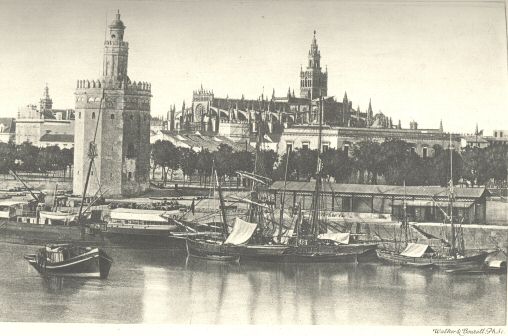
The manner of life of the Gitános of Madrid differs inno material respect from that of their brethren in otherplaces. The men, every market-day, are to be seen on theskirts of the mercado, generally with some miserableanimal—for example, a foundered mule or galled borrico, bymeans of which they seldom fail to gain a dollar or two, eitherby sale or exchange. It must not, however, be supposed thatthey content themselves with such paltry earnings. Providedthey have any valuable animal, which is not unfrequently thecase, they invariably keep such at home snug in the stall,conducting thither the chapman, should they find any, andconcluding the bargain with the greatest secrecy. Theirgeneral reason for this conduct is an unwillingness to exhibitanything calculated to excite the jealousy of the chalans, orjockeys of Spanish blood, who on the slightest umbrage are in thehabit of ejecting them from the fair by force of palos orcudgels, in which violence the chalans are to a certain extentcountenanced by law; for though by the edict of Carlos the Thirdthe Gitános were in other respects placed upon an equalitywith the rest of the Spaniards, they were still forbidden toobtain their livelihood by the traffic of markets and fairs.
They have occasionally however another excellent reason fornot exposing the animal in the public mercado—havingobtained him by dishonest means. The stealing, concealing,and receiving animals when stolen, are inveterate Gypsy habits,and are perhaps the last from which the Gitáno will bereclaimed, or will only cease when the race has becomeextinct. In the prisons of Madrid, either in that of theSaladero or De la Corte, there are never less than a dozenGitános immured for stolen horses or mules being found intheir possession, which themselves or their connections havespirited away from the neighbouring villages, or sometimes from aconsiderable distance. I say spirited away, for so well dothe thieves take their measures, and watch their opportunity,that they are seldom or never taken in the fact.
The Madrilenian Gypsy women are indefatigable in the pursuitof prey, prowling about the town and the suburbs from morningtill night, entering houses of all descriptions, from the highestto the lowest; telling fortunes, or attempting to play offvarious kinds of Gypsy tricks, from which they derive muchgreater profit, and of which we shall presently have occasion tomake particular mention.
From Madrid let us proceed to Andalusia, casting a cursoryglance on the Gitános of that country. I found themvery numerous at Granada, which in the Gitáno language istermed Meligrana. Their general condition in this place istruly miserable, far exceeding in wretchedness the state of thetribes of Estremadura. It is right to state that Granadaitself is the poorest city in Spain; the greatest part of thepopulation, which exceeds sixty thousand, living in beggary andnakedness, and the Gitános share in the generaldistress.

Many of them reside in caves scooped in the sides of theravines which lead to the higher regions of the Alpujarras, on askirt of which stands Granada. A common occupation of theGitános of Granada is working in iron, and it is notunfrequent to find these caves tenanted by Gypsy smiths and theirfamilies, who ply the hammer and forge in the bowels of theearth. To one standing at the mouth of the cave, especiallyat night, they afford a picturesque spectacle. Gatheredround the forge, their bronzed and naked bodies, illuminated bythe flame, appear like figures of demons; while the cave, withits flinty sides and uneven roof, blackened by the charcoalvapours which hover about it in festoons, seems to offer noinadequate representation of fabled purgatory. Working iniron was an occupation strictly forbidden to the Gitánosby the ancient laws, on what account does not exactly appear;though, perhaps, the trade of the smith was considered as toomuch akin to that of the chalan to be permitted to them. The Gypsy smith of Granada is still a chalan, even as his brotherin England is a jockey and tinker alternately.
Whilst speaking of the Gitános of Granada, we cannotpass by in silence a tragedy which occurred in this town amongstthem, some fifteen years ago, and the details of which are knownto every Gitáno in Spain, from Catalonia toEstremadura. We allude to the murder of Pindamonas by PepeConde. Both these individuals were Gitános; thelatter was a celebrated contrabandista, of whom many remarkabletales are told. On one occasion, having committed someenormous crime, he fled over to Barbary and turned Moor, and wasemployed by the Moorish emperor in his wars, in company with theother renegade Spaniards, whose grand depôt or presidio isthe town of Agurey in the kingdom of Fez. After the lapseof some years, when his crime was nearly forgotten, he returnedto Granada, where he followed his old occupations ofcontrabandista and chalan. Pindamonas was a Gitánoof considerable wealth, and was considered as the mostrespectable of the race at Granada, amongst whom he possessedconsiderable influence. Between this man and Pepe Condethere existed a jealousy, especially on the part of the latter,who, being a man of proud untamable spirit, could not well brooka superior amongst his own people. It chanced one day thatPindamonas and other Gitános, amongst whom was Pepe Conde,were in a coffee-house. After they had all partaken of somerefreshment, they called for the reckoning, the amount of whichPindamonas insisted on discharging. It will be necessaryhere to observe, that on such occasions in Spain it is consideredas a species of privilege to be allowed to pay, which is anhonour generally claimed by the principal man of the party. Pepe Conde did not fail to take umbrage at the attempt ofPindamonas, which he considered as an undue assumption ofsuperiority, and put in his own claim; but Pindamonas insisted,and at last flung down the money on the table, whereupon PepeConde instantly unclasped one of those terrible Manchegan kniveswhich are generally carried by the contrabandistas, and with afrightful gash opened the abdomen of Pindamonas, who presentlyexpired.

After this exploit, Pepe Conde fled, and was not seen for sometime. The cave, however, in which he had been in the habitof residing was watched, as a belief was entertained that sooneror later he would return to it, in the hope of being able toremove some of the property contained in it. This beliefwas well founded. Early one morning he was observed toenter it, and a band of soldiers was instantly despatched toseize him. This circumstance is alluded to in a Gypsystanza:—
‘Fly, Pepe Conde, seek the hill;
To flee’s thy only chance;
With bayonets fixed, thy blood to spill,
See soldiers four advance.’
And before the soldiers could arrive at the cave, Pepe Condehad discovered their approach and fled, endeavouring to make hisescape amongst the rocks and barrancos of the Alpujarras. The soldiers instantly pursued, and the chase continued aconsiderable time. The fugitive was repeatedly summoned tosurrender himself, but refusing, the soldiers at last fired, andfour balls entered the heart of the Gypsy contrabandista andmurderer.
Once at Madrid I received a letter from the sister’s sonof Pindamonas, dated from the prison of the Saladero. Inthis letter the writer, who it appears was in durance forstealing a pair of mules, craved my charitable assistance andadvice; and possibly in the hope of securing my favour, forwardedsome uncouth lines commemorative of the death of his relation,and commencing thus:—
‘The death of Pindamonas fill’d allthe world with pain;
At the coffee-house’s portal, by Pepe he wasslain.’
The faubourg of Triana, in Seville, has from time immemorialbeen noted as a favourite residence of the Gitános; andhere, at the present day, they are to be found in greater numberthan in any other town in Spain. This faubourg is indeedchiefly inhabited by desperate characters, as, besides theGitános, the principal part of the robber population ofSeville is here congregated. Perhaps there is no part evenof Naples where crime so much abounds, and the law is so littlerespected, as at Triana, the character of whose inmates was sographically delineated two centuries and a half back byCervantes, in one of the most amusing of his tales. [199]
In the vilest lanes of this suburb, amidst dilapidated wallsand ruined convents, exists the grand colony of SpanishGitános. Here they may be seen wielding the hammer;here they may be seen trimming the fetlocks of horses, orshearing the backs of mules and borricos with their cachas; andfrom hence they emerge to ply the same trade in the town, or toofficiate as terceros, or to buy, sell, or exchange animals inthe mercado, and the women to tell the bahi through the streets,even as in other parts of Spain, generally attended by one or twotawny bantlings in their arms or by their sides; whilst others,with baskets and chafing-pans, proceed to the delightful banks ofthe Len Baro, [200] by the Golden Tower, where, squattingon the ground and kindling their charcoal, they roast thechestnuts which, when well prepared, are the favourite bonnebouche of the Sevillians; whilst not a few, in league with thecontrabandistas, go from door to door offering for saleprohibited goods brought from the English at Gibraltar. Such is Gitáno life at Seville; such it is in the capitalof Andalusia.
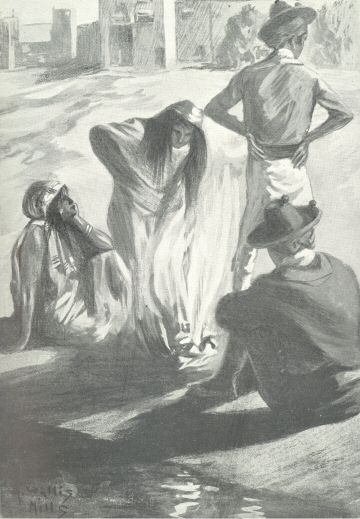
It is the common belief of the Gitános of otherprovinces that in Andalusia the language, customs, habits, andpractices peculiar to their race are best preserved. Thisopinion, which probably originated from the fact of their beingfound in greater numbers in this province than in any other, mayhold good in some instances, but certainly not in all. Invarious parts of Spain I have found the Gitános retainingtheir primitive language and customs better than in Seville,where they most abound: indeed, it is not plain that their numberhas operated at all favourably in this respect. At Cordova,a town at the distance of twenty leagues from Seville, whichscarcely contains a dozen Gitáno families, I found themliving in much more brotherly amity, and cherishing in a greaterdegree the observances of their forefathers.
I shall long remember these Cordovese Gitános, by whomI was very well received, but always on the supposition that Iwas one of their own race. They said that they neveradmitted strangers to their houses save at their marriagefestivals, when they flung their doors open to all, and saveoccasionally people of influence and distinction, who wished tohear their songs and converse with their women; but they assuredme, at the same time, that these they invariably deceived, andmerely made use of as instruments to serve their ownpurposes. As for myself, I was admitted without scruple totheir private meetings, and was made a participator of their mostsecret thoughts. During our intercourse some remarkablescenes occurred. One night more than twenty of us, men andwomen, were assembled in a long low room on the ground floor, ina dark alley or court in the old gloomy town of Cordova. After the Gitános had discussed several jockey plans, andsettled some private bargains amongst themselves, we all gatheredround a huge brasero of flaming charcoal, and began conversingsobre las cosas de Egypto, when I proposed that, as we hadno better means of amusing ourselves, we should endeavour to turninto the Calo language some pieces of devotion, that we might seewhether this language, the gradual decay of which I hadfrequently heard them lament, was capable of expressing any othermatters than those which related to horses, mules, and Gypsytraffic. It was in this cautious manner that I firstendeavoured to divert the attention of these singular people tomatters of eternal importance. My suggestion was receivedwith acclamations, and we forthwith proceeded to the translationof the Apostles’ creed. I first recited in Spanish,in the usual manner and without pausing, this noble confession,and then repeated it again, sentence by sentence, theGitános translating as I proceeded. They exhibitedthe greatest eagerness and interest in their unwonted occupation,and frequently broke into loud disputes as to the bestrendering—many being offered at the same time. In themeanwhile, I wrote down from their dictation; and at theconclusion I read aloud the translation, the result of the unitedwisdom of the assembly, whereupon they all raised a shout ofexultation, and appeared not a little proud of thecomposition.
The Cordovese Gitános are celebrated esquiladors. Connected with them and the exercise of the arte deesquilar, in Gypsy monrabar, I have a curious anecdote torelate. In the first place, however, it may not be amiss tosay something about the art itself, of all relating to which itis possible that the reader may be quite ignorant.
Nothing is more deserving of remark in Spanish grooming thanthe care exhibited in clipping and trimming various parts of thehorse, where the growth of hair is considered as prejudicial tothe perfect health and cleanliness of the animal, particularattention being always paid to the pastern, that part of the footwhich lies between the fetlock and the hoof, to guard against thearestin—that cutaneous disorder which is the dread of theSpanish groom, on which account the services of a skilfulesquilador are continually in requisition.
The esquilador, when proceeding to the exercise of hisvocation, generally carries under his arm a small box containingthe instruments necessary, and which consist principally ofvarious pairs of scissors, and the aciál, two shortsticks tied together with whipcord at the end, by means of whichthe lower lip of the horse, should he prove restive, is twisted,and the animal reduced to speedy subjection. In the girdleof the esquilador are stuck the large scissors called in Spanishtijeras, and in the Gypsy tongue cachas, with whichhe principally works. He operates upon the backs, ears, andtails of mules and borricos, which are invariably sheared quitebare, that if the animals are galled, either by their harness orthe loads which they carry, the wounds may be less liable tofester, and be more easy to cure. Whilst engaged withhorses, he confines himself to the feet and ears. Theesquiladores in the two Castiles, and in those provinces wherethe Gitános do not abound, are for the most partAragonese; but in the others, and especially in Andalusia, theyare of the Gypsy race. The Gitános are in generalvery expert in the use of the cachas, which they handle in amanner practised nowhere but in Spain; and with this instrumentthe poorer class principally obtain their bread.
In one of their couplets allusion is made to this occupationin the following manner:—
‘I’ll rise to-morrow bread to earn,
For hunger’s worn me grim;
Of all I meet I’ll ask in turn,
If they’ve no beasts to trim.’
Sometimes, whilst shearing the foot of a horse, exceedinglysmall scissors are necessary for the purpose of removing finesolitary hairs; for a Spanish groom will tell you that ahorse’s foot behind ought to be kept as clean and smooth asthe hand of a señora: such scissors can only be procuredat Madrid. My sending two pair of this kind to a CordoveseGypsy, from whom I had experienced much attention whilst in thatcity, was the occasion of my receiving a singular epistle fromanother whom I scarcely knew, and which I shall insert as beingan original Gypsy composition, and in some points not a littlecharacteristic of the people of whom I am now writing.
‘Cordova, 20th dayof January, 1837.
‘SEÑOR DONJORGE,
‘After saluting you and hoping that you are well, Iproceed to tell you that the two pair of scissors arrived at thistown of Cordova with him whom you sent them by; but,unfortunately, they were given to another Gypsy, whom you neitherknew nor spoke to nor saw in your life; for it chanced that hewho brought them was a friend of mine, and he told me that he hadbrought two pair of scissors which an Englishman had given himfor the Gypsies; whereupon I, understanding it was yourself,instantly said to him, “Those scissors are for me”;he told me, however, that he had already given them to another,and he is a Gypsy who was not even in Cordova during the time youwere. Nevertheless, Don Jorge, I am very grateful for yourthus remembering me, although I did not receive your present, andin order that you may know who I am, my name is Antonio Salazar,a man pitted with the small-pox, and the very first who spoke toyou in Cordova in the posada where you were; and you told me tocome and see you next day at eleven, and I went, and we conversedtogether alone. Therefore I should wish you to do me thefavour to send me scissors for trimming beasts,—goodscissors, mind you,—such would be a very great favour, andI should be ever grateful, for here in Cordova there are none, orif there be, they are good for nothing. Señor DonJorge, you remember I told you that I was an esquilador by trade,and only by that I got bread for my babes. Señor DonJorge, if you do send me the scissors for trimming, pray writeand direct to the alley De la Londiga, No. 28, to AntonioSalazar, in Cordova. This is what I have to tell you, anddo you ever command your trusty servant, who kisses your hand andis eager to serve you.
‘AntonioSalazar.’
FIRST COUPLET
‘That I may clip and trim the beasts, a pair of cachasgrant,
If not, I fear my luckless babes will perish all ofwant.’SECOND COUPLET
‘If thou a pair of cachas grant, that I my babes mayfeed,
I’ll pray to the Almighty God, that thee he everspeed.’
It is by no means my intention to describe the exact state andcondition of the Gitános in every town and province wherethey are to be found; perhaps, indeed, it will be considered thatI have already been more circumstantial and particular than thecase required. The other districts which they inhabit areprincipally those of Catalonia, Murcia, and Valencia; and theyare likewise to be met with in the Basque provinces, where theyare called Egipcioac, or Egyptians. What I next purpose tooccupy myself with are some general observations on the habits,and the physical and moral state of the Gitános throughoutSpain, and of the position which they hold in society.
p.207CHAPTER III
Already, from the two precedingchapters, it will have been perceived that the condition of theGitános in Spain has been subjected of late toconsiderable modification. The words of the Gypsy ofBadajoz are indeed, in some respects, true; they are no longerthe people that they were; the roads and‘despoblados’ have ceased to be infested by them, andthe traveller is no longer exposed to much danger on theiraccount; they at present confine themselves, for the most part,to towns and villages, and if they occasionally wander abroad, itis no longer in armed bands, formidable for their numbers, andcarrying terror and devastation in all directions, bivouackingnear solitary villages, and devouring the substance of theunfortunate inhabitants, or occasionally threatening even largetowns, as in the singular case of Logroño, mentioned byFrancisco de Cordova. As the reader will probably wish toknow the cause of this change in the lives and habits of thesepeople, we shall, as briefly as possible, afford as muchinformation on the subject as the amount of our knowledge willpermit.
One fact has always struck us with particular force in thehistory of these people, namely, that Gitanismo—which meansGypsy villainy of every description—flourished and knewnothing of decay so long as the laws recommended and enjoinedmeasures the most harsh and severe for the suppression of theGypsy sect; the palmy days of Gitanismo were those in which thecaste was proscribed, and its members, in the event of renouncingtheir Gypsy habits, had nothing farther to expect than theoccupation of tilling the earth, a dull hopeless toil; then itwas that the Gitános paid tribute to the inferiorministers of justice, and were engaged in illicit connection withthose of higher station, and by such means baffled the law, whosevengeance rarely fell upon their heads; and then it was that theybid it open defiance, retiring to the deserts and mountains, andliving in wild independence by rapine and shedding of blood; foras the law then stood they would lose all by resigning theirGitanismo, whereas by clinging to it they lived either in theindependence so dear to them, or beneath the protection of theirconfederates. It would appear that in proportion as the lawwas harsh and severe, so was the Gitáno bold andsecure. The fiercest of these laws was the one of Philipthe Fifth, passed in the year 1745, which commands that therefractory Gitános be hunted down with fire and sword;that it was quite inefficient is satisfactorily proved by itsbeing twice reiterated, once in the year ‘46, and again in‘49, which would scarcely have been deemed necessary had itquelled the Gitános. This law, with some unimportantmodifications, continued in force till the year ‘83, whenthe famous edict of Carlos Tercero superseded it. Will anyfeel disposed to doubt that the preceding laws had served tofoster what they were intended to suppress, when we state theremarkable fact, that since the enactment of that law, as humaneas the others were unjust, we have heard nothing more of theGitános from official quarters; they have ceased toplay a distinct part in the history of Spain; and the lawno longer speaks of them as a distinct people? Thecaste of the Gitáno still exists, but it is neither soextensive nor so formidable as a century ago, when the law indenouncing Gitanismo proposed to the Gitános thealternatives of death for persisting in their profession, orslavery for abandoning it.
There are fierce and discontented spirits amongst them, whoregret such times, and say that Gypsy law is now no more, thatthe Gypsy no longer assists his brother, and that union hasceased among them. If this be true, can better proof beadduced of the beneficial working of the later law? Ablessing has been conferred on society, and in a manner highlycreditable to the spirit of modern times; reform has beenaccomplished, not by persecution, not by the gibbet and the rack,but by justice and tolerance. The traveller has flung asidehis cloak, not compelled by the angry buffeting of the northwind, but because the mild, benignant weather makes such adefence no longer necessary. The law no longer compels theGitános to stand back to back, on the principal of mutualdefence, and to cling to Gitanismo to escape from servitude andthraldom.
Taking everything into consideration, and viewing the subjectin all its bearings with an impartial glance, we are compelled tocome to the conclusion that the law of Carlos Tercero, theprovisions of which were distinguished by justice and clemency,has been the principal if not the only cause of the decline ofGitanismo in Spain. Some importance ought to be attached tothe opinion of the Gitános themselves on this point. ‘El Crallis ha nicobado la liri de los Cales,’ is aproverbial saying among them. By Crallis, or King, theymean Carlos Tercero, so that the saying, the proverbial saying,may be thus translated: The Law of Carlos Tercero hassuperseded Gypsy Law.
By the law the schools are open to them, and there is no artor science which they may not pursue, if they are willing. Have they availed themselves of the rights which the law hasconferred upon them?
Up to the present period but little—they still continuejockeys and blacksmiths; but some of these Gypsy chalans, thesebronzed smiths, these wild-looking esquiladors, can read or writein the proportion of one man in three or four; what more can beexpected? Would you have the Gypsy bantling, born in filthand misery, ‘midst mules and borricos, amidst the mud of achoza or the sand of a barranco, grasp with its swarthy hands thecrayon and easel, the compass, or the microscope, or the tubewhich renders more distinct the heavenly orbs, and essay tobecome a Murillo, or a Feijoo, or a Lorenzo de Hervas, as soon asthe legal disabilities are removed which doomed him to be athievish jockey or a sullen husbandman? Much will have beenaccomplished, if, after the lapse of a hundred years, one hundredhuman beings shall have been evolved from the Gypsy stock, whoshall prove sober, honest, and useful members ofsociety,—that stock so degraded, so inveterate inwickedness and evil customs, and so hardened by brutalisinglaws. Should so many beings, should so many souls berescued from temporal misery and eternal woe; should only thehalf of that number, should only the tenth, nay, should only onepoor wretched sheep be saved, there will be joy in heaven, formuch will have been accomplished on earth, and those lines willhave been in part falsified which filled the stout heart ofMahmoud with dismay:—
‘For the root that’s unclean, hope ifyou can;
No washing e’er whitens the black Zigan:
The tree that’s bitter by birth and race,
If in paradise garden to grow you place,
And water it free with nectar and wine,
From streams in paradise meads that shine,
At the end its nature it still declares,
For bitter is all the fruit it bears.
If the egg of the raven of noxious breed
You place ‘neath the paradise bird, and feed
The splendid fowl upon its nest,
With immortal figs, the food of the blest,
And give it to drink from Silisbél, [211]
Whilst life in the egg breathes Gabriél,
A raven, a raven, the egg shall bear,
And the fostering bird shall waste its care.’—Ferdousi.
The principal evidence which the Gitános have hithertogiven that a partial reformation has been effected in theirhabits, is the relinquishment, in a great degree, of thatwandering life of which the ancient laws were continuallycomplaining, and which was the cause of infinite evils, andtended not a little to make the roads insecure.
Doubtless there are those who will find some difficulty inbelieving that the mild and conciliatory clauses of the law inquestion could have much effect in weaning the Gitánosfrom this inveterate habit, and will be more disposed to thinkthat this relinquishment was effected by energetic measuresresorted to by the government, to compel them to remain in theirplaces of location. It does not appear, however, that suchmeasures were ever resorted to. Energy, indeed, in theremoval of a nuisance, is scarcely to be expected from Spaniardsunder any circumstances. All we can say on the subject,with certainty, is, that since the repeal of the tyrannical laws,wandering has considerably decreased among theGitános.
Since the law has ceased to brand them, they have come nearerto the common standard of humanity, and their general conditionhas been ameliorated. At present, only the very poorest,the parias of the race, are to be found wandering about theheaths and mountains, and this only in the summer time, and theirprincipal motive, according to their own confession, is to avoidthe expense of house rent; the rest remain at home, followingtheir avocations, unless some immediate prospect of gain, lawfulor unlawful, calls them forth; and such is frequently thecase. They attend most fairs, women and men, and on the wayfrequently bivouac in the fields, but this practice must not beconfounded with systematic wandering.
Gitanismo, therefore, has not been extinguished, onlymodified; but that modification has been effected within thememory of man, whilst previously near four centuries elapsed,during which no reform had been produced amongst them by thevarious measures devised, all of which were distinguished by anabsence not only of true policy, but of common-sense; it istherefore to be hoped, that if the Gitános are abandonedto themselves, by which we mean no arbitrary laws are againenacted for their extinction, the sect will eventually cease tobe, and its members become confounded with the residue of thepopulation; for certainly no Christian nor merely philanthropicheart can desire the continuance of any sect or association ofpeople whose fundamental principle seems to be to hate all therest of mankind, and to live by deceiving them; and such is thepractice of the Gitános.
During the last five years, owing to the civil wars, the tieswhich unite society have been considerably relaxed; the law hasbeen trampled under foot, and the greatest part of Spain overrunwith robbers and miscreants, who, under pretence of carrying onpartisan warfare, and not unfrequently under no pretence at all,have committed the most frightful excesses, plundering andmurdering the defenceless. Such a state of things wouldhave afforded the Gitános a favourable opportunity toresume their former kind of life, and to levy contributions asformerly, wandering about in bands. Certain it is, however,that they have not sought to repeat their ancient excesses,taking advantage of the troubles of the country; they have goneon, with a few exceptions, quietly pursuing that part of theirsystem to which they still cling, their jockeyism, which, thoughbased on fraud and robbery, is far preferable to wanderingbrigandage, which necessarily involves the frequent shedding ofblood. Can better proof be adduced, that Gitanismo owes itsdecline, in Spain, not to force, not to persecution, not to anywant of opportunity of exercising it, but to some othercause?—and we repeat that we consider the principal if notthe only cause of the decline of Gitanismo to be the conferringon the Gitános the rights and privileges of othersubjects.
We have said that the Gitános have not much availedthemselves of the permission, which the law grants them, ofembarking in various spheres of life. They remain jockeys,but they have ceased to be wanderers; and the grand object of thelaw is accomplished. The law forbids them to be jockeys, orto follow the trade of trimming and shearing animals, withoutsome other visible mode of subsistence. This provision,except in a few isolated instances, they evade; and the law seeksnot, and perhaps wisely, to disturb them, content with havingachieved so much. The chief evils of Gitanismo which stillremain consist in the systematic frauds of the Gypsy jockeys andthe tricks of the women. It is incurring considerable riskto purchase a horse or a mule, even from the most respectableGitáno, without a previous knowledge of the animal and hisformer possessor, the chances being that it is either diseased orstolen from a distance. Of the practices of the females,something will be said in particular in a future chapter.
The Gitános in general are very poor, a pair of largecachas and various scissors of a smaller description constitutingtheir whole capital; occasionally a good hit is made, as theycall it, but the money does not last long, being quicklysquandered in feasting and revelry. He who has habituallyin his house a couple of donkeys is considered a thrivingGitáno; there are some, however, who are wealthy in thestrict sense of the word, and carry on a very extensive trade inhorses and mules. These, occasionally, visit the mostdistant fairs, traversing the greatest part of Spain. Thereis a celebrated cattle-fair held at Leon on St. John’s orMidsummer Day, and on one of these occasions, being present, Iobserved a small family of Gitános, consisting of a man ofabout fifty, a female of the same age, and a handsome youngGypsy, who was their son; they were richly dressed after theGypsy fashion, the men wearing zamarras with massy clasps andknobs of silver, and the woman a species of riding-dress withmuch gold embroidery, and having immense gold rings attached toher ears. They came from Murcia, a distance of one hundredleagues and upwards. Some merchants, to whom I wasrecommended, informed me that they had credit on their house tothe amount of twenty thousand dollars.
They experienced rough treatment in the fair, and on a verysingular account: immediately on their appearing on the ground,the horses in the fair, which, perhaps, amounted to threethousand, were seized with a sudden and universal panic; it wasone of those strange incidents for which it is difficult toassign a rational cause; but a panic there was amongst thebrutes, and a mighty one; the horses neighed, screamed, andplunged, endeavouring to escape in all directions; some appearedabsolutely possessed, stamping and tearing, their manes and tailsstiffly erect, like the bristles of the wild boar—many arider lost his seat. When the panic had ceased, and it didcease almost as suddenly as it had arisen, the Gitánoswere forthwith accused as the authors of it; it was said thatthey intended to steal the best horses during the confusion, andthe keepers of the ground, assisted by a rabble of chalans, whohad their private reasons for hating the Gitános, drovethem off the field with sticks and cudgels. So much forhaving a bad name.
These wealthy Gitános, when they are not ashamed oftheir blood or descent, and are not addicted to proud fancies, or‘barbales,’ as they are called, possess greatinfluence with the rest of their brethren, almost as much as therabbins amongst the Jews; their bidding is considered law, andthe other Gitános are at their devotion. On thecontrary, when they prefer the society of the Busné tothat of their own race, and refuse to assist their less fortunatebrethren in poverty or in prison, they are regarded withunbounded contempt and abhorrence, as in the case of the richGypsy of Badajoz, and are not unfrequently doomed to destruction:such characters are mentioned in their couplets:—
‘The Gypsy fiend of Manga mead,
Who never gave a straw,
He would destroy, for very greed,
The good Egyptian law.‘The false Juanito day and night
Had best with caution go;
The Gypsy carles of Yeira height
Have sworn to lay him low.’
However some of the Gitános may complain that there isno longer union to be found amongst them, there is still much ofthat fellow-feeling which springs from a consciousness ofproceeding from one common origin, or, as they love to term it,‘blood.’ At present their system exhibits lessof a commonwealth than when they roamed in bands amongst thewilds, and principally subsisted by foraging, each individualcontributing to the common stock, according to his success. The interests of individuals are now more distinct, and thatclose connection is of course dissolved which existed when theywandered about, and their dangers, gains, and losses were felt incommon; and it can never be too often repeated that they are nolonger a proscribed race, with no rights nor safety save whatthey gained by a close and intimate union. Nevertheless,the Gitáno, though he naturally prefers his own interestto that of his brother, and envies him his gain when he does notexpect to share in it, is at all times ready to side with himagainst the Busno, because the latter is not a Gitáno, butof a different blood, and for no other reason. When oneGitáno confides his plans to another, he is in no fearthat they will be betrayed to the Busno, for whom there is nosympathy, and when a plan is to be executed which requiresco-operation, they seek not the fellowship of the Busné,but of each other, and if successful, share the gain likebrothers.
As a proof of the fraternal feeling which is not unfrequentlydisplayed amongst the Gitános, I shall relate acircumstance which occurred at Cordova a year or two before Ifirst visited it. One of the poorest of the Gitánosmurdered a Spaniard with the fatal Manchegan knife; for thiscrime he was seized, tried, and found guilty. Blood-shedding in Spain is not looked upon with much abhorrence,and the life of the culprit is seldom taken, provided he canoffer a bribe sufficient to induce the notary public to reportfavourably upon his case; but in this instance money was of noavail; the murdered individual left behind him powerful friendsand connections, who were determined that justice should take itscourse. It was in vain that the Gitános exerted alltheir influence with the authorities in behalf of their comrade,and such influence was not slight; it was in vain that theyoffered extravagant sums that the punishment of death might becommuted to perpetual slavery in the dreary presidio of Ceuta; Iwas credibly informed that one of the richest Gitános, byname Fruto, offered for his own share of the ransom the sum offive thousand crowns, whilst there was not an individual butcontributed according to his means—nought availed, and theGypsy was executed in the Plaza. The day before theexecution, the Gitános, perceiving that the fate of theirbrother was sealed, one and all quitted Cordova, shutting uptheir houses and carrying with them their horses, their mules,their borricos, their wives and families, and the greatest partof their household furniture. No one knew whither theydirected their course, nor were they seen in Cordova for somemonths, when they again suddenly made their appearance; a few,however, never returned. So great was the horror of theGitános at what had occurred, that they were in the habitof saying that the place was cursed for evermore; and when I knewthem, there were many amongst them who, on no account, wouldenter the Plaza which had witnessed the disgraceful end of theirunfortunate brother.
The position which the Gitános hold in society in Spainis the lowest, as might be expected; they are considered at bestas thievish chalans, and the women as half sorceresses, and inevery respect thieves; there is not a wretch, however vile, theoutcast of the prison and the presidio, who calls himselfSpaniard, but would feel insulted by being termed Gitáno,and would thank God that he is not; and yet, strange to say,there are numbers, and those of the higher classes, who seektheir company, and endeavour to imitate their manners and way ofspeaking. The connections which they form with theSpaniards are not many; occasionally some wealthy Gitánomarries a Spanish female, but to find a Gitána united to aSpaniard is a thing of the rarest occurrence, if it ever takesplace. It is, of course, by intermarriage alone that thetwo races will ever commingle, and before that event is broughtabout, much modification must take place amongst theGitános, in their manners, in their habits, in theiraffections, and their dislikes, and, perhaps, even in theirphysical peculiarities; much must be forgotten on both sides, andeverything is forgotten in the course of time.
The number of the Gitáno population of Spain at thepresent day may be estimated at about forty thousand. Atthe commencement of the present century it was said to amount tosixty thousand. There can be no doubt that the sect is byno means so numerous as it was at former periods; witness thosebarrios in various towns still denominated Gitánerias, butfrom whence the Gitános have disappeared even like theMoors from the Morerias. Whether this diminution in numberhas been the result of a partial change of habits, of pestilenceor sickness, of war or famine, or of all these causes combined,we have no means of determining, and shall abstain from offeringconjectures on the subject.
p.221CHAPTER IV
In the autumn of the year 1839, Ilanded at Tarifa, from the coast of Barbary. I arrived in asmall felouk laden with hides for Cadiz, to which place I wasmyself going. We stopped at Tarifa in order to performquarantine, which, however, turned out a mere farce, as we wereall permitted to come on shore; the master of the felouk havingbribed the port captain with a few fowls. We formed amotley group. A rich Moor and his son, a child, with theirJewish servant Yusouf, and myself with my own man Hayim BenAttar, a Jew. After passing through the gate, the Moors andtheir domestics were conducted by the master to the house of oneof his acquaintance, where he intended they should lodge; whilsta sailor was despatched with myself and Hayim to the only innwhich the place afforded. I stopped in the street to speakto a person whom I had known at Seville. Before we hadconcluded our discourse, Hayim, who had walked forward, returned,saying that the quarters were good, and that we were in highluck, for that he knew the people of the inn were Jews. ‘Jews,’ said I, ‘here in Tarifa, and keeping aninn, I should be glad to see them.’ So I left myacquaintance, and hastened to the house. We first entered astable, of which the ground floor of the building consisted, andascending a flight of stairs entered a very large room, and fromthence passed into a kitchen, in which were several people. One of these was a stout, athletic, burly fellow of about fifty,dressed in a buff jerkin, and dark cloth pantaloons. Hishair was black as a coal and exceedingly bushy, his face muchmarked from some disorder, and his skin as dark as that of atoad. A very tall woman stood by the dresser, muchresembling him in feature, with the same hair and complexion, butwith more intelligence in her eyes than the man, who looked heavyand dogged. A dark woman, whom I subsequently discovered tobe lame, sat in a corner, and two or three swarthy girls, fromfifteen to eighteen years of age, were flitting about theroom. I also observed a wicked-looking boy, who might havebeen called handsome, had not one of his eyes been injured. ‘Jews,’ said I, in Moorish, to Hayim, as I glanced atthese people and about the room; ‘these are not Jews, butchildren of the Dar-bushi-fal.’
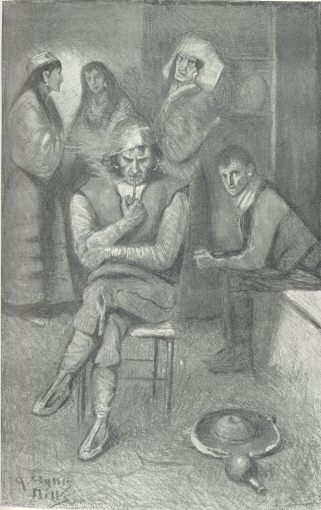
‘List to the Corahai,’ said the tall woman, inbroken Gypsy slang, ‘hear how they jabber (hunelad comochamulian), truly we will make them pay for the noise they raisein the house.’ Then coming up to me, she demandedwith a shout, fearing otherwise that I should not understand,whether I would not wish to see the room where I was tosleep. I nodded: whereupon she led me out upon a backterrace, and opening the door of a small room, of which therewere three, asked me if it would suit. ‘Perfectly,’ said I, and returned with her to thekitchen.
‘O, what a handsome face! what a royal person!’exclaimed the whole family as I returned, in Spanish, but in thewhining, canting tones peculiar to the Gypsies, when they arebent on victimising. ‘A more ugly Busno it has neverbeen our chance to see,’ said the same voices in the nextbreath, speaking in the jargon of the tribe. ‘Won’t your Moorish Royalty please to eatsomething?’ said the tall hag. ‘We have nothingin the house; but I will run out and buy a fowl, which I hope mayprove a royal peacock to nourish and strengthen you.’ ‘I hope it may turn to drow in your entrails,’ shemuttered to the rest in Gypsy. She then ran down, and in aminute returned with an old hen, which, on my arrival, I hadobserved below in the stable. ‘See this beautifulfowl,’ said she, ‘I have been running over all Tarifato procure it for your kingship; trouble enough I have had toobtain it, and dear enough it has cost me. I will now cutits throat.’ ‘Before you kill it,’ saidI, ‘I should wish to know what you paid for it, that theremay be no dispute about it in the account.’ ‘Two dollars I paid for it, most valorous and handsome sir;two dollars it cost me, out of my own quisobi—out of my ownlittle purse.’ I saw it was high time to put an endto these zalamerias, and therefore exclaimed in Gitáno,‘You mean two brujis (reals), O mother of all the witches,and that is twelve cuartos more than it is worth.’ ‘Ay Dios mio, whom have we here?’ exclaimed thefemales. ‘One,’ I replied, ‘who knows youwell and all your ways. Speak! am I to have the hen for tworeals? if not, I shall leave the house this moment.’ ‘O yes, to be sure, brother, and for nothing if you wishit,’ said the tall woman, in natural and quite alteredtones; ‘but why did you enter the house speaking in Corahailike a Bengui? We thought you a Busno, but we now see thatyou are of our religion; pray sit down and tell us where you havebeen.’ . .
Myself.—‘Now, my good people, since I haveanswered your questions, it is but right that you should answersome of mine; pray who are you? and how happens it that you arekeeping this inn?’
Gypsy Hag.—‘Verily, brother, we canscarcely tell you who we are. All we know of ourselves is,that we keep this inn, to our trouble and sorrow, and that ourparents kept it before us; we were all born in this house, whereI suppose we shall die.’
Myself.—‘Who is the master of the house,and whose are these children?’
Gypsy Hag.—‘The master of the house is thefool, my brother, who stands before you without saying a word; tohim belong these children, and the cripple in the chair is hiswife, and my cousin. He has also two sons who are grown-upmen; one is a chumajarri (shoemaker), and the other serves atanner.’
Myself.—‘Is it not contrary to the law ofthe Cales to follow such trades?’
Gypsy Hag.—‘We know of no law, and littleof the Cales themselves. Ours is the only Calo family inTarifa, and we never left it in our lives, except occasionally togo on the smuggling lay to Gibraltar. True it is that theCales, when they visit Tarifa, put up at our house, sometimes toour cost. There was one Rafael, son of the rich Fruto ofCordova, here last summer, to buy up horses, and he departed abaria and a half in our debt; however, I do not grudge it him,for he is a handsome and clever Chabó—a fellow ofmany capacities. There was more than one Busno had cause torue his coming to Tarifa.’
Myself.—‘Do you live on good terms with theBusné of Tarifa?’
Gypsy Hag.—‘Brother, we live on the bestterms with the Busné of Tarifa; especially with theerrays. The first people in Tarifa come to this house, tohave their baji told by the cripple in the chair and bymyself. I know not how it is, but we are more considered bythe grandees than the poor, who hate and loathe us. When myfirst and only infant died, for I have been married, the child ofone of the principal people was put to me to nurse, but I hatedit for its white blood, as you may well believe. It neverthrove, for I did it a private mischief, and though it grew upand is now a youth, it is—mad.’
Myself.—‘With whom will yourbrother’s children marry? You say there are noGypsies here.’
Gypsy Hag.—‘Ay de mi, hermano! It isthat which grieves me. I would rather see them sold to theMoors than married to the Busné. When Rafael washere he wished to persuade the chumajarri to accompany him toCordova, and promised to provide for him, and to find him a wifeamong the Callees of that town; but the faint heart would not,though I myself begged him to comply. As for the curtidor(tanner), he goes every night to the house of a Busnee; and once,when I reproached him with it, he threatened to marry her. I intend to take my knife, and to wait behind the door in thedark, and when she comes out to gash her over the eyes. Itrow he will have little desire to wed with her then.’
Myself.—‘Do many Busné from thecountry put up at this house?’
Gypsy Hag.—‘Not so many as formerly,brother; the labourers from the Campo say that we are allthieves; and that it is impossible for any one but a Calo toenter this house without having the shirt stripped from hisback. They go to the houses of their acquaintance in thetown, for they fear to enter these doors. I scarcely knowwhy, for my brother is the veriest fool in Tarifa. Were itnot for his face, I should say that he is no Chabó, for hecannot speak, and permits every chance to slip through hisfingers. Many a good mule and borrico have gone out of thestable below, which he might have secured, had he but tongueenough to have cozened the owners. But he is a fool, as Isaid before; he cannot speak, and is no Chabó.’
How far the person in question, who sat all the while smokinghis pipe, with the most unperturbed tranquillity, deserved thecharacter bestowed upon him by his sister, will presentlyappear. It is not my intention to describe here all thestrange things I both saw and heard in this Gypsy inn. Several Gypsies arrived from the country during the six days thatI spent within its walls; one of them, a man, from Moron, wasreceived with particular cordiality, he having a son, whom he wasthinking of betrothing to one of the Gypsy daughters. Somefemales of quality likewise visited the house to gossip, liketrue Andalusians. It was singular to observe the behaviourof the Gypsies to these people, especially that of the remarkablewoman, some of whose conversation I have given above. Shewhined, she canted, she blessed, she talked of beauty of colour,of eyes, of eyebrows, and pestañas (eyelids), and ofhearts which were aching for such and such a lady. Amongstothers, came a very fine woman, the widow of a colonel latelyslain in battle; she brought with her a beautiful innocent littlegirl, her daughter, between three and four years of age. The Gypsy appeared to adore her; she sobbed, she shed tears, shekissed the child, she blessed it, she fondled it. I had myeye upon her countenance, and it brought to my recollection thatof a she-wolf, which I had once seen in Russia, playing with herwhelp beneath a birch-tree. ‘You seem to love thatchild very much, O my mother,’ said I to her, as the ladywas departing.
Gypsy Hag.—‘No lo camélo,hijo! I do not love it, O my son, I do not love it; I loveit so much, that I wish it may break its leg as it goesdownstairs, and its mother also.’
On the evening of the fourth day, I was seated on the stonebench at the stable door, taking the fresco; the Gypsy innkeepersat beside me, smoking his pipe, and silent as usual; presently aman and woman with a borrico, or donkey, entered theportal. I took little or no notice of a circumstance soslight, but I was presently aroused by hearing the Gypsy’spipe drop upon the ground. I looked at him, and scarcelyrecognised his face. It was no longer dull, black, andheavy, but was lighted up with an expression so extremelyvillainous that I felt uneasy. His eyes were scanning therecent comers, especially the beast of burden, which was abeautiful female donkey. He was almost instantly at theirside, assisting to remove its housings, and the alforjas, orbags. His tongue had become unloosed, as if by sorcery; andfar from being unable to speak, he proved that, when it suitedhis purpose, he could discourse with wonderful volubility. The donkey was soon tied to the manger, and a large measure ofbarley emptied before it, the greatest part of which the Gypsyboy presently removed, his father having purposely omitted to mixthe barley with the straw, with which the Spanish mangers arealways kept filled. The guests were hurried upstairs assoon as possible. I remained below, and subsequentlystrolled about the town and on the beach. It was about nineo’clock when I returned to the inn to retire to rest;strange things had evidently been going on during myabsence. As I passed through the large room on my way to myapartment, lo, the table was set out with much wine, fruits, andviands. There sat the man from the country, three partsintoxicated; the Gypsy, already provided with another pipe, saton his knee, with his right arm most affectionately round hisneck; on one side sat the chumajarri drinking and smoking, on theother the tanner. Behold, poor humanity, thought I tomyself, in the hands of devils; in this manner are human soulsensnared to destruction by the fiends of the pit. Thefemales had already taken possession of the woman at the otherend of the table, embracing her, and displaying every mark offriendship and affection. I passed on, but ere I reached myapartment I heard the words mule and donkey. ‘Adios,’ said I, for I but too well knew what was onthe carpet.
In the back stable the Gypsy kept a mule, a most extraordinaryanimal, which was employed in bringing water to the house, a taskwhich it effected with no slight difficulty; it was reported tobe eighteen years of age; one of its eyes had been removed bysome accident, it was foundered, and also lame, the result of abroken leg. This animal was the laughing-stock of allTarifa; the Gypsy grudged it the very straw on while alone he fedit, and had repeatedly offered it for sale at a dollar, which hecould never obtain. During the night there was muchmerriment going on, and I could frequently distinguish the voiceof the Gypsy raised to a boisterous pitch. In the morningthe Gypsy hag entered my apartment, bearing the breakfast ofmyself and Hayim. ‘What were you about lastnight?’ said I.
‘We were bargaining with the Busno, evil overtake him,and he has exchanged us the ass, for the mule and thereckoning,’ said the hag, in whose countenance triumph wasblended with anxiety.
‘Was he drunk when he saw the mule?’ Idemanded.
‘He did not see her at all, O my son, but we told him wehad a beautiful mule, worth any money, which we were anxious todispose of, as a donkey suited our purpose better. We areafraid that when he sees her he will repent his bargain, and ifhe calls off within four-and-twenty hours, the exchange is null,and the justicia will cause us to restore the ass; we have,however, already removed her to our huérta out of thetown, where we have hid her below the ground. Dios sabe(God knows) how it will turn out.’
When the man and woman saw the lame, foundered, one-eyedcreature, for which and the reckoning they had exchanged theirown beautiful borrico, they stood confounded. It was aboutten in the morning, and they had not altogether recovered fromthe fumes of the wine of the preceding night; at last the man,with a frightful oath, exclaimed to the innkeeper, ‘Restoremy donkey, you Gypsy villain!’
‘It cannot be, brother,’ replied the latter,‘your donkey is by this time three leagues from here: Isold her this morning to a man I do not know, and I am afraid Ishall have a hard bargain with her, for he only gave two dollars,as she was unsound. O, you have taken me in, I am a poorfool as they call me here, and you understand much, very much,baribu.’ [230]
‘Her value was thirty-five dollars, thou demon,’said the countryman, ‘and the justicia will make you paythat.’
‘Come, come, brother,’ said the Gypsy, ‘allthis is mere conversation; you have a capital bargain, to-day themercado is held, and you shall sell the mule; I will go with youmyself. O, you understand baribu; sister, bring the bottleof anise; the señor and the señora must drink acopíta.’ After much persuasion, and manyoaths, the man and woman were weak enough to comply; when theyhad drunk several glasses, they departed for the market, theGypsy leading the mule. In about two hours they returnedwith the wretched beast, but not exactly as they went; a numerouscrowd followed, laughing and hooting. The man was nowfrantic, and the woman yet more so. They forced their wayupstairs to collect their baggage, which they soon effected, andwere about to leave the house, vowing revenge. Now ensued atruly terrific scene, there were no more blandishments; the Gypsymen and women were in arms, uttering the most frightfulexecrations; as the woman came downstairs, the females assailedher like lunatics; the cripple poked at her with a stick, thetall hag clawed at her hair, whilst the father Gypsy walked closebeside the man, his hand on his clasp-knife, looking like nothingin this world: the man, however, on reaching the door, turned tohim and said: ‘Gypsy demon, my borrico by threeo’clock—or you know the rest, thejusticia.’
The Gypsies remained filled with rage and disappointment; thehag vented her spite on her brother. ‘’Tis yourfault,’ said she; ‘fool! you have no tongue; you aChabó, you can’t speak’; whereas, within a fewhours, he had perhaps talked more than an auctioneer during athree days’ sale: but he reserved his words for fittingoccasions, and now sat as usual, sullen and silent, smoking hispipe.
The man and woman made their appearance at threeo’clock, but they came—intoxicated; the Gypsy’seyes glistened—blandishment was again had recourseto. ‘Come and sit down with the cavalier here,’whined the family; ‘he is a friend of ours, and will soonarrange matters to your satisfaction.’ I arose, andwent into the street; the hag followed me. ‘Will younot assist us, brother, or are you no Chabó?’ shemuttered.
‘I will have nothing to do with your matters,’said I.
‘I know who will,’ said the hag, and hurried downthe street.
The man and woman, with much noise, demanded their donkey; theinnkeeper made no answer, and proceeded to fill up severalglasses with the anisado. In about a quarter of anhour, the Gypsy hag returned with a young man, well dressed, andwith a genteel air, but with something wild and singular in hiseyes. He seated himself by the table, smiled, took a glassof liquor, drank part of it, smiled again, and handed it to thecountryman. The latter seeing himself treated in thisfriendly manner by a caballero, was evidently much flattered,took off his hat to the newcomer, and drank, as did the womanalso. The glass was filled, and refilled, till they becameyet more intoxicated. I did not hear the young man say aword: he appeared a passive automaton. The Gypsies,however, spoke for him, and were profuse of compliments. Itwas now proposed that the caballero should settle the dispute; along and noisy conversation ensued, the young man lookingvacantly on: the strange people had no money, and had already runup another bill at a wine-house to which they had retired. At last it was proposed, as if by the young man, that the Gypsyshould purchase his own mule for two dollars, and forgive thestrangers the reckoning of the preceding night. To thisthey agreed, being apparently stultified with the liquor, and themoney being paid to them in the presence of witnesses, theythanked the friendly mediator, and reeled away.
Before they left the town that night, they had contrived tospend the entire two dollars, and the woman, who first recoveredher senses, was bitterly lamenting that they had permittedthemselves to be despoiled so cheaply of a prenda tanpreciosa, as was the donkey. Upon the whole, however, Idid not much pity them. The woman was certainly not theman’s wife. The labourer had probably left hisvillage with some strolling harlot, bringing with him the animalwhich had previously served to support himself and family.
I believe that the Gypsy read, at the first glance, theirhistory, and arranged matters accordingly. The donkey wassoon once more in the stable, and that night there was muchrejoicing in the Gypsy inn.
Who was the singular mediator? He was neither more norless than the foster child of the Gypsy hag, the unfortunatebeing whom she had privately injured in his infancy. Afterhaving thus served them as an instrument in their villainy, hewas told to go home. . . .
THE GYPSY SOLDIER OF VALDEPEÑAS
It was at Madrid one fine afternoon in the beginning of March1838, that, as I was sitting behind my table in a cabinete, as itis called, of the third floor of No. 16, in the Calle deSantiágo, having just taken my meal, my hostess enteredand informed me that a military officer wished to speak to me,adding, in an undertone, that he looked a strangeguest. I was acquainted with no military officer in theSpanish service; but as at that time I expected daily to bearrested for having distributed the Bible, I thought that verypossibly this officer might have been sent to perform that pieceof duty. I instantly ordered him to be admitted, whereupona thin active figure, somewhat above the middle height, dressedin a blue uniform, with a long sword hanging at his side, trippedinto the room. Depositing his regimental hat on the ground,he drew a chair to the table, and seating himself, placed hiselbows on the board, and supporting his face with his hands,confronted me, gazing steadfastly upon me, without uttering aword. I looked no less wistfully at him, and was of thesame opinion as my hostess, as to the strangeness of myguest. He was about fifty, with thin flaxen hair coveringthe sides of his head, which at the top was entirely bald. His eyes were small, and, like ferrets’, red andfiery. His complexion like a brick, a dull red, checkeredwith spots of purple. ‘May I inquire your name andbusiness, sir?’ I at length demanded.
Stranger.—‘My name is Chaléco ofValdepeñas; in the time of the French I served asbragante, fighting for Ferdinand VII. I am now a captain onhalf-pay in the service of Donna Isabel; as for my business here,it is to speak with you. Do you know this book?’
Myself.—‘This book is Saint Luke’sGospel in the Gypsy language; how can this book concernyou?’
Stranger.—‘No one more. It is in thelanguage of my people.’
Myself.—‘You do not pretend to say that youare a Caló?’
Stranger.—‘I do! I am Zíncalo,by the mother’s side. My father, it is true, was oneof the Busné; but I glory in being a Caló, and carenot to acknowledge other blood.’
Myself.—‘How became you possessed of thatbook?’
Stranger.—‘I was this morning in the Prado,where I met two women of our people, and amongst other thingsthey told me that they had a gabicóte in ourlanguage. I did not believe them at first, but they pulledit out, and I found their words true. They then spoke to meof yourself, and told me where you live, so I took the book fromthem and am come to see you.’
Myself.—‘Are you able to understand thisbook?’
Stranger.—‘Perfectly, though it is writtenin very crabbed language: [235] but I learnt toread Caló when very young. My mother was a goodCalli, and early taught me both to speak and read it. Shetoo had a gabicóte, but not printed like this, and ittreated of a different matter.’
Myself.—‘How came your mother, being a goodCalli, to marry one of a different blood?’
Stranger.—‘It was no fault of hers; therewas no remedy. In her infancy she lost her parents, whowere executed; and she was abandoned by all, till my father,taking compassion on her, brought her up and educated her: atlast he made her his wife, though three times her age. She,however, remembered her blood and hated my father, and taught meto hate him likewise, and avoid him. When a boy, I used tostroll about the plains, that I might not see my father; and myfather would follow me and beg me to look upon him, and would askme what I wanted; and I would reply, Father, the only thing Iwant is to see you dead.’
Myself.—‘That was strange language from achild to its parent.’
Stranger.—‘It was—but you know thecouplet, [236a] which says, “I do not wish tobe a lord—I am by birth a Gypsy—I do not wish to be agentleman—I am content with being aCaló!”’
Myself.—‘I am anxious to hear more of yourhistory—pray proceed.’
Stranger.—‘When I was about twelve yearsold my father became distracted, and died. I then continuedwith my mother for some years; she loved me much, and procured ateacher to instruct me in Latin. At last she died, and thenthere was a pléyto (law-suit). I took to the sierraand became a highwayman; but the wars broke out. My cousinJara, of Valdepeñas, raised a troop of brigantes. [236b] I enlisted with him anddistinguished myself very much; there is scarcely a man or womanin Spain but has heard of Jara and Chaléco. I am nowcaptain in the service of Donna Isabel—I am covered withwounds—I am—ugh! ugh! ugh—!’
He had commenced coughing, and in a manner which perfectlyastounded me. I had heard hooping coughs, consumptivecoughs, coughs caused by colds, and other accidents, but a coughso horrible and unnatural as that of the Gypsy soldier, I hadnever witnessed in the course of my travels. In a moment hewas bent double, his frame writhed and laboured, the veins of hisforehead were frightfully swollen, and his complexion becameblack as the blackest blood; he screamed, he snorted, he barked,and appeared to be on the point of suffocation—yet moreexplosive became the cough; and the people of the house,frightened, came running into the apartment. I cries,‘The man is perishing, run instantly for asurgeon!’ He heard me, and with a quick movementraised his left hand as if to countermand the order; anotherstruggle, then one mighty throe, which seemed to search hisdeepest intestines; and he remained motionless, his head on hisknee. The cough had left him, and within a minute or two heagain looked up.
‘That is a dreadful cough, friend,’ said I, whenhe was somewhat recovered. ‘How did you getit?’
Gypsy Soldier.—‘I am—shot through thelungs—brother! Let me but take breath, and I willshow you the hole—the agujéro.’
He continued with me a considerable time, and showed not theslightest disposition to depart; the cough returned twice, butnot so violently;—at length, having an engagement, I arose,and apologising, told him I must leave him. The next day hecame again at the same hour, but he found me not, as I was abroaddining with a friend. On the third day, however, as I wassitting down to dinner, in he walked, unannounced. I amrather hospitable than otherwise, so I cordially welcomed him,and requested him to partake of my meal. ‘Conmúcho gusto,’ he replied, and instantly took hisplace at the table. I was again astonished, for if hiscough was frightful, his appetite was yet more so. He atelike a wolf of the sierra;—soup, puchero, fowl and bacondisappeared before him in a twinkling. I ordered in coldmeat, which he presently despatched; a large piece of cheese wasthen produced. We had been drinking water.
‘Where is the wine?’ said he.
‘I never use it,’ I replied.
He looked blank. The hostess, however, who was presentwaiting, said, ‘If the gentleman wish for wine, I have abota nearly full, which I will instantly fetch.’
The skin bottle, when full, might contain about fourquarts. She filled him a very large glass, and was removingthe skin, but he prevented her, saying, ‘Leave it, my goodwoman; my brother here will settle with you for the little Ishall use.’
He now lighted his cigar, and it was evident that he had madegood his quarters. On the former occasion I thought hisbehaviour sufficiently strange, but I liked it still less on thepresent. Every fifteen minutes he emptied his glass, whichcontained at least a pint; his conversation becamehorrible. He related the atrocities which he had committedwhen a robber and bragante in La Mancha. ‘It was ourcustom,’ said he, ‘to tie our prisoners to theolive-trees, and then, putting our horses to full speed, to tiltat them with our spears.’ As he continued to drink hebecame waspish and quarrelsome: he had hitherto talked Castilian,but he would now only converse in Gypsy and in Latin, the last ofwhich languages he spoke with great fluency, thoughungrammatically. He told me that he had killed six men induels; and, drawing his sword, fenced about the room. I sawby the manner in which he handled it, that he was master of hisweapon. His cough did not return, and he said it seldomafflicted him when he dined well. He gave me to understandthat he had received no pay for two years. ‘Thereforeyou visit me,’ thought I. At the end of three hours,perceiving that he exhibited no signs of taking his departure, Iarose, and said I must again leave him. ‘As youplease, brother,’ said he; ‘use no ceremony with me,I am fatigued, and will wait a little while.’ I didnot return till eleven at night, when my hostess informed me thathe had just departed, promising to return next day. He hademptied the bota to the last drop, and the cheese produced beinginsufficient for him, he sent for an entire Dutch cheese on myaccount; part of which he had eaten and the rest carriedaway. I now saw that I had formed a most troublesomeacquaintance, of whom it was highly necessary to rid myself, ifpossible; I therefore dined out for the next nine days.
For a week he came regularly at the usual hour, at the end ofwhich time he desisted; the hostess was afraid of him, as shesaid that he was a brujo or wizard, and only spoke to him throughthe wicket.
On the tenth day I was cast into prison, where I continuedseveral weeks. Once, during my confinement, he called atthe house, and being informed of my mishap, drew his sword, andvowed with horrible imprecations to murder the prime minister ofOfalia, for having dared to imprison his brother. On myrelease, I did not revisit my lodgings for some days, but livedat an hotel. I returned late one afternoon, with my servantFrancisco, a Basque of Hernáni, who had served me with theutmost fidelity during my imprisonment, which he had voluntarilyshared with me. The first person I saw on entering was theGypsy soldier, seated by the table, whereon were several bottlesof wine which he had ordered from the tavern, of course on myaccount. He was smoking, and looked savage and sullen;perhaps he was not much pleased with the reception he hadexperienced. He had forced himself in, and the woman of thehouse sat in a corner looking upon him with dread. Iaddressed him, but he would scarcely return an answer. Atlast he commenced discoursing with great volubility in Gypsy andLatin. I did not understand much of what he said. Hiswords were wild and incoherent, but he repeatedly threatened someperson. The last bottle was now exhausted: he demandedmore. I told him in a gentle manner that he had drunkenough. He looked on the ground for some time, then slowly,and somewhat hesitatingly, drew his sword and laid it on thetable. It was become dark. I was not afraid of thefellow, but I wished to avoid anything unpleasant. I calledto Francisco to bring lights, and obeying a sign which I madehim, he sat down at the table. The Gypsy glared fiercelyupon him—Francisco laughed, and began with great glee totalk in Basque, of which the Gypsy understood not a word. The Basques, like all Tartars, [241a] and such theyare, are paragons of fidelity and good nature; they are onlydangerous when outraged, when they are terrible indeed. Francisco, to the strength of a giant joined the disposition of alamb. He was beloved even in the patio of the prison, wherehe used to pitch the bar and wrestle with the murderers andfelons, always coming off victor. He continued speakingBasque. The Gypsy was incensed; and, forgetting thelanguages in which, for the last hour, he had been speaking,complained to Francisco of his rudeness in speaking any tonguebut Castilian. The Basque replied by a loudcarcajáda, and slightly touched the Gypsy on theknee. The latter sprang up like a mine discharged, seizedhis sword, and, retreating a few steps, made a desperate lunge atFrancisco.
The Basques, next to the Pasiegos, [241b] are the best cudgel-players in Spain,and in the world. Francisco held in his hand part of abroomstick, which he had broken in the stable, whence he had justascended. With the swiftness of lightning he foiled thestroke of Chaléco, and, in another moment, with adexterous blow, struck the sword out of his hand, sending itringing against the wall.
The Gypsy resumed his seat and his cigar. Heoccasionally looked at the Basque. His glances were atfirst atrocious, but presently changed their expression, andappeared to me to become prying and eagerly curious. He atlast arose, picked up his sword, sheathed it, and walked slowlyto the door; when there he stopped, turned round, advanced closeto Francisco, and looked him steadfastly in the face. ‘My good fellow,’ said he, ‘I am a Gypsy, andcan read baji. Do you know where you will be at this timeto-morrow?’ [242] Then,laughing like a hyena, he departed, and I never saw himagain.
At that time on the morrow, Francisco was on hisdeath-bed. He had caught the jail fever, which had longraged in the Carcel de la Corte, where I was imprisoned. Ina few days he was buried, a mass of corruption, in the CampoSanto of Madrid.
p.243CHAPTER V
The Gitános, in their habitsand manner of life, are much less cleanly than theSpaniards. The hovels in which they reside exhibit none ofthe neatness which is observable in the habitations of even thepoorest of the other race. The floors are unswept, andabound with filth and mud, and in their persons they are scarcelyless vile. Inattention to cleanliness is a characteristicof the Gypsies, in all parts of the world.
The Bishop of Forli, as far back as 1422, gives evidence uponthis point, and insinuates that they carried the plague withthem; as he observes that it raged with peculiar violence theyear of their appearance at Forli. [243]
At the present day they are almost equally disgusting, in thisrespect, in Hungary, England, and Spain. Amongst the richerGitános, habits of greater cleanliness of course existthan amongst the poorer. An air of sluttishness, however,pervades their dwellings, which, to an experienced eye, wouldsufficiently attest that the inmates were Gitános, in theevent of their absence.
What can be said of the Gypsy dress, of which such frequentmention is made in the Spanish laws, and which is prohibitedtogether with the Gypsy language and manner of life? Ofwhatever it might consist in former days, it is so little to bedistinguished from the dress of some classes amongst theSpaniards, that it is almost impossible to describe thedifference. They generally wear a high-peaked,narrow-brimmed hat, a zamarra of sheep-skin in winter, and,during summer, a jacket of brown cloth; and beneath this they arefond of exhibiting a red plush waistcoat, something after thefashion of the English jockeys, with numerous buttons andclasps. A faja, or girdle of crimson silk, surrounds thewaist, where, not unfrequently, are stuck the cachas which wehave already described. Pantaloons of coarse cloth orleather descend to the knee; the legs are protected by woollenstockings, and sometimes by a species of spatterdash, either ofcloth or leather; stout high-lows complete the equipment.
Such is the dress of the Gitános of most parts ofSpain. But it is necessary to remark that such also is thedress of the chalans, and of the muleteers, except that thelatter are in the habit of wearing broad sombreros aspreservatives from the sun. This dress appears to be ratherAndalusian than Gitáno; and yet it certainly beseems theGitáno better than the chalan or muleteer. He wearsit with more easy negligence or jauntiness, by which he may berecognised at some distance, even from behind.
It is still more difficult to say what is the peculiar dressof the Gitánas; they wear not the large red cloaks andimmense bonnets of coarse beaver which distinguish their sistersof England; they have no other headgear than a handkerchief,which is occasionally resorted to as a defence against theseverity of the weather; their hair is sometimes confined by acomb, but more frequently is permitted to stray dishevelled downtheir shoulders; they are fond of large ear-rings, whether ofgold, silver, or metal, resembling in this respect the poissardesof France. There is little to distinguish them from theSpanish women save the absence of the mantilla, which they nevercarry. Females of fashion not unfrequently take pleasure indressing à la Gitána, as it is called; but thisfemale Gypsy fashion, like that of the men, is more properly thefashion of Andalusia, the principal characteristic of which isthe saya, which is exceedingly short, with many rows offlounces.
True it is that the original dress of the Gitános, maleand female, whatever it was, may have had some share in formingthe Andalusian fashion, owing to the great number of thesewanderers who found their way to that province at an earlyperiod. The Andalusians are a mixed breed of variousnations, Romans, Vandals, Moors; perhaps there is a slightsprinkling of Gypsy blood in their veins, and of Gypsy fashion intheir garb.
The Gitános are, for the most part, of the middle size,and the proportions of their frames convey a powerful idea ofstrength and activity united; a deformed or weakly object israrely found amongst them in persons of either sex; such probablyperish in their infancy, unable to support the hardships andprivations to which the race is still subjected from its greatpoverty, and these same privations have given and still give acoarseness and harshness to their features, which are allstrongly marked and expressive. Their complexion is by nomeans uniform, save that it is invariably darker than the generalolive hue of the Spaniards; not unfrequently countenances as darkas those of mulattos present themselves, and in some fewinstances of almost negro blackness. Like most people ofsavage ancestry, their teeth are white and strong; their mouthsare not badly formed, but it is in the eye more than in any otherfeature that they differ from other human beings.
There is something remarkable in the eye of the Gitáno:should his hair and complexion become fair as those of the Swedeor the Finn, and his jockey gait as grave and ceremonious as thatof the native of Old Castile, were he dressed like a king, apriest, or a warrior, still would the Gitáno be detectedby his eye, should it continue unchanged. The Jew is knownby his eye, but then in the Jew that feature is peculiarly small;the Chinese has a remarkable eye, but then the eye of the Chineseis oblong, and even with the face, which is flat; but the eye ofthe Gitáno is neither large nor small, and exhibits nomarked difference in its shape from the eyes of the commoncast. Its peculiarity consists chiefly in a strange staringexpression, which to be understood must be seen, and in a thinglaze, which steals over it when in repose, and seems to emitphosphoric light. That the Gypsy eye has sometimes apeculiar effect, we learn from the following stanza:—
‘A Gypsy stripling’s glossy eye
Has pierced my bosom’s core,
A feat no eye beneath the sky
Could e’er effect before.’
The following passages are extracted from a Spanish work, [247] and cannot be out of place here, asthey relate to those matters to which we have devoted thischapter.
‘The Gitános have an olive complexion and verymarked physiognomy; their cheeks are prominent, their lips thick,their eyes vivid and black; their hair is long, black, andcoarse, and their teeth very white. The general expressionof their physiognomy is a compound of pride, slavishness, andcunning. They are, for the most part, of good stature, wellformed, and support with facility fatigue and every kind ofhardship. When they discuss any matter, or speak amongthemselves, whether in Catalan, in Castilian, or in Germania,which is their own peculiar jargon, they always make use of muchgesticulation, which contributes to give to their conversationand to the vivacity of their physiognomy a certain expression,still more penetrating and characteristic.
‘When a Gitáno has occasion to speak of somebusiness in which his interest is involved, he redoubles hisgestures in proportion as he knows the necessity of convincingthose who hear him, and fears their impassibility. If anyrancorous idea agitate him in the course of his narrative; if heendeavour to infuse into his auditors sentiments of jealousy,vengeance, or any violent passion, his features becomeexaggerated, and the vivacity of his glances, and the contractionof his lips, show clearly, and in an imposing manner, the foreignorigin of the Gitános, and all the customs of barbarouspeople. Even his very smile has an expression hard anddisagreeable. One might almost say that joy in him is aforced sentiment, and that, like unto the savage man, sadness isthe dominant feature of his physiognomy.
‘The Gitána is distinguished by the samecomplexion, and almost the same features. In her frame sheis as well formed, and as flexible as the Gitáno. Condemned to suffer the same privations and wants, hercountenance, when her interest does not oblige her to dissembleher feelings, presents the same aspect of melancholy, and showsbesides, with more energy, the rancorous passions of which thefemale heart is susceptible. Free in her actions, hercarriage, and her pursuits, she speaks, vociferates, and makesmore gestures than the Gitáno, and, in imitation of him,her arms are in continual motion, to give more expression to theimagery with which she accompanies her discourse; her whole bodycontributes to her gesture, and to increase its force;endeavouring by these means to sharpen the effect of language initself insufficient; and her vivid and disordered imagination isdisplayed in her appearance and attitude.
‘When she turns her hand to any species of labour, herhurried action, the disorder of her hair, which is scarcelysubjected by a little comb, and her propensity to irritation,show how little she loves toil, and her disgust for any continuedoccupation.
‘In her disputes, the air of menace and high passion,the flow of words, and the facility with which she provokes anddespises danger, indicate manners half barbarous, and ignoranceof other means of defence. Finally, both in males andfemales, their physical constitution, colour, agility, andflexibility, reveal to us a caste sprung from a burning clime,and devoted to all those exercises which contribute to evolvebodily vigour, and certain mental faculties.
‘The dress of the Gitáno varies with the countrywhich he inhabits. Both in Rousillon and Catalonia hishabiliments generally consist of jacket, waistcoat, pantaloons,and a red faja, which covers part of his waistcoat; on his feethe wears hempen sandals, with much ribbon tied round the leg ashigh as the calf; he has, moreover, either woollen or cottonstockings; round his neck he wears a handkerchief, carelesslytied; and in the winter he uses a blanket or mantle, withsleeves, cast over the shoulder; his head is covered with theindispensable red cap, which appears to be the favourite ornamentof many nations in the vicinity of the Mediterranean and CaspianSea.
‘The neck and the elbows of the jacket are adorned withpieces of blue and yellow cloth embroidered with silk, as well asthe seams of the pantaloons; he wears, moreover, on the jacket orthe waistcoat, various rows of silver buttons, small and round,sustained by rings or chains of the same metal. The oldpeople, and those who by fortune, or some other cause, exercise,in appearance, a kind of authority over the rest, are almostalways dressed in black or dark-blue velvet. Some of thosewho affect elegance amongst them keep for holidays a completedress of sky-blue velvet, with embroidery at the neck,pocket-holes, arm-pits, and in all the seams; in a word, with theexception of the turban, this was the fashion of dress of theancient Moors of Granada, the only difference being occasioned bytime and misery.
‘The dress of the Gitánas is very varied: theyoung girls, or those who are in tolerably easy circumstances,generally wear a black bodice laced up with a string, andadjusted to their figures, and contrasting with thescarlet-coloured saya, which only covers a part of the leg; theirshoes are cut very low, and are adorned with little buckles ofsilver; the breast, and the upper part of the bodice, are coveredeither with a white handkerchief, or one of some vivid colour;and on the head is worn another handkerchief, tied beneath thechin, one of the ends of which falls on the shoulder, in themanner of a hood. When the cold or the heat permit, theGitána removes the hood, without untying the knots, andexhibits her long and shining tresses restrained by a comb. The old women, and the very poor, dress in the same manner, savethat their habiliments are more coarse and the colours less inharmony. Amongst them misery appears beneath the mostrevolting aspect; whilst the poorest Gitáno preserves acertain deportment which would make his aspect supportable, ifhis unquiet and ferocious glance did not inspire us withaversion.’
p.252CHAPTER VI
Whilst their husbands are engagedin their jockey vocation, or in wielding the cachas, the Callees,or Gypsy females, are seldom idle, but are endeavouring, byvarious means, to make all the gain they can. The richestamongst them are generally contrabandistas, and in the largetowns go from house to house with prohibited goods, especiallysilk and cotton, and occasionally with tobacco. Theylikewise purchase cast-off female wearing-apparel, which, whenvamped up and embellished, they sometimes contrive to sell asnew, with no inconsiderable profit.
Gitánas of this description are of the most respectableclass; the rest, provided they do not sell roasted chestnuts, oresteras, which are a species of mat, seek a livelihood bydifferent tricks and practices, more or less fraudulent; forexample—
La Bahi, or fortune-telling, which is called inSpanish, buena ventura.—This way of extracting moneyfrom the credulity of dupes is, of all those practised by theGypsies, the readiest and most easy; promises are the onlycapital requisite, and the whole art of fortune-telling consistsin properly adapting these promises to the age and condition ofthe parties who seek for information. The Gitánasare clever enough in the accomplishment of this, and in mostcases afford perfect satisfaction. Their practice chieflylies amongst females, the portion of the human race most given tocuriosity and credulity. To the young maidens they promiselovers, handsome invariably, and sometimes rich; to wiveschildren, and perhaps another husband; for their eyes are sopenetrating, that occasionally they will develop your most secretthoughts and wishes; to the old, riches—and nothing butriches; for they have sufficient knowledge of the human heart tobe aware that avarice is the last passion that becomes extinctwithin it. These riches are to proceed either from thediscovery of hidden treasures or from across the water; from theAmericas, to which the Spaniards still look with hope, as thereis no individual in Spain, however poor, but has some connectionin those realms of silver and gold, at whose death he considersit probable that he may succeed to a brilliant‘heréncia.’ The Gitánas, in theexercise of this practice, find dupes almost as readily amongstthe superior classes, as the veriest dregs of thepopulation. It is their boast, that the best houses areopen to them; and perhaps in the space of one hour, they willspae the bahi to a duchess, or countess, in one of the hundredpalaces of Madrid, and to half a dozen of the lavanderas engagedin purifying the linen of the capital, beneath the willows whichdroop on the banks of the murmuring Manzanares. One greatadvantage which the Gypsies possess over all other people is anutter absence of mauvaise honte; their speech is asfluent, and their eyes as unabashed, in the presence of royalty,as before those from whom they have nothing to hope or fear; theresult being, that most minds quail before them. There weretwo Gitánas at Madrid, one Pepita by name, and the otherLa Chicharona; the first was a spare, shrewd, witch-like female,about fifty, and was the mother-in-law of La Chicharona, who wasremarkable for her stoutness. These women subsistedentirely by fortune-telling and swindling. It chanced thatthe son of Pepita, and husband of Chicharona, having spiritedaway a horse, was sent to the presidio of Malaga for ten years ofhard labour. This misfortune caused inexpressibleaffliction to his wife and mother, who determined to make everyeffort to procure his liberation. The readiest way whichoccurred to them was to procure an interview with the QueenRegent Christina, who they doubted not would forthwith pardon theculprit, provided they had an opportunity of assailing her withtheir Gypsy discourse; for, to use their own words, ‘theywell knew what to say.’ I at that time lived close bythe palace, in the street of Santiago, and daily, for the spaceof a month, saw them bending their steps in that direction.
One day they came to me in a great hurry, with a strangeexpression on both their countenances. ‘We have seenChristina, hijo’ (my son), said Pepita to me.
‘Within the palace?’ I inquired.
‘Within the palace, O child of my garlochin,’answered the sibyl: ‘Christina at last saw and sent for us,as I knew she would; I told her “bahi,” andChicharona danced the Romalis (Gypsy dance) beforeher.’
‘What did you tell her?’
‘I told her many things,’ said the hag,‘many things which I need not tell you: know, however, thatamongst other things, I told her that the chabori (little queen)would die, and then she would be Queen of Spain. I toldher, moreover, that within three years she would marry the son ofthe King of France, and it was her bahi to die Queen of Franceand Spain, and to be loved much, and hated much.’
‘And did you not dread her anger, when you told herthese things?’
‘Dread her, the Busnee?’ screamed Pepita:‘No, my child, she dreaded me far more; I looked at herso—and raised my finger so—and Chicharona clapped herhands, and the Busnee believed all I said, and was afraid of me;and then I asked for the pardon of my son, and she pledged herword to see into the matter, and when we came away, she gave methis baria of gold, and to Chicharona this other, so at allevents we have hokkanoed the queen. May an evil endovertake her body, the Busnee!’
Though some of the Gitánas contrive to subsist byfortune-telling alone, the generality of them merely make use ofit as an instrument towards the accomplishment of greaterthings. The immediate gains are scanty; a few cuartos beingthe utmost which they receive from the majority of theircustomers. But the bahi is an excellent passport intohouses, and when they spy a convenient opportunity, they seldomfail to avail themselves of it. It is necessary to watchthem strictly, as articles frequently disappear in a mysteriousmanner whilst Gitánas are telling fortunes. Thebahi, moreover, is occasionally the prelude to a device which weshall now attempt to describe, and which is called HokkanoBaro, or the great trick, of which we have already saidsomething in the former part of this work. It consists inpersuading some credulous person to deposit whatever money andvaluables the party can muster in a particular spot, under thepromise that the deposit will increase many manifold. Someof our readers will have difficulty in believing that any peoplecan be found sufficiently credulous to allow themselves to beduped by a trick of this description, the grossness of theintended fraud seeming too palpable. Experience, however,proves the contrary. The deception is frequently practisedat the present day, and not only in Spain but inEngland—enlightened England—and in France likewise;an instance being given in the memoirs of Vidocq, the latecelebrated head of the secret police of Paris, though, in thatinstance, the perpetrator of the fraud was not a Gypsy. Themost subtle method of accomplishing the hokkano baro is thefollowing:—
When the dupe—a widow we will suppose, for in thesecases the dupes are generally widows—has been induced toconsent to make the experiment, the Gitána demands of herwhether she has in the house some strong chest with a safelock. On receiving an affirmative answer, she will requestto see all the gold and silver of any description which she maychance to have in her possession. The treasure is shownher; and when the Gitána has carefully inspected andcounted it, she produces a white handkerchief, saying, Lady, Igive you this handkerchief, which is blessed. Place in ityour gold and silver, and tie it with three knots. I amgoing for three days, during which period you must keep thebundle beneath your pillow, permitting no one to go near it, andobserving the greatest secrecy, otherwise the money will takewings and fly away. Every morning during the three days itwill be well to open the bundle, for your own satisfaction, tosee that no misfortune has befallen your treasure; be alwayscareful, however, to fasten it again with the three knots. On my return, we will place the bundle, after having inspectedit, in the chest, which you shall yourself lock, retaining thekey in your possession. But, thenceforward, for threeweeks, you must by no means unlock the chest, nor look at thetreasure—if you do it will fly away. Only follow mydirections, and you will gain much, very much, baribu.
The Gitána departs, and, during the three days,prepares a bundle as similar as possible to the one whichcontains the money of her dupe, save that instead of gold ounces,dollars, and plate, its contents consist of copper money andpewter articles of little or no value. With this bundleconcealed beneath her cloak, she returns at the end of three daysto her intended victim. The bundle of real treasure isproduced and inspected, and again tied up by the Gitána,who then requests the other to open the chest, which done, sheformally places a bundlein it; but, in the meanwhile, shehas contrived to substitute the fictitious for the realone. The chest is then locked, the lady retaining thekey. The Gitána promises to return at the end ofthree weeks, to open the chest, assuring the lady that if it benot unlocked until that period, it will be found filled with goldand silver; but threatening that in the event of her injunctionsbeing disregarded, the money deposited will vanish. Shethen walks off with great deliberation, bearing away thespoil. It is needless to say that she never returns.
There are other ways of accomplishing the hokkano baro. The most simple, and indeed the one most generally used by theGitánas, is to persuade some simple individual to hide asum of money in the earth, which they afterwards carryaway. A case of this description occurred within my ownknowledge, at Madrid, towards the latter part of the year1837. There was a notorious Gitána, of the name ofAurora; she was about forty years of age, a Valencian by birth,and immensely fat. This amiable personage, by some means,formed the acquaintance of a wealthy widow lady; and was not slowin attempting to practise the hokkano baro upon her. Shesucceeded but too well. The widow, at the instigation ofAurora, buried one hundred ounces of gold beneath a ruined archin a field, at a short distance from the wall of Madrid. The inhumation was effected at night by the widow alone. Aurora was, however, on the watch, and, in less than ten minutesafter the widow had departed, possessed herself of the treasure;perhaps the largest one ever acquired by this kind ofdeceit. The next day the widow had certain misgivings, and,returning to the spot, found her money gone. About sixmonths after this event, I was imprisoned in the Carcel de laCorte, at Madrid, and there I found Aurora, who was in durancefor defrauding the widow. She said that it had been herintention to depart for Valencia with the ‘barias,’as she styled her plunder, but the widow had discovered the tricktoo soon, and she had been arrested. She added, however,that she had contrived to conceal the greatest part of theproperty, and that she expected her liberation in a few days,having been prodigal of bribes to the‘justicia.’ In effect, her liberation tookplace sooner than my own. Nevertheless, she had littlecause to triumph, as before she left the prison she had beenfleeced of the last cuarto of her ill-gotten gain, by alguazilsand escribanos, who, she admitted, understood hokkano baro muchbetter than herself.
When I next saw Aurora, she informed me that she was once moreon excellent terms with the widow, whom she had persuaded thatthe loss of the money was caused by her own imprudence, inlooking for it before the appointed time; the spirit of the earthhaving removed it in anger. She added that her dupe wasquite disposed to make another venture, by which she hoped toretrieve her former loss.
Ustilar pastésas.—Under this head may beplaced various kinds of theft committed by theGitános. The meaning of the words is stealing withthe hands; but they are more generally applied to the filching ofmoney by dexterity of hand, when giving or receivingchange. For example: a Gitána will enter a shop, andpurchase some insignificant article, tendering in payment a bariaor golden ounce. The change being put down before her onthe counter, she counts the money, and complains that she hasreceived a dollar and several pesetas less than her due. Itseems impossible that there can be any fraud on her part, as shehas not even taken the pieces in her hand, but merely placed herfingers upon them; pushing them on one side. She now asksthe merchant what he means by attempting to deceive the poorwoman. The merchant, supposing that he has made a mistake,takes up the money, counts it, and finds in effect that the justsum is not there. He again hands out the change, but thereis now a greater deficiency than before, and the merchant isconvinced that he is dealing with a witch. TheGitána now pushes the money to him, uplifts her voice, andtalks of the justicia. Should the merchant becomefrightened, and, emptying a bag of dollars, tell her to payherself, as has sometimes been the case, she will have a fineopportunity to exercise her powers, and whilst taking the changewill contrive to convey secretly into her sleeves five or sixdollars at least; after which she will depart with muchvociferation, declaring that she will never again enter the shopof so cheating a picaro.
Of all the Gitánas at Madrid, Aurora the fat was, bytheir own confession, the most dexterous at this species ofrobbery; she having been known in many instances, whilstreceiving change for an ounce, to steal the whole value, whichamounts to sixteen dollars. It was not without reason thatmerchants in ancient times were, according to Martin Del Rio,advised to sell nothing out of their shops to Gitánas, asthey possessed an infallible secret for attracting to their ownpurses from the coffers of the former the money with which theypaid for the articles they purchased. This secret consistedin stealing á pastésas, which they stillpractise. Many accounts of witchcraft and sorcery, whichare styled old women’s tales, are perhaps equally wellfounded. Real actions have been attributed to wrongcauses.
Shoplifting, and other kinds of private larceny, are connectedwith stealing á pastésas, for in all dexterity ofhand is required. Many of the Gitánas of Madrid areprovided with large pockets, or rather sacks, beneath theirgowns, in which they stow away their plunder. Some of thesepockets are capacious enough to hold, at one time, a dozen yardsof cloth, a Dutch cheese and a bottle of wine. Nothing thatshe can eat, drink, or sell, comes amiss to a veritableGitána; and sometimes the contents of her pocket wouldafford materials for an inventory far more lengthy and curiousthan the one enumerating the effects found on the person of theman-mountain at Lilliput.
Chiving Drao.—In former times the Spanish Gypsiesof both sexes were in the habit of casting a venomous preparationinto the mangers of the cattle for the purpose of causingsickness. At present this practice has ceased, or nearlyso; the Gitános, however, talk of it as universal amongsttheir ancestors. They were in the habit of visiting thestalls and stables secretly, and poisoning the provender of theanimals, who almost immediately became sick. After a fewdays the Gitános would go to the labourers and offer tocure the sick cattle for a certain sum, and if their proposal wasaccepted would in effect perform the cure.
Connected with the cure was a curious piece of doubledealing. They privately administered an efficacious remedy,but pretended to cure the animals not by medicines but by charms,which consisted of small variegated beans, called in theirlanguage bobis, [262a] dropped into themangers. By this means they fostered the idea, alreadyprevalent, that they were people possessed of supernatural giftsand powers, who could remove diseases without having recourse tomedicine. By means of drao, they likewise procuredthemselves food; poisoning swine, as their brethren in Englandstill do, [262b] and then feasting on the flesh, whichwas abandoned as worthless: witness one of their ownsongs:—
‘By Gypsy drow the Porker died,
I saw him stiff at evening tide,
But I saw him not when morning shone,
For the Gypsies ate him flesh and bone.’
By drao also they could avenge themselves on their enemies bydestroying their cattle, without incurring a shadow ofsuspicion. Revenge for injuries, real or imaginary, issweet to all unconverted minds; to no one more than the Gypsy,who, in all parts of the world, is, perhaps, the most revengefulof human beings.
Vidocq in his memoirs states, that having formed a connectionwith an individual whom he subsequently discovered to be thecaptain of a band of Walachian Gypsies, the latter, whose namewas Caroun, wished Vidocq to assist in scattering certain powdersin the mangers of the peasants’ cattle; Vidocq, fromprudential motives, refused the employment. There can be nodoubt that these powders were, in substance, the drao of theSpanish Gitános.
La Bar Lachi, or the Loadstone.—If theGitános in general be addicted to any one superstition, itis certainly with respect to this stone, to which they attributeall kinds of miraculous powers. There can be no doubt, thatthe singular property which it possesses of attracting steel, byfilling their untutored minds with amazement, first gave rise tothis veneration, which is carried beyond all reasonablebounds.
They believe that he who is in possession of it has nothing tofear from steel or lead, from fire or water, and that deathitself has no power over him. The Gypsy contrabandistas areparticularly anxious to procure this stone, which they carry upontheir persons in their expeditions; they say, that in the eventof being pursued by the jaracanallis, or revenue officers,whirlwinds of dust will arise, and conceal them from the view oftheir enemies; the horse-stealers say much the same thing, andassert that they are uniformly successful, when they bear aboutthem the precious stone. But it is said to be able toeffect much more. Extraordinary things are related of itspower in exciting the amorous passions, and, on this account, itis in great request amongst the Gypsy hags; all these women areprocuresses, and find persons of both sexes weak and wickedenough to make use of their pretended knowledge in thecomposition of love-draughts and decoctions.
In the case of the loadstone, however, there is no pretence,the Gitánas believing all they say respecting it, andstill more; this is proved by the eagerness with which they seekto obtain the stone in its natural state, which is somewhatdifficult to accomplish.
In the museum of natural curiosities at Madrid there is alarge piece of loadstone originally extracted from the Americanmines. There is scarcely a Gitána in Madrid who isnot acquainted with this circumstance, and who does not long toobtain the stone, or a part of it; its being placed in a royalmuseum serving to augment, in their opinion, its realvalue. Several attempts have been made to steal it, all ofwhich, however, have been unsuccessful. The Gypsies seemnot to be the only people who envy royalty the possession of thisstone. Pepita, the old Gitána of whose talent attelling fortunes such honourable mention has already been made,informed me that a priest, who was muy enamorado (in love),proposed to her to steal the loadstone, offering her all hissacerdotal garments in the event of success: whether the singularreward that was promised had but slight temptations for her, orwhether she feared that her dexterity was not equal to theaccomplishment of the task, we know not, but she appears to havedeclined attempting it. According to the Gypsy account, theperson in love, if he wish to excite a corresponding passion inanother quarter by means of the loadstone, must swallow, inaguardiente, a small portion of the stone pulverised, at thetime of going to rest, repeating to himself the following magicrhyme:—
‘To the Mountain of Olives one morning Ihied,
Three little black goats before me I spied,
Those three little goats on three cars I laid,
Black cheeses three from their milk I made;
The one I bestow on the loadstone of power,
That save me it may from all ills that lower;
The second to Mary Padilla I give,
And to all the witch hags about her that live;
The third I reserve for Asmodeus lame,
That fetch me he may whatever I name.’
La raiz del buen Baron, or the root of the goodBaron.—On this subject we cannot be veryexplicit. It is customary with the Gitánas to sell,under this title, various roots and herbs, to unfortunate femaleswho are desirous of producing a certain result; these roots areboiled in white wine, and the abominable decoction is takenfasting. I was once shown the root of the good baron,which, in this instance, appeared to be parsley root. Bythe good baron is meant his Satanic majesty, on whom the root isvery appropriately fathered.
p.266CHAPTER VII
It is impossible to dismiss thesubject of the Spanish Gypsies without offering some remarks ontheir marriage festivals. There is nothing which theyretain connected with their primitive rites and principles, morecharacteristic perhaps of the sect of the Rommany, of the sect ofthe husbands and wives, than what relates to the marriageceremony, which gives the female a protector, and the man ahelpmate, a sharer of his joys and sorrows. The Gypsies arealmost entirely ignorant of the grand points of morality; theyhave never had sufficient sense to perceive that to lie, tosteal, and to shed human blood violently, are crimes which aresure, eventually, to yield bitter fruits to those who perpetratethem; but on one point, and that one of no little importance asfar as temporal happiness is concerned, they are in general wiserthan those who have had far better opportunities than suchunfortunate outcasts, of regulating their steps, anddistinguishing good from evil. They know that chastity is ajewel of high price, and that conjugal fidelity is capable ofoccasionally flinging a sunshine even over the dreary hours of alife passed in the contempt of almost all laws, whether human ordivine.
There is a word in the Gypsy language to which those who speakit attach ideas of peculiar reverence, far superior to thatconnected with the name of the Supreme Being, the creator ofthemselves and the universe. This word isLácha, which with them is the corporeal chastity ofthe females; we say corporeal chastity, for no other do they holdin the slightest esteem; it is lawful amongst them, naypraiseworthy, to be obscene in look, gesture, and discourse, tobe accessories to vice, and to stand by and laugh at the worstabominations of the Busné, provided their Láchaye trupos, or corporeal chastity, remains unblemished. The Gypsy child, from her earliest years, is told by her strangemother, that a good Calli need only dread one thing in thisworld, and that is the loss of Lácha, in comparison withwhich that of life is of little consequence, as in such an eventshe will be provided for, but what provision is there for a Gypsywho has lost her Lácha? ‘Bear this in mind, mychild,’ she will say, ‘and now eat this bread, and goforth and see what you can steal.’
A Gypsy girl is generally betrothed at the age of fourteen tothe youth whom her parents deem a suitable match, and who isgenerally a few years older than herself. Marriage isinvariably preceded by betrothment; and the couple must then waittwo years before their union can take place, according to the lawof the Calés. During this period it is expected thatthey treat each other as common acquaintance; they are permittedto converse, and even occasionally to exchange slightpresents. One thing, however, is strictly forbidden, and ifin this instance they prove contumacious, the betrothment isinstantly broken and the pair are never united, and thenceforwardbear an evil reputation amongst their sect. This one thingis, going into the campo in each other’s company, or havingany rendezvous beyond the gate of the city, town, or village, inwhich they dwell. Upon this point we can perhaps do nobetter than quote one of their own stanzas:—
‘Thy sire and mother wrath and hate
Have vowed against us, love!
The first, first night that from the gate
We two together rove.’
With all the other Gypsies, however, and with the Busnéor Gentiles, the betrothed female is allowed the freestintercourse, going whither she will, and returning at all timesand seasons. With respect to the Busné, indeed, theparents are invariably less cautious than with their own race, asthey conceive it next to an impossibility that their child shouldlose her Lácha by any intercourse with the whiteblood; and true it is that experience has proved that theirconfidence in this respect is not altogether idle. TheGitánas have in general a decided aversion to the whitemen; some few instances, however, to the contrary are said tohave occurred.
A short time previous to the expiration of the term of thebetrothment, preparations are made for the Gypsy bridal. The wedding-day is certainly an eventful period in the life ofevery individual, as he takes a partner for better or for worse,whom he is bound to cherish through riches and poverty; but tothe Gypsy particularly the wedding festival is an importantaffair. If he is rich, he frequently becomes poor before itis terminated; and if he is poor, he loses the little which hepossesses, and must borrow of his brethren; frequently involvinghimself throughout life, to procure the means of giving afestival; for without a festival, he could not become a Rom, thatis, a husband, and would cease to belong to this sect ofRommany.
There is a great deal of what is wild and barbarous attachedto these festivals. I shall never forget a particular oneat which I was present. After much feasting, drinking, andyelling, in the Gypsy house, the bridal train salliedforth—a frantic spectacle. First of all marched avillainous jockey-looking fellow, holding in his hands, uplifted,a long pole, at the top of which fluttered in the morning air asnow-white cambric handkerchief, emblem of the bride’spurity. Then came the betrothed pair, followed by theirnearest friends; then a rabble rout of Gypsies, screaming andshouting, and discharging guns and pistols, till all around rangwith the din, and the village dogs barked. On arriving atthe church gate, the fellow who bore the pole stuck it into theground with a loud huzza, and the train, forming two ranks,defiled into the church on either side of the pole and itsstrange ornaments. On the conclusion of the ceremony, theyreturned in the same manner in which they had come.
Throughout the day there was nothing going on but singing,drinking, feasting, and dancing; but the most singular part ofthe festival was reserved for the dark night. Nearly a tonweight of sweetmeats had been prepared, at an enormous expense,not for the gratification of the palate, but for a purpose purelyGypsy. These sweetmeats of all kinds, and of all forms, butprincipally yémas, or yolks of eggs prepared with a crustof sugar (a delicious bonne-bouche), were strewn on the floor ofa large room, at least to the depth of three inches. Intothis room, at a given signal, tripped the bride and bridegroomdancing romális, followed amain by all theGitános and Gitánas, dancingromális. To convey a slight idea of the scene isalmost beyond the power of words. In a few minutes thesweetmeats were reduced to a powder, or rather to a mud, thedancers were soiled to the knees with sugar, fruits, and yolks ofeggs. Still more terrific became the lunaticmerriment. The men sprang high into the air, neighed,brayed, and crowed; whilst the Gitánas snapped theirfingers in their own fashion, louder than castanets, distortingtheir forms into all kinds of obscene attitudes, and utteringwords to repeat which were an abomination. In a corner ofthe apartment capered the while Sebastianillo, a convict Gypsyfrom Melilla, strumming the guitar most furiously, and producingdemoniacal sounds which had some resemblance to Malbrun(Malbrouk), and, as he strummed, repeating at intervals the Gypsymodification of the song:—
‘Chalá Malbrúnchinguerár,
Birandón, birandón, birandéra—
Chalá Malbrún chinguerár,
No sé bus truterá—
No sé bus truterá.
No sé bustruterá.
La romí que le caméla,
Birandón, birandón,’ etc.
The festival endures three days, at the end of which thegreatest part of the property of the bridegroom, even if he werepreviously in easy circumstances, has been wasted in this strangekind of riot and dissipation. Paco, the Gypsy of Badajoz,attributed his ruin to the extravagance of his marriage festival;and many other Gitános have confessed the same thing ofthemselves. They said that throughout the three days theyappeared to be under the influence of infatuation, having noother wish or thought but to make away with their substance; somehave gone so far as to cast money by handfuls into thestreet. Throughout the three days all the doors are keptopen, and all corners, whether Gypsies or Busné, welcomedwith a hospitality which knows no bounds.
In nothing do the Jews and Gitános more resemble eachother than in their marriages, and what is connectedtherewith. In both sects there is a betrothment: amongstthe Jews for seven, amongst the Gitános for a period oftwo years. In both there is a wedding festival, whichendures amongst the Jews for fifteen and amongst theGitános for three days, during which, on both sides, muchthat is singular and barbarous occurs, which, however, hasperhaps its origin in antiquity the most remote. But thewedding ceremonies of the Jews are far more complex andallegorical than those of the Gypsies, a more simplepeople. The Nazarene gazes on these ceremonies with muteastonishment; the washing of the bride—the painting of theface of herself and her companions with chalk andcarmine—her ensconcing herself within the curtains of thebed with her female bevy, whilst the bridegroom hides himselfwithin his apartment with the youths his companions—herenvelopment in the white sheet, in which she appears like acorse, the bridegroom’s going to sup with her, when heplaces himself in the middle of the apartment with his eyes shut,and without tasting a morsel. His going to the synagogue,and then repairing to breakfast with the bride, where hepractises the same self-denial—the washing of thebridegroom’s plate and sending it after him, that he maybreak his fast—the binding his hands behind him—hisransom paid by the bride’s mother—the visit of thesages to the bridegroom—the mulct imposed in case herepent—the killing of the bullock at the house of thebridegroom—the present of meat and fowls, meal and spices,to the bride—the gold and silver—that most imposingpart of the ceremony, the walking of the bride by torchlight tothe house of her betrothed, her eyes fixed in vacancy, whilst theyouths of her kindred sing their wild songs around her—thecup of milk and the spoon presented to her by thebridegroom’s mother—the arrival of the sages in themorn—the reading of the Ketuba—the night—thehalf-enjoyment—the old woman—the tantalising knock atthe door—and then the festival of fishes which concludesall, and leaves the jaded and wearied couple to repose after afortnight of persecution.
The Jews, like the Gypsies, not unfrequently ruin themselvesby the riot and waste of their marriage festivals. Throughout the entire fortnight, the houses, both of bride andbridegroom, are flung open to all corners;—feasting andsong occupy the day—feasting and song occupy the hours ofthe night, and this continued revel is only broken by theceremonies of which we have endeavoured to convey a faintidea. In these festivals the sages or ulemmatake adistinguished part, doing their utmost to ruin the contractedparties, by the wonderful despatch which they make of the fowlsand viands, sweetmeats, and strong watersprovided for theoccasion.
After marriage the Gypsy females generally continue faithfulto their husbands through life; giving evidence that theexhortations of their mothers in early life have not been withouteffect. Of course licentious females are to be found bothamongst the matrons and the unmarried; but such instances arerare, and must be considered in the light of exceptions to aprinciple. The Gypsy women (I am speaking of those ofSpain), as far as corporeal chastity goes, are very paragons; butin other respects, alas!—little can be said in praise oftheir morality.
p.274CHAPTER VIII
Whilst in Spain I devoted as muchtime as I could spare from my grand object, which was tocirculate the Gospel through that benighted country, to attemptto enlighten the minds of the Gitános on the subject ofreligion. I cannot say that I experienced much success inmy endeavours; indeed, I never expected much, being fullyacquainted with the stony nature of the ground on which I wasemployed; perhaps some of the seed that I scattered mayeventually spring up and yield excellent fruit. Of onething I am certain: if I did the Gitános no good, I didthem no harm.
It has been said that there is a secret monitor, orconscience, within every heart, which immediately upbraids theindividual on the commission of a crime; this may be true, butcertainly the monitor within the Gitáno breast is a veryfeeble one, for little attention is ever paid to itsreproofs. With regard to conscience, be it permitted toobserve, that it varies much according to climate, country, andreligion; perhaps nowhere is it so terrible and strong as inEngland; I need not say why. Amongst the English, I haveseen many individuals stricken low, and broken-hearted, by theforce of conscience; but never amongst the Spaniards or Italians;and I never yet could observe that the crimes which theGitános were daily and hourly committing occasioned themthe slightest uneasiness.
One important discovery I made among them: it was, that noindividual, however wicked and hardened, is utterlygodless. Call it superstition, if you will, still acertain fear and reverence of something sacred and supreme wouldhang about them. I have heard Gitános stiffly denythe existence of a Deity, and express the utmost contempt foreverything holy; yet they subsequently never failed to contradictthemselves, by permitting some expression to escape which beliedtheir assertions, and of this I shall presently give a remarkableinstance.
I found the women much more disposed to listen to anything Ihad to say than the men, who were in general so taken up withtheir traffic that they could think and talk of nothing else; thewomen, too, had more curiosity and more intelligence; theconversational powers of some of them I found to be very great,and yet they were destitute of the slightest rudiments ofeducation, and were thieves by profession. At Madrid I hadregular conversaziones, or, as they are called in Spanish,tertúlias, with these women, who generally visited metwice a week; they were perfectly unreserved towards me withrespect to their actions and practices, though their behaviour,when present, was invariably strictly proper. I havealready had cause to mention Pépa the sibyl, and herdaughter-in-law, Chicharona; the manners of the first weresometimes almost elegant, though, next to Aurora, she was themost notorious she-thug in Madrid; Chicharona was good-humoured,like most fat personages. Pépa had likewise twodaughters, one of whom, a very remarkable female, was called LaTuérta, from the circumstance of her having but one eye,and the other, who was a girl of about thirteen, LaCasdamí, or the scorpion, from the malice which sheoccasionally displayed.
Pépa and Chicharona were invariably my most constantvisitors. One day in winter they arrived as usual; theOne-eyed and the Scorpion following behind.
Myself.—‘I am glad to see you, Pépa:what have you been doing this morning?’
Pépa.—‘I have been telling baji, andChicharona has been stealing á pastésas; we havehad but little success, and have come to warm ourselves at thebraséro. As for the One-eyed, she is a very sluggard(holgazána), she will neither tell fortunes norsteal.’
The One-eyed.—‘Hold your peace, mother ofthe Bengues; I will steal, when I see occasion, but it shall notbe á pastésas, and I will hokkawar (deceive), butit shall not be by telling fortunes. If I deceive, it shallbe by horses, by jockeying. [276] If I steal,it shall be on the road—I’ll rob. You knowalready what I am capable of, yet knowing that, you would have metell fortunes like yourself, or steal like Chicharona. Mediñela cónche (it fills me with fury) to be askedto tell fortunes, and the next Busnee that talks to me of bajis,I will knock all her teeth out.’
The Scorpion.—‘My sister is right; I, too,would sooner be a salteadóra (highwaywoman), or achalána (she-jockey), than steal with the hands, or tellbájis.’
Myself.—‘You do not mean to say, OTuérta, that you are a jockey, and that you rob on thehighway.’
The One-eyed.—‘I am a chalána,brother, and many a time I have robbed upon the road, as all ourpeople know. I dress myself as a man, and go forth withsome of them. I have robbed alone, in the pass of theGuadarama, with my horse and escopéta. I alone oncerobbed a cuadrilla of twenty Gallégos, who were returningto their own country, after cutting the harvests of Castile; Istripped them of their earnings, and could have stripped them oftheir very clothes had I wished, for they were down on theirknees like cowards. I love a brave man, be he Busnéor Gypsy. When I was not much older than the Scorpion, Iwent with several others to rob the cortíjo of an old man;it was more than twenty leagues from here. We broke in atmidnight, and bound the old man: we knew he had money; but hesaid no, and would not tell us where it was; so we tortured him,pricking him with our knives and burning his hands over the lamp;all, however, would not do. At last I said, “Let ustry the pimientos”; so we took the green pepperhusks, pulled open his eyelids, and rubbed the pupils with thegreen pepper fruit. That was the worst pinch of all. Would you believe it? the old man bore it. Then our peoplesaid, “Let us kill him,” but I said, no, it were apity: so we spared him, though we got nothing. I have lovedthat old man ever since for his firm heart, and should havewished him for a husband.’
The Scorpion.—‘Ojalá, that I hadbeen in that cortíjo, to see such sport!’
Myself.—‘Do you fear God, OTuérta?’
The One-eyed.—‘Brother, I fearnothing.’
Myself.—‘Do you believe in God, OTuérta?’
The One-eyed.—‘Brother, I do not; I hateall connected with that name; the whole is folly; mediñela cónche. If I go to church, it is butto spit at the images. I spat at the búlto ofMaría this morning; and I love the Corojai, and theLondoné, [278a] because they arenot baptized.’
Myself.—‘You, of course, never say aprayer.’
The One-eyed.—‘No, no; there are three orfour old words, taught me by some old people, which I sometimessay to myself; I believe they have both force andvirtue.’
Myself.—‘I would fain hear; pray tell methem.’
The One-eyed.—‘Brother, they are words notto be repeated.’
Myself.—‘Why not?’
The One-eyed.—‘They are holy words,brother.’
Myself.—‘Holy! You say there is noGod; if there be none, there can be nothing holy; pray tell methe words, O Tuérta.’
The One-eyed.—‘Brother, I darenot.’
Myself.—‘Then you do fearsomething.’
The One-eyed.—‘Not I—
‘Saboca Enrecar María Ereria,[278b]
and now I wish I had not said them.’
Myself.—‘You are distracted, OTuérta: the words say simply, ‘Dwell within us,blessed Maria.’ You have spitten on her búltothis morning in the church, and now you are afraid to repeat fourwords, amongst which is her name.’
The One-eyed.—‘I did not understand them;but I wish I had not said them.’
. . . . .
I repeat that there is no individual, however hardened, who isutterly godless.
The reader will have already gathered from the conversationsreported in this volume, and especially from the last, that thereis a wide difference between addressing Spanish Gitánosand Gitánas and English peasantry: of a certainty whatwill do well for the latter is calculated to make no impressionon these thievish half-wild people. Try them with theGospel, I hear some one cry, which speaks to all: I did try themwith the Gospel, and in their own language. I commencedwith Pépa and Chicharona. Determined that theyshould understand it, I proposed that they themselves shouldtranslate it. They could neither read nor write, which,however, did not disqualify them from being translators. Ihad myself previously translated the whole Testament into theSpanish Rommany, but I was desirous to circulate amongst theGitános a version conceived in the exact language in whichthey express their ideas. The women made no objection, theywere fond of our tertúlias, and they likewise reckoned onone small glass of Malaga wine, with which I invariably presentedthem. Upon the whole, they conducted themselves much betterthan could have been expected. We commenced with SaintLuke: they rendering into Rommany the sentences which I deliveredto them in Spanish. They proceeded as far as the eighthchapter, in the middle of which they broke down. Was thatto be wondered at? The only thing which astonished me was,that I had induced two such strange beings to advance so far in atask so unwonted, and so entirely at variance with their habits,as translation.
These chapters I frequently read over to them, explaining thesubject in the best manner I was able. They said it waslachó, and jucál, and mistó, all of whichwords express approval of the quality of a thing. Were theyimproved, were their hearts softened by these Scripturelectures? I know not. Pépa committed a ratherdaring theft shortly afterwards, which compelled her to concealherself for a fortnight; it is quite possible, however, that shemay remember the contents of those chapters on her death-bed; ifso, will the attempt have been a futile one?
I completed the translation, supplying deficiencies from myown version begun at Badajoz in 1836. This translation Iprinted at Madrid in 1838; it was the first book which everappeared in Rommany, and was called ‘Embéo e MajaroLucas,’ or Gospel of Luke the Saint. I likewisepublished, simultaneously, the same Gospel in Basque, which,however, I had no opportunity of circulating.
The Gitános of Madrid purchased the Gypsy Luke freely:many of the men understood it, and prized it highly, induced ofcourse more by the language than the doctrine; the women wereparticularly anxious to obtain copies, though unable to read; buteach wished to have one in her pocket, especially when engaged inthieving expeditions, for they all looked upon it in the light ofa charm, which would preserve them from all danger and mischance;some even went so far as to say, that in this respect it wasequally efficacious as the Bar Lachí, or loadstone, whichthey are in general so desirous of possessing. Of thisGospel [281] five hundred copies were printed, ofwhich the greater number I contrived to circulate amongst theGypsies in various parts; I cast the book upon the waters andleft it to its destiny.
I have counted seventeen Gitánas assembled at one timein my apartment in the Calle de Santiágo in Madrid; forthe first quarter of an hour we generally discoursed uponindifferent matters, I then by degrees drew their attention toreligion and the state of souls. I finally became so boldthat I ventured to speak against their inveterate practices,thieving and lying, telling fortunes, and stealing ápastésas; this was touching upon delicate ground, and Iexperienced much opposition and much feminine clamour. Ipersevered, however, and they finally assented to all I said, notthat I believe that my words made much impression upon theirhearts. In a few months matters were so far advanced thatthey would sing a hymn; I wrote one expressly for them inRommany, in which their own wild couplets were, to a certainextent, imitated.
The people of the street in which I lived, seeing such numbersof these strange females continually passing in and out, werestruck with astonishment, and demanded the reason. Theanswers which they obtained by no means satisfied them. ‘Zeal for the conversion of souls,—the souls too ofGitánas,—disparáte! the fellow is ascoundrel. Besides he is an Englishman, and is notbaptized; what cares he for souls? They visit him for otherpurposes. He makes base ounces, which they carry away andcirculate. Madrid is already stocked with falsemoney.’ Others were of opinion that we met for thepurposes of sorcery and abomination. The Spaniard has noconception that other springs of action exist than interest orvillainy.
My little congregation, if such I may call it, consistedentirely of women; the men seldom or never visited me, save theystood in need of something which they hoped to obtain fromme. This circumstance I little regretted, their manners andconversation being the reverse of interesting. It must not,however, be supposed that, even with the women, matters went oninvariably in a smooth and satisfactory manner. Thefollowing little anecdote will show what slight dependence can beplaced upon them, and how disposed they are at all times to takepart in what is grotesque and malicious. One day theyarrived, attended by a Gypsy jockey whom I had never previouslyseen. We had scarcely been seated a minute, when thisfellow, rising, took me to the window, and without any preambleor circumlocution, said—‘Don Jorge, you shall lend metwo barias’ (ounces of gold). ‘Not toyour whole race, my excellent friend,’ said I; ‘areyou frantic? Sit down and be discreet.’ Heobeyed me literally, sat down, and when the rest departed,followed with them. We did not invariably meet at my ownhouse, but occasionally at one in a street inhabited byGypsies. On the appointed day I went to this house, where Ifound the women assembled; the jockey was also present. Onseeing me he advanced, again took me aside, and againsaid—‘Don Jorge, you shall lend me twobarias.’ I made him no answer, but at once entered onthe subject which brought me thither. I spoke for some timein Spanish; I chose for the theme of my discourse the situationof the Hebrews in Egypt, and pointed out its similarity to thatof the Gitános in Spain. I spoke of the power ofGod, manifested in preserving both as separate and distinctpeople amongst the nations until the present day. I warmedwith my subject. I subsequently produced a manuscript book,from which I read a portion of Scripture, and the Lord’sPrayer and Apostles’ Creed, in Rommany. When I hadconcluded I looked around me.
The features of the assembly were twisted, and the eyes of allturned upon me with a frightful squint; not an individual presentbut squinted,—the genteel Pépa, the good-humouredChicharona, the Casdamí, etc. etc. The Gypsy fellow,the contriver of the jest, squinted worst of all. Such areGypsies.
p. 287THEZINCALI
PART III
CHAPTER I
There is no nation in the world,however exalted or however degraded, but is in possession of somepeculiar poetry. If the Chinese, the Hindoos, the Greeks,and the Persians, those splendid and renowned races, have theirmoral lays, their mythological epics, their tragedies, and theirimmortal love songs, so also have the wild and barbarous tribesof Soudan, and the wandering Esquimaux, their ditties, which,however insignificant in comparison with the compositions of theformer nations, still are entitled in every essential point tothe name of poetry; if poetry mean metrical compositions intendedto soothe and recreate the mind fatigued by the cares,distresses, and anxieties to which mortality is subject.
The Gypsies too have their poetry. Of that of theRussian Zigani we have already said something. It hasalways been our opinion, and we believe that in this we are by nomeans singular, that in nothing can the character of a people beread with greater certainty and exactness than in itssongs. How truly do the warlike ballads of the Northmen andthe Danes, their drapasand kæmpe-viser,depict the character of the Goth; and how equally do the songs ofthe Arabians, replete with homage to the one high, uncreated, andeternal God, ‘the fountain of blessing,’ ‘theonly conqueror,’ lay bare to us the mind of the Moslem ofthe desert, whose grand characteristic is religious veneration,and uncompromising zeal for the glory of the Creator.
And well and truly do the coplas and gachaplas of theGitános depict the character of the race. Thispoetry, for poetry we will call it, is in most respects such asmight be expected to originate among people of their class; a setof Thugs, subsisting by cheating and villainy of everydescription; hating the rest of the human species, and bound toeach other by the bonds of common origin, language, andpursuits. The general themes of this poetry are the variousincidents of Gitáno life and the feelings of theGitános. A Gypsy sees a pig running down a hill, andimagines that it cries ‘Ustilame Caloro!’ [288]—a Gypsy reclining sick on theprison floor beseeches his wife to intercede with the alcayde forthe removal of the chain, the weight of which is bursting hisbody—the moon arises, and two Gypsies, who are about tosteal a steed, perceive a Spaniard, and instantlyflee—Juanito Ralli, whilst going home on his steed, isstabbed by a Gypsy who hates him—Facundo, a Gypsy, runsaway at the sight of the burly priest of Villa Franca, who hatesall Gypsies. Sometimes a burst of wild temper givesoccasion to a strain—the swarthy lover threatens to slayhis betrothed, even at the feet of Jesus, should she proveunfaithful. It is a general opinion amongst theGitános that Spanish women are very fond of Rommany chalsand Rommany. There is a stanza in which a Gitánohopes to bear away a beauty of Spanish race by means of a word ofRommany whispered in her ear at the window.
Amongst these effusions are even to be found tender andbeautiful thoughts; for Thugs and Gitános have theirmoments of gentleness. True it is that such are few and farbetween, as a flower or a shrub is here and there seen springingup from the interstices of the rugged and frightful rocks ofwhich the Spanish sierras are composed: a wicked mother is afraidto pray to the Lord with her own lips, and calls on her innocentbabe to beseech him to restore peace and comfort to herheart—an imprisoned youth appears to have no earthly friendon whom he can rely, save his sister, and wishes for a messengerto carry unto her the tale of his sufferings, confident that shewould hasten at once to his assistance. And what can bemore touching than the speech of the relenting lover to the fairone whom he has outraged?
‘Extend to me the hand so small,
Wherein I see thee weep,
For O thy balmy tear-drops all
I would collect and keep.’
This Gypsy poetry consists of quartets, or rather couplets,but two rhymes being discernible, and those generally imperfect,the vowels alone agreeing in sound. Occasionally, however,sixains, or stanzas of six lines, are to be found, but this is ofrare occurrence. The thought, anecdote or adventuredescribed, is seldom carried beyond one stanza, in whicheverything is expressed which the poet wishes to impart. This feature will appear singular to those who are unacquaintedwith the character of the popular poetry of the south, and areaccustomed to the redundancy and frequently tedious repetition ofa more polished muse. It will be well to inform such thatthe greater part of the poetry sung in the south, and especiallyin Spain, is extemporary. The musician composes it at thestretch of his voice, whilst his fingers are tugging at theguitar; which style of composition is by no means favourable to along and connected series of thought. Of course, thegreater part of this species of poetry perishes as soon asborn. A stanza, however, is sometimes caught up by thebystanders, and committed to memory; and being frequentlyrepeated, makes, in time, the circuit of the country. Forexample, the stanza about Coruncho Lopez, which was originallymade at the gate of a venta by a Miquelet, [290] who was conducting the said Lopez tothe galleys for a robbery. It is at present sung throughthe whole of the peninsula, however insignificant it may sound toforeign ears:—
‘Coruncho Lopez, gallant lad,
A smuggling he would ride;
He stole his father’s ambling prad,
And therefore to the galleys sad
Coruncho now I guide.’
The couplets of the Gitános are composed in the sameoff-hand manner, and exactly resemble in metre the popularditties of the Spaniards. In spirit, however, as well aslanguage, they are in general widely different, as they mostlyrelate to the Gypsies and their affairs, and not unfrequentlyabound with abuse of the Busné or Spaniards. Many ofthese creations have, like the stanza of Coruncho Lopez, beenwafted over Spain amongst the Gypsy tribes, and are evenfrequently repeated by the Spaniards themselves; at least, bythose who affect to imitate the phraseology of theGitános. Those which appear in the presentcollection consist partly of such couplets, and partly of such aswe have ourselves taken down, as soon as they originated, notunfrequently in the midst of a circle of these singular people,dancing and singing to their wild music. In no instancehave they been subjected to modification; and the Englishtranslation is, in general, very faithful to the original, aswill easily be perceived by referring to the lexicon. Tothose who may feel disposed to find fault with or criticise thesesongs, we have to observe, that the present work has been writtenwith no other view than to depict the Gitános such as theyare, and to illustrate their character; and, on that account, wehave endeavoured, as much as possible, to bring them before thereader, and to make them speak for themselves. They are ahalf-civilised, unlettered people, proverbial for a species ofknavish acuteness, which serves them in lieu of wisdom. Toplace in the mouth of such beings the high-flown sentiments ofmodern poetry would not answer our purpose, though severalauthors have not shrunk from such an absurdity.
These couplets have been collected in Estremadura and NewCastile, in Valencia and Andalusia; the four provinces where theGitáno race most abounds. We wish, however, toremark, that they constitute scarcely a tenth part of ouroriginal gleanings, from which we have selected one hundred ofthe most remarkable and interesting.
The language of the originals will convey an exact idea of theRommany of Spain, as used at the present day amongst theGitános in the fairs, when they are buying and sellinganimals, and wish to converse with each other in a wayunintelligible to the Spaniards. We are free to confessthat it is a mere broken jargon, but it answers the purpose ofthose who use it; and it is but just to remark that many of itselements are of the most remote antiquity, and the mostillustrious descent, as will be shown hereafter. We haveuniformly placed the original by the side of the translation; forthough unwilling to make the Gitános speak in any othermanner than they are accustomed, we are equally averse to have itsupposed that many of the thoughts and expressions which occur inthese songs, and which are highly objectionable, originated withourselves. [292]
RHYMES OF THE GITÁNOS
Unto a refuge me they led,
To save from dungeon drear;
Then sighing to my wife I said,
I leave my baby dear.
Back from the refuge soon I sped,
My child’s sweet face to see;
Then sternly to my wife I said,
You’ve seen the last of me.
O when I sit my courser bold,
My bantling in my rear,
And in my hand my musket hold,
O how they quake with fear.
Pray, little baby, pray the Lord,
Since guiltless still thou art,
That peace and comfort he afford
To this poor troubled heart.
The false Juanito, day and night,
Had best with caution go,
The Gypsy carles of Yeira height
Have sworn to lay him low.
There runs a swine down yonder hill,
As fast as e’er he can,
And as he runs he crieth still,
Come, steal me, Gypsy man.
I wash’d not in the limpid flood
The shirt which binds my frame;
But in Juanito Ralli’s blood
I bravely wash’d the same.
I sallied forth upon my grey,
With him my hated foe,
And when we reach’d the narrow way
I dealt a dagger blow.
To blessed Jesus’ holy feet
I’d rush to kill and slay
My plighted lass so fair and sweet,
Should she the wanton play.
I for a cup of water cried,
But they refus’d my prayer,
Then straight into the road I hied,
And fell to robbing there.
I ask’d for fire to warm my frame,
But they’d have scorn’d my prayer,
If I, to pay them for the same,
Had stripp’d my body bare.
Then came adown the village street,
With little babes that cry,
Because they have no crust to eat,
A Gypsy company;
And as no charity they meet,
They curse the Lord on high.
I left my house and walk’d about,
They seized me fast and bound;
It is a Gypsy thief, they shout,
The Spaniards here have found.
From out the prison me they led,
Before the scribe they brought;
It is no Gypsy thief, he said,
The Spaniards here have caught.
Throughout the night, the dusky night,
I prowl in silence round,
And with my eyes look left and right,
For him, the Spanish hound,
That with my knife I him may smite,
And to the vitals wound.
Will no one to the sister bear
News of her brother’s plight,
How in this cell of dark despair,
To cruel death he’s dight?
The Lord, as e’en the Gentiles state,
By Egypt’s race was bred,
And when he came to man’s estate,
His blood the Gentiles shed.
O never with the Gentiles wend,
Nor deem their speeches true;
Or else, be certain in the end
Thy blood will lose its hue.
From out the prison me they bore,
Upon an ass they placed,
And scourg’d me till I dripp’d with gore,
As down the road it paced.
They bore me from the prison nook,
They bade me rove at large;
When out I’d come a gun I took,
And scathed them with its charge.
My mule so bonny I bestrode,
To Portugal I’d flee,
And as I o’er the water rode
A man came suddenly;
And he his love and kindness show’d
By setting his dog on me.
Unless within a fortnight’s space
Thy face, O maid, I see;
Flamenca, of Egyptian race,
My lady love shall be.
Flamenca, of Egyptian race,
If thou wert only mine,
Within a bonny crystal case
For life I’d thee enshrine.
Sire nor mother me caress,
For I have none on earth;
One little brother I possess,
And he’s a fool by birth.
Thy sire and mother wrath and hate
Have vow’d against me, love!
The first, first night that from the gate
We two together rove.
Come to the window, sweet love, do,
And I will whisper there,
In Rommany, a word or two,
And thee far off will bear.
A Gypsy stripling’s sparkling eye
Has pierced my bosom’s core,
A feat no eye beneath the sky
Could e’er effect before.
Dost bid me from the land begone,
And thou with child by me?
Each time I come, the little one,
I’ll greet in Rommany.
With such an ugly, loathly wife
The Lord has punish’d me;
I dare not take her for my life
Where’er the Spaniards be.
O, I am not of gentle clan,
I’m sprung from Gypsy tree;
And I will be no gentleman,
But an Egyptian free.
On high arose the moon so fair,
The Gypsy ’gan to sing:
I see a Spaniard coming there,
I must be on the wing.
This house of harlotry doth smell,
I flee as from the pest;
Your mother likes my sire too well;
To hie me home is best.
The girl I love more dear than life,
Should other gallant woo,
I’d straight unsheath my dudgeon knife
And cut his weasand through;
Or he, the conqueror in the strife,
The same to me should do.
Loud sang the Spanish cavalier,
And thus his ditty ran:
God send the Gypsy lassie here,
And not the Gypsy man.
At midnight, when the moon began
To show her silver flame,
There came to him no Gypsy man,
The Gypsy lassie came.
p.298CHAPTER II
The Gitános, abject and vileas they have ever been, have nevertheless found admirers inSpain, individuals who have taken pleasure in their phraseology,pronunciation, and way of life; but above all, in the songs anddances of the females. This desire for cultivating theiracquaintance is chiefly prevalent in Andalusia, where, indeed,they most abound; and more especially in the town of Seville, thecapital of the province, where, in the barrio or Faubourg ofTriana, a large Gitáno colon has long flourished, with thedenizens of which it is at all times easy to have intercourse,especially to those who are free of their money, and are willingto purchase such a gratification at the expense of dollars andpesetas.
When we consider the character of the Andalusians in general,we shall find little to surprise us in this predilection for theGitános. They are an indolent frivolous people, fondof dancing and song, and sensual amusements. They liveunder the most glorious sun and benign heaven in Europe, andtheir country is by nature rich and fertile, yet in no provinceof Spain is there more beggary and misery; the greater part ofthe land being uncultivated, and producing nothing but thorns andbrushwood, affording in itself a striking emblem of the moralstate of its inhabitants.
Though not destitute of talent, the Andalusians are not muchaddicted to intellectual pursuits, at least in the presentday. The person in most esteem among them is invariably thegreatest majo, and to acquire that character it isnecessary to appear in the dress of a Merry Andrew, to bully,swagger, and smoke continually, to dance passably, and to strumthe guitar. They are fond of obscenity and what they termpicardías. Amongst them learning is at aterrible discount, Greek, Latin, or any of the languagesgenerally termed learned, being considered in any light butaccomplishments, but not so the possession of thieves’slang or the dialect of the Gitános, the knowledge of afew words of which invariably creates a certain degree ofrespect, as indicating that the individual is somewhat versed inthat kind of life or tratofor which alone the Andalusianshave any kind of regard.
In Andalusia the Gitáno has been studied by those who,for various reasons, have mingled with the Gitános. It is tolerably well understood by the chalans, or jockeys, whohave picked up many words in the fairs and market-places whichthe former frequent. It has, however, been cultivated to agreater degree by other individuals, who have sought the societyof the Gitános from a zest for their habits, their dances,and their songs; and such individuals have belonged to allclasses, amongst them have been noblemen and members of thepriestly order.
Perhaps no people in Andalusia have been more addicted ingeneral to the acquaintance of the Gitános than thefriars, and pre-eminently amongst these the half-jockeyhalf-religious personages of the Cartujan convent at Xeres. This community, now suppressed, was, as is well known, inpossession of a celebrated breed of horses, which fed in thepastures of the convent, and from which they derived noinconsiderable part of their revenue. These reverendgentlemen seem to have been much better versed in the points of ahorse than in points of theology, and to have understoodthieves’ slang and Gitáno far better than thelanguage of the Vulgate. A chalan, who had some knowledgeof the Gitáno, related to me the following singularanecdote in connection with this subject.
He had occasion to go to the convent, having been long intreaty with the friars for a steed which he had been commissionedby a nobleman to buy at any reasonable price. The friars,however, were exorbitant in their demands. On arriving atthe gate, he sang to the friar who opened it a couplet which hehad composed in the Gypsy tongue, in which he stated the highestprice which he was authorised to give for the animal in question;whereupon the friar instantly answered in the same tongue in anextemporary couplet full of abuse of him and his employer, andforthwith slammed the door in the face of the disconcertedjockey.
An Augustine friar of Seville, called, we believe, FatherManso, who lived some twenty years ago, is still remembered forhis passion for the Gitános; he seemed to be under theinfluence of fascination, and passed every moment that he couldsteal from his clerical occupations in their company. Hisconduct at last became so notorious that he fell under thecensure of the Inquisition, before which he was summoned;whereupon he alleged, in his defence, that his sole motive forfollowing the Gitános was zeal for their spiritualconversion. Whether this plea availed him we know not; butit is probable that the Holy Office dealt mildly with him; suchoffenders, indeed, have never had much to fear from it. Hadhe been accused of liberalism, or searching into the Scriptures,instead of connection with the Gitános, we should,doubtless, have heard either of his execution or imprisonment forlife in the cells of the cathedral of Seville.
Such as are thus addicted to the Gitános and theirlanguage, are called, in Andalusia, Los del’ Aficion, orthose of the predilection. These people have, during thelast fifty years, composed a spurious kind of Gypsy literature:we call it spurious because it did not originate with theGitános, who are, moreover, utterly unacquainted with it,and to whom it would be for the most part unintelligible. It is somewhat difficult to conceive the reason which inducedthese individuals to attempt such compositions; the only probableone seems to have been a desire to display to each other theirskill in the language of their predilection. It is right,however, to observe, that most of these compositions, withrespect to language, are highly absurd, the greatest libertiesbeing taken with the words picked up amongst the Gitános,of the true meaning of which the writers, in many instances, seemto have been entirely ignorant. From what we can learn, thecomposers of this literature flourished chiefly at thecommencement of the present century: Father Manso is said to havebeen one of the last. Many of their compositions, which areboth in poetry and prose, exist in manuscript in a compilationmade by one Luis Lobo. It has never been our fortune to seethis compilation, which, indeed, we scarcely regret, as a rathercurious circumstance has afforded us a perfect knowledge of itscontents.
Whilst at Seville, chance made us acquainted with a highlyextraordinary individual, a tall, bony, meagre figure, in atattered Andalusian hat, ragged capote, and still more raggedpantaloons, and seemingly between forty and fifty years ofage. The only appellation to which he answered wasManuel. His occupation, at the time we knew him, wasselling tickets for the lottery, by which he obtained a miserablelivelihood in Seville and the neighbouring villages. Hisappearance was altogether wild and uncouth, and there was aninsane expression in his eye. Observing us one day inconversation with a Gitána, he addressed us, and we soonfound that the sound of the Gitáno language had struck achord which vibrated through the depths of his soul. Hishistory was remarkable; in his early youth a manuscript copy ofthe compilation of Luis Lobo had fallen into his hands. This book had so taken hold of his imagination, that he studiedit night and day until he had planted it in his memory frombeginning to end; but in so doing, his brain, like that of thehero of Cervantes, had become dry and heated, so that he wasunfitted for any serious or useful occupation. After thedeath of his parents he wandered about the streets in greatdistress, until at last he fell into the hands of certaintoreros, or bull-fighters, who kept him about them, in order thathe might repeat to them the songs of the Aficion. They subsequently carried him to Madrid, where, however, theysoon deserted him after he had experienced much brutality fromtheir hands. He returned to Seville, and soon became theinmate of a madhouse, where he continued several years. Having partially recovered from his malady, he was liberated, andwandered about as before. During the cholera at Seville,when nearly twenty thousand human beings perished, he wasappointed conductor of one of the death-carts, which went throughthe streets for the purpose of picking up the dead bodies. His perfect inoffensiveness eventually procured him friends, andhe obtained the situation of vendor of lottery tickets. Hefrequently visited us, and would then recite long passages fromthe work of Lobo. He was wont to say that he was the onlyone in Seville, at the present day, acquainted with the languageof the Aficion; for though there were many pretenders, theirknowledge was confined to a few words.
From the recitation of this individual, we wrote down theBrijindope, or Deluge, and the poem on the plague which broke outin Seville in the year 1800. These and some songs of lessconsequence, constitute the poetical part of the compilation inquestion; the rest, which is in prose, consisting chiefly oftranslations from the Spanish, of proverbs and religiouspieces.
p.304BRIJINDOPE.—THE DELUGE [304]
A POEM: IN TWO PARTS
PART THE FIRST
I with fear and terror quake,
Whilst the pen to write I take;
I will utter many a pray’r
To the heaven’s Regent fair,
That she deign to succour me,
And I’ll humbly bend my knee;
For but poorly do I know
With my subject on to go;
Therefore is my wisest plan
Not to trust in strength of man.
I my heavy sins bewail,
Whilst I view the wo and wail
Handed down so solemnly
In the book of times gone by.
Onward, onward, now I’ll move
In the name of Christ above,
And his Mother true and dear,
She who loves the wretch to cheer.
All I know, and all I’ve heard
I will state—how God appear’d
And to Noah thus did cry:
Weary with the world am I;
Let an ark by thee be built,
For the world is lost in guilt;
And when thou hast built it well,
Loud proclaim what now I tell:
Straight repent ye, for your Lord
In his hand doth hold a sword.
And good Noah thus did call:
Straight repent ye one and all,
For the world with grief I see
Lost in vileness utterly.
God’s own mandate I but do,
He hath sent me unto you.
Laugh’d the world to bitter scorn,
I his cruel sufferings mourn;
Brawny youths with furious air
Drag the Patriarch by the hair;
Lewdness governs every one:
Leaves her convent now the nun,
And the monk abroad I see
Practising iniquity.
Now I’ll tell how God, intent
To avenge, a vapour sent,
With full many a dreadful sign—
Mighty, mighty fear is mine:
As I hear the thunders roll,
Seems to die my very soul;
As I see the world o’erspread
All with darkness thick and dread;
I the pen can scarcely ply
For the tears which dim my eye,
And o’ercome with grievous wo,
Fear the task I must forego
I have purposed to perform.—
Hark, I hear upon the storm
Thousand, thousand devils fly,
Who with awful howlings cry:
Now’s the time and now’s the hour,
We have licence, we have power
To obtain a glorious prey.—
I with horror turn away;
Tumbles house and tumbles wall;
Thousands lose their lives and all,
Voiding curses, screams and groans,
For the beams, the bricks and stones
Bruise and bury all below—
Nor is that the worst, I trow,
For the clouds begin to pour
Floods of water more and more,
Down upon the world with might,
Never pausing day or night.
Now in terrible distress
All to God their cries address,
And his Mother dear adore,—
But the time of grace is o’er,
For the Almighty in the sky
Holds his hand upraised on high.
Now’s the time of madden’d rout,
Hideous cry, despairing shout;
Whither, whither shall they fly?
For the danger threat’ningly
Draweth near on every side,
And the earth, that’s opening wide,
Swallows thousands in its womb,
Who would ‘scape the dreadful doom.
Of dear hope exists no gleam,
Still the water down doth stream;
Ne’er so little a creeping thing
But from out its hold doth spring:
See the mouse, and see its mate
Scour along, nor stop, nor wait;
See the serpent and the snake
For the nearest highlands make;
The tarantula I view,
Emmet small and cricket too,
All unknowing where to fly,
In the stifling waters die.
See the goat and bleating sheep,
See the bull with bellowings deep.
And the rat with squealings shrill,
They have mounted on the hill:
See the stag, and see the doe,
How together fond they go;
Lion, tiger-beast, and pard,
To escape are striving hard:
Followed by her little ones,
See the hare how swift she runs:
Asses, he and she, a pair.
Mute and mule with bray and blare,
And the rabbit and the fox,
Hurry over stones and rocks,
With the grunting hog and horse,
Till at last they stop their course—
On the summit of the hill
All assembled stand they still;
In the second part I’ll tell
Unto them what there befell.
PART THE SECOND
When I last did bid farewell,
I proposed the world to tell,
Higher as the Deluge flow’d,
How the frog and how the toad,
With the lizard and the eft,
All their holes and coverts left,
And assembled on the height;
Soon I ween appeared in sight
All that’s wings beneath the sky,
Bat and swallow, wasp and fly,
Gnat and sparrow, and behind
Comes the crow of carrion kind;
Dove and pigeon are descried,
And the raven fiery-eyed,
With the beetle and the crane
Flying on the hurricane:
See they find no resting-place,
For the world’s terrestrial space
Is with water cover’d o’er,
Soon they sink to rise no more:
‘To our father let us flee!’
Straight the ark-ship openeth he,
And to everything that lives
Kindly he admission gives.
Of all kinds a single pair,
And the members safely there
Of his house he doth embark,
Then at once he shuts the ark;
Everything therein has pass’d,
There he keeps them safe and fast.
O’er the mountain’s topmost peak
Now the raging waters break.
Till full twenty days are o’er,
‘Midst the elemental roar,
Up and down the ark forlorn,
Like some evil thing is borne:
O what grief it is to see
Swimming on the enormous sea
Human corses pale and white,
More, alas! than I can write:
O what grief, what grief profound,
But to think the world is drown’d:
True a scanty few are left,
All are not of life bereft,
So that, when the Lord ordain,
They may procreate again,
In a world entirely new,
Better people and more true,
To their Maker who shall bow;
And I humbly beg you now,
Ye in modern times who wend,
That your lives ye do amend;
For no wat’ry punishment,
But a heavier shall be sent;
For the blessed saints pretend
That the latter world shall end
To tremendous fire a prey,
And to ashes sink away.
To the Ark I now go back,
Which pursues its dreary track,
Lost and ‘wilder’d till the Lord
In his mercy rest accord.
Early of a morning tide
They unclosed a window wide,
Heaven’s beacon to descry,
And a gentle dove let fly,
Of the world to seek some trace,
And in two short hours’ space
It returns with eyes that glow,
In its beak an olive bough.
With a loud and mighty sound,
They exclaim: ‘The world we’ve found.’
To a mountain nigh they drew,
And when there themselves they view,
p. 310Boundthey swiftly on the shore,
And their fervent thanks outpour,
Lowly kneeling to their God;
Then their way a couple trod,
Man and woman, hand in hand,
Bent to populate the land,
To the Moorish region fair—
And another two repair
To the country of the Gaul;
In this manner wend they all,
And the seeds of nations lay.
I beseech ye’ll credence pay,
For our father, high and sage,
Wrote the tale in sacred page,
As a record to the world,
Record sad of vengeance hurl’d.
I, a low and humble wight,
Beg permission now to write
Unto all that in our land
Tongue Egyptian understand.
May our Virgin Mother mild
Grant to me, her erring child,
Plenteous grace in every way,
And success. Amen I say.
THE PESTILENCE
I’m resolved now to tell
In the speech of Gypsy-land
All the horror that befell
In this city huge and grand.
In the eighteenth hundred year
In the midst of summertide,
God, with man dissatisfied,
His right hand on high did rear,
With a rigour most severe;
Whence we well might understand
He would strict account demand
Of our lives and actions here.
The dread event to render clear
Now the pen I take in hand.
At the dread event aghast,
Straight the world reform’d its course;
Yet is sin in greater force,
Now the punishment is past;
For the thought of God is cast
All and utterly aside,
As if death itself had died.
Therefore to the present race
These memorial lines I trace
In old Egypt’s tongue of pride.
As the streets you wander’d through
How you quail’d with fear and dread,
Heaps of dying and of dead
At the leeches’ door to view.
To the tavern O how few
To regale on wine repair;
All a sickly aspect wear.
Say what heart such sights could brook—
Wail and woe where’er you look—
Wail and woe and ghastly care.
Plying fast their rosaries,
See the people pace the street,
And for pardon God entreat
Long and loud with streaming eyes.
And the carts of various size,
Piled with corses, high in air,
To the plain their burden bear.
O what grief it is to me
Not a friar or priest to see
In this city huge and fair.
p. 313ONTHE LANGUAGE OF THE GITÁNOS
‘I am not very willing that any languageshould be totally extinguished; the similitude and derivation oflanguages afford the most indubitable proof of the traduction ofnations, and the genealogy of mankind; they add often physicalcertainty to historical evidence of ancient migrations, and ofthe revolutions of ages which left no written monuments behindthem.’—Johnson.
The Gypsy dialect of Spain is atpresent very much shattered and broken, being rather thefragments of the language which the Gypsies brought with themfrom the remote regions of the East than the language itself: itenables, however, in its actual state, the Gitános to holdconversation amongst themselves, the import of which is quitedark and mysterious to those who are not of their race, or bysome means have become acquainted with their vocabulary. The relics of this tongue, singularly curious in themselves, mustbe ever particularly interesting to the philological antiquarian,inasmuch as they enable him to arrive at a satisfactoryconclusion respecting the origin of the Gypsy race. Duringthe later part of the last century, the curiosity of some learnedindividuals, particularly Grellmann, Richardson, and Marsden,induced them to collect many words of the Romanian language, asspoken in Germany, Hungary, and England, which, upon analysing,they discovered to be in general either pure Sanscrit orHindustani words, or modifications thereof; these investigationshave been continued to the present time by men of equal curiosityand no less erudition, the result of which has been theestablishment of the fact, that the Gypsies of those countriesare the descendants of a tribe of Hindus who for some particularreason had abandoned their native country. In England, oflate, the Gypsies have excited particular attention; but a desirefar more noble and laudable than mere antiquarian curiosity hasgiven rise to it, namely, the desire of propagating the glory ofChrist amongst those who know Him not, and of saving souls fromthe jaws of the infernal wolf. It is, however, with theGypsies of Spain, and not with those of England and othercountries, that we are now occupied, and we shall merely mentionthe latter so far as they may serve to elucidate the case of theGitános, their brethren by blood and language. Spainfor many centuries has been the country of error; she hasmistaken stern and savage tyranny for rational government; base,low, and grovelling superstition for clear, bright, andsoul-ennobling religion; sordid cheating she has considered asthe path to riches; vexatious persecution as the path to power;and the consequence has been, that she is now poor and powerless,a pagan amongst the pagans, with a dozen kings, and withnone. Can we be surprised, therefore, that, mistaken inpolicy, religion, and moral conduct, she should have fallen intoerror on points so naturally dark and mysterious as the historyand origin of those remarkable people whom for the last fourhundred years she has supported under the name ofGitános? The idea entertained at the present day inSpain respecting this race is, that they are the descendants ofthe Moriscos who remained in Spain, wandering about amongst themountains and wildernesses, after the expulsion of the great bodyof the nation from the country in the time of Philip the Third,and that they form a distinct body, entirely unconnected with thewandering tribes known in other countries by the names ofBohemians, Gypsies, etc. This, like all unfounded opinions,of course originated in ignorance, which is always ready to haverecourse to conjecture and guesswork, in preference to travellingthrough the long, mountainous, and stony road of patientinvestigation; it is, however, an error far more absurd and moredestitute of tenable grounds than the ancient belief that theGitános were Egyptians, which they themselves have alwaysprofessed to be, and which the original written documents whichthey brought with them on their first arrival in Western Europe,and which bore the signature of the king of Bohemia, expresslystated them to be. The only clue to arrive at any certaintyrespecting their origin, is the language which they still speakamongst themselves; but before we can avail ourselves of theevidence of this language, it will be necessary to make a fewremarks respecting the principal languages and dialects of thatimmense tract of country, peopled by at least eighty millions ofhuman beings, generally known by the name of Hindustan, twoPersian words tantamount to the land of Ind, or, the land wateredby the river Indus.
The most celebrated of these languages is the Sanskrida, or,as it is known in Europe, the Sanscrit, which is the language ofreligion of all those nations amongst whom the faith of Brahmahas been adopted; but though the language of religion, by whichwe mean the tongue in which the religious books of the Brahmanicsect were originally written and are still preserved, it has longsince ceased to be a spoken language; indeed, history is silentas to any period when it was a language in common use amongst anyof the various tribes of the Hindus; its knowledge, as far asreading and writing it went, having been entirely confined to thepriests of Brahma, or Brahmans, until within the lasthalf-century, when the British, having subjugated the whole ofHindustan, caused it to be openly taught in the colleges whichthey established for the instruction of their youth in thelanguages of the country. Though sufficiently difficult toacquire, principally on account of its prodigious richness insynonyms, it is no longer a sealed language,—its laws,structure, and vocabulary being sufficiently well known by meansof numerous elementary works, adapted to facilitate itsstudy. It has been considered by famous philologists as themother not only of all the languages of Asia, but of all othersin the world. So wild and preposterous an idea, however,only serves to prove that a devotion to philology, whoseprincipal object should be the expansion of the mind by thevarious treasures of learning and wisdom which it can unlock,sometimes only tends to its bewilderment, by causing it toembrace shadows for reality. The most that can be allowed,in reason, to the Sanscrit is that it is the mother of a certainclass or family of languages, for example, those spoken inHindustan, with which most of the European, whether of theSclavonian, Gothic, or Celtic stock, have some connection. True it is that in this case we know not how to dispose of theancient Zend, the mother of the modern Persian, the language inwhich were written those writings generally attributed toZerduscht, or Zoroaster, whose affinity to the said tongues is aseasily established as that of the Sanscrit, and which, in respectto antiquity, may well dispute the palm with its Indianrival. Avoiding, however, the discussion of this point, weshall content ourselves with observing, that closely connectedwith the Sanscrit, if not derived from it, are theBengáli, the high Hindustáni, or grand popularlanguage of Hindustan, generally used by the learned in theirintercourse and writings, the languages of Multan, Guzerat, andother provinces, without mentioning the mixed dialect calledMongolian Hindustáni, a corrupt jargon of Persian,Turkish, Arabic, and Hindu words, first used by the Mongols,after the conquest, in their intercourse with the natives. Many of the principal languages of Asia are totally unconnectedwith the Sanscrit, both in words and grammatical structure; theseare mostly of the great Tartar family, at the head of which thereis good reason for placing the Chinese and Tibetian.
Bearing the same analogy to the Sanscrit tongue as the Indiandialects specified above, we find the Rommany, or speech of theRoma, or Zincali, as they style themselves, known in England andSpain as Gypsies and Gitános. This speech, whereverit is spoken, is, in all principal points, one and the same,though more or less corrupted by foreign words, picked up in thevarious countries to which those who use it havepenetrated. One remarkable feature must not be passed overwithout notice, namely, the very considerable number of Sclavonicwords, which are to be found embedded within it, whether it bespoken in Spain or Germany, in England or Italy; from whichcircumstance we are led to the conclusion, that these people, intheir way from the East, travelled in one large compact body, andthat their route lay through some region where the Sclavonianlanguage, or a dialect thereof, was spoken. This region Ihave no hesitation in asserting to have been Bulgaria, where theyprobably tarried for a considerable period, as nomad herdsmen,and where numbers of them are still to be found at the presentday. Besides the many Sclavonian words in the Gypsy tongue,another curious feature attracts the attention of thephilologist—an equal or still greater quantity of termsfrom the modern Greek; indeed, we have full warranty for assumingthat at one period the Spanish section, if not the rest of theGypsy nation, understood the Greek language well, and that,besides their own Indian dialect, they occasionally used it forconsiderably upwards of a century subsequent to their arrival, asamongst the Gitános there were individuals to whom it wasintelligible so late as the year 1540.
Where this knowledge was obtained it is difficult tosay,—perhaps in Bulgaria, where two-thirds of thepopulation profess the Greek religion, or rather in Romania,where the Romaic is generally understood; that they didunderstand the Romaic in 1540, we gather from a very remarkablework, called El Estudioso Cortesáno, written byLorenzo Palmiréno: this learned and highly extraordinaryindividual was by birth a Valencian, and died about 1580; he wasprofessor at various universities—of rhetoric at Valencia,of Greek at Zaragossa, where he gave lectures, in which heexplained the verses of Homer; he was a proficient in Greek,ancient and modern, and it should be observed that, in thepassage which we are about to cite, he means himself by thelearned individual who held conversation with the Gitános.[321] El EstudiosoCortesánowas reprinted at Alcala in 1587, from whichedition we now copy.
‘Who are the Gitános? I answer; these vilepeople first began to show themselves in Germany, in the year1417, where they call them Tartars or Gentiles; in Italy they aretermed Ciani. They pretend that they come from Lower Egypt,and that they wander about as a penance, and to prove this, theyshow letters from the king of Poland. They lie, however,for they do not lead the life of penitents, but of dogs andthieves. A learned person, in the year 1540, prevailed withthem, by dint of much persuasion, to show him the king’sletter, and he gathered from it that the time of their penancewas already expired; he spoke to them in the Egyptian tongue;they said, however, as it was a long time since their departurefrom Egypt, they did not understand it; he then spoke to them inthe vulgar Greek, such as is used at present in the Morea andArchipelago; some understood it, others did not; so thatas all did not understand it, we may conclude that the languagewhich they use is a feigned one, [67] got up by thievesfor the purpose of concealing their robberies, like the jargon ofblind beggars.’
Still more abundant, however, than the mixture of Greek, stillmore abundant than the mixture of Sclavonian, is the alloy in theGypsy language, wherever spoken, of modern Persian words, whichcircumstance will compel us to offer a few remarks on the sharewhich the Persian has had in the formation of the dialects ofIndia, as at present spoken.
The modern Persian, as has been already observed, is adaughter of the ancient Zend, and, as such, is entitled to claimaffinity with the Sanscrit, and its dialects. With thislanguage none in the world would be able to vie in simplicity andbeauty, had not the Persians, in adopting the religion ofMahomet, unfortunately introduces into their speech an infinityof words of the rude coarse language used by the barbaric Arabtribes, the immediate followers of the warlike Prophet. With the rise of Islam the modern Persian was doomed to becarried into India. This country, from the time ofAlexander, had enjoyed repose from external aggression, had beenruled by its native princes, and been permitted by Providence toexercise, without control or reproof, the degradingsuperstitions, and the unnatural and bloody rites of a religionat the formation of which the fiends of cruelty and lust seem tohave presided; but reckoning was now about to be demanded of theaccursed ministers of this system for the pain, torture, andmisery which they had been instrumental in inflicting on theircountrymen for the gratification of their avarice, filthypassions, and pride; the new Mahometans were at hand—Arab,Persian, and Afghan, with the glittering scimitar upraised, fullof zeal for the glory and adoration of the one high God, and therelentless persecutors of the idol-worshippers. Already, inthe four hundred and twenty-sixth year of the Hegeira, we read ofthe destruction of the great Butkhan, or image-house of Sumnaut,by the armies of the far-conquering Mahmoud, when the disseveredheads of the Brahmans rolled down the steps of the gigantic andBabel-like temple of the great image—
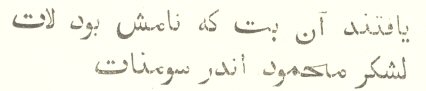
(This image grim, whose name was Laut,
Bold Mahmoud found when he took Sumnaut.)
It is not our intention to follow the conquests of theMahometans from the days of Walid and Mahmoud to those of Timourand Nadir; sufficient to observe, that the greatest part of Indiawas subdued, new monarchies established, and the old religion,though far too powerful and widely spread to be extirpated, wasto a considerable extent abashed and humbled before the brightrising sun of Islam. The Persian language, which theconquerors [324] of whatever denomination introducedwith them to Hindustan, and which their descendants at thepresent day still retain, though not lords of the ascendant,speedily became widely extended in these regions, where it hadpreviously been unknown. As the language of the court, itwas of course studied and acquired by all those natives whosewealth, rank, and influence necessarily brought them intoconnection with the ruling powers; and as the language of thecamp, it was carried into every part of the country where theduties of the soldiery sooner or later conducted them; the resultof which relations between the conquerors and conquered was theadoption into the popular dialects of India of an infinity ofmodern Persian words, not merely those of science, such as itexists in the East, and of luxury and refinement, but even thosewhich serve to express many of the most common objects,necessities, and ideas, so that at the present day a knowledge ofthe Persian is essential for the thorough understanding of theprincipal dialects of Hindustan, on which account, as well as forthe assistance which it affords in communication with theMahometans, it is cultivated with peculiar care by the presentpossessors of the land.
No surprise, therefore, can be entertained that the speech ofthe Gitános in general, who, in all probability, departedfrom Hindustan long subsequent to the first Mahometan invasions,abounds, like other Indian dialects, with words either purelyPersian, or slightly modified to accommodate them to the geniusof the language. Whether the Rommany originally constitutedpart of the natives of Multan or Guzerat, and abandoned theirnative land to escape from the torch and sword of Tamerlane andhis Mongols, as Grellmann and others have supposed, or whether,as is much more probable, they were a thievish caste, like someothers still to be found in Hindustan, who fled westward, eitherfrom the vengeance of justice, or in pursuit of plunder, theirspeaking Persian is alike satisfactorily accounted for. With the view of exhibiting how closely their language isconnected with the Sanscrit and Persian, we subjoin the first tennumerals in the three tongues, those of the Gypsy according tothe Hungarian dialect. [325a]
| Gypsy. | Persian. | Sanscrit. [325b] |
1 | Jek | Ek | Ega |
2 | Dui | Du | Dvaya |
3 | Trin | Se | Treya |
4 | Schtar | Chehar | Tschatvar |
5 | Pansch | Pansch | Pantscha |
6 | Tschov | Schesche | Schasda |
7 | Efta | Heft | Sapta |
8 | Ochto | Hescht | Aschta |
9 | Enija | Nu | Nava |
10 | Dösch | De | Dascha |
It would be easy for us to adduce a thousand instances, asstriking as the above, of the affinity of the Gypsy tongue to thePersian, Sanscrit, and the Indian dialects, but we have not spacefor further observation on a point which long since has beensufficiently discussed by others endowed with abler pens than ourown; but having made these preliminary remarks, which we deemednecessary for the elucidation of the subject, we now hasten tospeak of the Gitáno language as used in Spain, and todetermine, by its evidence (and we again repeat, that thelanguage is the only criterion by which the question can bedetermined), how far the Gitános of Spain are entitled toclaim connection with the tribes who, under the names ofZingáni, etc., are to be found in various parts of Europe,following, in general, a life of wandering adventure, andpractising the same kind of thievish arts which enable those inSpain to obtain a livelihood at the expense of the more honestand industrious of the community.
The Gitános of Spain, as already stated, are generallybelieved to be the descendants of the Moriscos, and have beenasserted to be such in printed books. [326] Now they are known to speak alanguage or jargon amongst themselves which the other natives ofSpain do not understand; of course, then, supposing them to be ofMorisco origin, the words of this tongue or jargon, which are notSpanish, are the relics of the Arabic or Moorish tongue oncespoken in Spain, which they have inherited from their Moorishancestors. Now it is well known, that the Moorish of Spainwas the same tongue as that spoken at present by the Moors ofBarbary, from which country Spain was invaded by the Arabs, andto which they again retired when unable to maintain their groundagainst the armies of the Christians. We will, therefore,collate the numerals of the Spanish Gitáno with those ofthe Moorish tongue, preceding both with those of the HungarianGypsy, of which we have already made use, for the purpose ofmaking clear the affinity of that language to the Sanscrit andPersian. By this collation we shall at once perceivewhether the Gitáno of Spain bears most resemblance to theArabic, or the Rommany of other lands.
| Hungarian | Spanish | Moorish |
1 | Jek | Yeque | Wahud |
2 | Dui | Dui | Snain |
3 | Trin | Trin | Slatza |
4 | Schtar | Estar | Arba |
5 | Pansch | Pansche | Khamsa |
6 | Tschov | Job. Zoi | Seta |
7 | Efta | Hefta | Sebéa |
8 | Ochto | Otor | Sminía |
9 | Enija | Esnia (Nu. Pers.) | Tussa |
10 | Dösch | Deque | Aschra |
We believe the above specimens will go very far to change theopinion of those who have imbibed the idea that theGitános of Spain are the descendants of Moors, and are ofan origin different from that of the wandering tribes of Rommanyin other parts of the world, the specimens of the two dialects ofthe Gypsy, as far as they go, being so strikingly similar, as toleave no doubt of their original identity, whilst, on thecontrary, with the Moorish neither the one nor the other exhibitsthe slightest point of similarity or connection. But withthese specimens we shall not content ourselves, but proceed togive the names of the most common things and objects in theHungarian and Spanish Gitáno, collaterally, with theirequivalents in the Moorish Arabic; from which it will appear thatwhilst the former are one and the same language, they are inevery respect at variance with the latter. When we considerthat the Persian has adopted so many words and phrases from theArabic, we are at first disposed to wonder that a considerableportion of these words are not to be discovered in every dialectof the Gypsy tongue, since the Persian has lent it so much of itsvocabulary. Yet such is by no means the case, as it is veryuncommon, in any one of these dialects, to discover words derivedfrom the Arabic. Perhaps, however, the followingconsideration will help to solve this point. TheGitános, even before they left India, were probably muchthe same rude, thievish, and ignorant people as they are at thepresent day. Now the words adopted by the Persian from theArabic, and which it subsequently introduced into the dialects ofIndia, are sounds representing objects and ideas with which sucha people as the Gitános could necessarily be but scantilyacquainted, a people whose circle of ideas only embraces physicalobjects, and who never commune with their own minds, nor exertthem but in devising low and vulgar schemes of pillage anddeceit. Whatever is visible and common is seldom or neverrepresented by the Persians, even in their books, by the help ofArabic words: the sun and stars, the sea and river, the earth,its trees, its fruits, its flowers, and all that it produces andsupports, are seldom named by them by other terms than thosewhich their own language is capable of affording; but inexpressing the abstract thoughts of their minds, and they are apeople who think much and well, they borrow largely from thelanguage of their religion—the Arabic. We therefore,perhaps, ought not to be surprised that in the scanty phraseologyof the Gitános, amongst so much Persian, we find so littlethat is Arabic; had their pursuits been less vile, their desiresless animal, and their thoughts less circumscribed, it wouldprobably have been otherwise; but from time immemorial they haveshown themselves a nation of petty thieves, horse-traffickers,and the like, without a thought of the morrow, being content toprovide against the evil of the passing day.
The following is a comparison of words in the threelanguages:—
| Hungarian | Spanish | Moorish |
Bone | Cokalos | Cocal | Adorn |
City | Forjus | Foros | Beled |
Day | Dives | Chibes | Youm |
Drink (to) | Piava | Piyar | Yeschrab |
Ear | Kan | Can | Oothin |
Eye | Jakh | Aquia | Ein |
Feather | Por | Porumia | Risch |
Fire | Vag | Yaque | Afia |
Fish | Maczo | Macho | Hutz |
Foot | Pir | Piro, pindro | Rjil |
Gold | Sonkai | Sonacai | Dahab |
Great | Baro | Baro | Quibír |
Hair | Bala | Bal | Schar |
He, pron. | Wow | O | Hu |
Head | Tschero | Jero | Ras |
House | Ker | Quer | Dar |
Husband | Rom | Ron | Zooje |
Lightning | Molnija | Malunó | Brak |
Love (to) | Camaba | Camelar | Yehib |
Man | Manusch | Manu | Rajil |
Milk | Tud | Chuti | Helib |
Mountain | Bar | Bur | Djibil |
Mouth | Mui | Mui | Fum |
Name | Nao | Nao | Ism |
Night | Rat | Rachi | Lila |
Nose | Nakh | Naqui | Munghár |
Old | Puro | Puro | Shaive |
Red | Lal | Lalo | Hamr |
Salt | Lon | Lon | Mela |
Sing | Gjuwawa | Gilyabar | Iganni |
Sun | Cam | Can | Schems |
Thief | Tschor | Choro | Harám |
Thou | Tu | Tucue | Antsin |
Tongue | Tschib | Chipe | Lsán |
Tooth | Dant | Dani | Sinn |
Tree | Karscht | Caste | Schizara |
Water | Pani | Pani | Ma |
Wind | Barbar | Barban | Ruhk |
We shall offer no further observations respecting the affinityof the Spanish Gitáno to the other dialects, as weconceive we have already afforded sufficient proof of itsoriginal identity with them, and consequently shaken to theground the absurd opinion that the Gitános of Spain arethe descendants of the Arabs and Moriscos. We shall nowconclude with a few remarks on the present state of theGitáno language in Spain, where, perhaps, within thecourse of a few years, it will have perished, without leaving avestige of its having once existed; and where, perhaps, thesingular people who speak it are likewise doomed to disappear,becoming sooner or later engulfed and absorbed in the great bodyof the nation, amongst whom they have so long existed a separateand peculiar class.
Though the words or a part of the words of the original tonguestill remain, preserved by memory amongst the Gitános, itsgrammatical peculiarities have disappeared, the entire languagehaving been modified and subjected to the rules of Spanishgrammar, with which it now coincides in syntax, in theconjugation of verbs, and in the declension of its nouns. Were it possible or necessary to collect all the relics of thisspeech, they would probably amount to four or five thousandwords; but to effect such an achievement, it would be necessaryto hold close and long intercourse with almost everyGitáno in Spain, and to extract, by various means, thepeculiar information which he might be capable of affording; forit is necessary to state here, that though such an amount ofwords may still exist amongst the Gitános in general, nosingle individual of their sect is in possession of one-thirdpart thereof, nor indeed, we may add, those of any single city orprovince of Spain; nevertheless all are in possession, more orless, of the language, so that, though of different provinces,they are enabled to understand each other tolerably well, whendiscoursing in this their characteristic speech. Those whotravel most are of course best versed in it, as, independent ofthe words of their own village or town, they acquire others byintermingling with their race in various places. Perhapsthere is no part of Spain where it is spoken better than inMadrid, which is easily accounted for by the fact, that Madrid,as the capital, has always been the point of union of theGitános, from all those provinces of Spain where they areto be found. It is least of all preserved in Seville,notwithstanding that its Gitáno population is veryconsiderable, consisting, however, almost entirely of natives ofthe place. As may well be supposed, it is in all placesbest preserved amongst the old people, their children beingcomparatively ignorant of it, as perhaps they themselves are incomparison with their own parents. We are persuaded thatthe Gitáno language of Spain is nearly at its last stageof existence, which persuasion has been our main instigator tothe present attempt to collect its scanty remains, and by theassistance of the press, rescue it in some degree fromdestruction. It will not be amiss to state here, that it isonly by listening attentively to the speech of theGitános, whilst discoursing amongst themselves, that anacquaintance with their dialect can be formed, and by seizingupon all unknown words as they fall in succession from theirlips. Nothing can be more useless and hopeless than theattempt to obtain possession of their vocabulary by inquiring ofthem how particular objects and ideas are styled; for with theexception of the names of the most common things, they aretotally incapable, as a Spanish writer has observed, of yieldingthe required information, owing to their great ignorance, theshortness of their memories, or rather the state of bewildermentto which their minds are brought by any question which tends tobring their reasoning faculties into action, though notunfrequently the very words which have been in vain required ofthem will, a minute subsequently, proceed inadvertently fromtheir mouths.
We now take leave of their language. When wishing topraise the proficiency of any individual in their tongue, theyare in the habit of saying, ‘He understands the sevenjargons.’ In the Gospel which we have printed in thislanguage, and in the dictionary which we have compiled, we haveendeavoured, to the utmost of our ability, to deserve thatcompliment; and at all times it will afford us sincere andheartfelt pleasure to be informed that any Gitáno, capableof appreciating the said little works, has observed, whilstreading them or hearing them read: It is clear that the writer ofthese books understood
The SevenJargons.
p. 335ONROBBER LANGUAGE; OR, AS IT IS CALLED IN SPAIN, GERMANIA
‘So I went with them to a music booth, wherethey made me almost drunk with gin, and began to talk theirFlash Language, which I did notunderstand.’—Narrative of the Exploits of HenrySimms, executed at Tyburn, 1746.
‘Hablaronse los dos en Germania, de lo qualresultó darme un abraço, yofrecerseme.’—Quevedo. Vida dal granTacaño.
Having in the preceding articleendeavoured to afford all necessary information concerning theRommany, or language used by the Gypsies amongst themselves, wenow propose to turn our attention to a subject of no lessinterest, but which has hitherto never been treated in a mannercalculated to lead to any satisfactory result or conclusion; onthe contrary, though philosophic minds have been engaged in itsconsideration, and learned pens have not disdained to occupythemselves with its details, it still remains a singular proof ofthe errors into which the most acute and laborious writers areapt to fall, when they take upon themselves the task of writingon matters which cannot be studied in the closet, and on which noinformation can be received by mixing in the society of the wise,the lettered, and the respectable, but which must be investigatedin the fields, and on the borders of the highways, in prisons,and amongst the dregs of society. Had the latter systembeen pursued in the matter now before us, much clearer, morerational, and more just ideas would long since have beenentertained respecting the Germania, or language of thieves.
In most countries of Europe there exists, amongst those whoobtain their existence by the breach of the law, and by preyingupon the fruits of the labours of the quiet and orderly portionof society, a particular jargon or dialect, in which the formerdiscuss their schemes and plans of plunder, without being ingeneral understood by those to whom they are obnoxious. Thename of this jargon varies with the country in which it isspoken. In Spain it is called ‘Germania’; inFrance, ‘Argot’; in Germany,‘Rothwelsch,’ or Red Italian; in Italy,‘Gergo’; whilst in England it is known by many names;for example, ‘cant, slang, thieves’ Latin,’etc. The most remarkable circumstance connected with thehistory of this jargon is, that in all the countries in which itis spoken, it has invariably, by the authors who have treated ofit, and who are numerous, been confounded with the Gypsylanguage, and asserted to be the speech of those wanderers whohave so long infested Europe under the name of Gitános,etc. How far this belief is founded in justice we shall nowendeavour to show, with the premise that whatever we advance isderived, not from the assertions or opinions of others, but fromour own observation; the point in question being one which noperson is capable of solving, save him who has mixed withGitános and thieves,—not with the former merely orthe latter, but with both.
We have already stated what is the Rommany or language of theGypsies. We have proved that when properly spoken it is toall intents and purposes entitled to the appellation of alanguage, and that wherever it exists it is virtually the same;that its origin is illustrious, it being a daughter of theSanscrit, and in consequence in close connection with some of themost celebrated languages of the East, although it at present isonly used by the most unfortunate and degraded of beings,wanderers without home and almost without country, as whereverthey are found they are considered in the light of foreigners andinterlopers. We shall now state what the language ofthieves is, as it is generally spoken in Europe; after which weshall proceed to analyse it according to the various countries inwhich it is used.
The dialect used for their own peculiar purposes amongstthieves is by no means entitled to the appellation of a language,but in every sense to that of a jargon or gibberish, it being forthe most part composed of words of the native language of thosewho use it, according to the particular country, thoughinvariably in a meaning differing more or less from the usual andreceived one, and for the most part in a metaphoricalsense. Metaphor and allegory, indeed, seem to form thenucleus of this speech, notwithstanding that other elements areto be distinguished; for it is certain that in every countrywhere it is spoken, it contains many words differing from thelanguage of that country, and which may either be traced toforeign tongues, or are of an origin at which, in many instances,it is impossible to arrive. That which is most calculatedto strike the philosophic mind when considering this dialect, isdoubtless the fact of its being formed everywhere upon the sameprinciple—that of metaphor, in which point all the branchesagree, though in others they differ as much from each other asthe languages on which they are founded; for example, as theEnglish and German from the Spanish and Italian. Thiscircumstance naturally leads to the conclusion that the robberlanguage has not arisen fortuitously in the various countrieswhere it is at present spoken, but that its origin is one and thesame, it being probably invented by the outlaws of one particularcountry; by individuals of which it was, in course of time,carried to others, where its principles, if not its words, wereadopted; for upon no other supposition can we account for itsgeneral metaphorical character in regions various anddistant. It is, of course, impossible to state withcertainty the country in which this jargon first arose, yet thereis cogent reason for supposing that it may have been Italy. The Germans call it Rothwelsch, which signifies ‘RedItalian,’ a name which appears to point out Italy as itsbirthplace; and which, though by no means of sufficientimportance to determine the question, is strongly corroborativeof the supposition, when coupled with the following fact. We have already intimated, that wherever it is spoken, thisspeech, though composed for the most part of words of thelanguage of the particular country, applied in a metaphoricalsense, exhibits a considerable sprinkling of foreign words; nowof these words no slight number are Italian or bastard Latin,whether in Germany, whether in Spain, or in other countries moreor less remote from Italy. When we consider the ignoranceof thieves in general, their total want of education, the slightknowledge which they possess even of their mother tongue, it ishardly reasonable to suppose that in any country they were evercapable of having recourse to foreign languages, for the purposeof enriching any peculiar vocabulary or phraseology which theymight deem convenient to use among themselves; nevertheless, byassociating with foreign thieves, who had either left theirnative country for their crimes, or from a hope of reaping a richharvest of plunder in other lands, it would be easy for them toadopt a considerable number of words belonging to the languagesof their foreign associates, from whom perhaps they derived anincrease of knowledge in thievish arts of everydescription. At the commencement of the fifteenth centuryno nation in Europe was at all calculated to vie with the Italianin arts of any kind, whether those whose tendency was the benefitor improvement of society, or those the practice of which servesto injure and undermine it. The artists and artisans ofItaly were to be found in all the countries of Europe, fromMadrid to Moscow, and so were its charlatans, its jugglers, andmultitudes of its children, who lived by fraud and cunning. Therefore, when a comprehensive view of the subject is taken,there appears to be little improbability in supposing, that notonly were the Italians the originators of the metaphorical robberjargon, which has been termed ‘Red Italian,’ but thatthey were mainly instrumental in causing it to be adopted by thethievish race in various countries of Europe.
It is here, however, necessary to state, that in the robberjargon of Europe, elements of another language are to bediscovered, and perhaps in greater number than the Italianwords. The language which we allude to is the Rommany; thislanguage has been, in general, confounded with the vocabularyused among thieves, which, however, is a gross error, so gross,indeed, that it is almost impossible to conceive the manner inwhich it originated: the speech of the Gypsies being a genuinelanguage of Oriental origin, and the former little more than aphraseology of convenience, founded upon particular Europeantongues. It will be sufficient here to remark, that theGypsies do not understand the jargon of the thieves, whilst thelatter, with perhaps a few exceptions, are ignorant of thelanguage of the former. Certain words, however, of theRommany have found admission into the said jargon, which may beaccounted for by the supposition that the Gypsies, beingthemselves by birth, education, and profession, thieves of thefirst water, have, on various occasions, formed alliances withthe outlaws of the various countries in which they are at presentto be found, which association may have produced the result abovealluded to; but it will be as well here to state, that in nocountry of Europe have the Gypsies forsaken or forgotten theirnative tongue, and in its stead adopted the‘Germania,’ ‘Red Italian,’ or robberjargon, although in some they preserve their native language in astate of less purity than in others. We are induced to makethis statement from an assertion of the celebrated LorenzoHervas, who, in the third volume of his Catalogo de lasLenguas, trat. 3, cap. vi., p. 311, expresses himself to thefollowing effect:—‘The proper language of theGitános neither is nor can be found amongst those whoscattered themselves through the western kingdoms of Europe, butonly amongst those who remained in the eastern, where they arestill to be found. The former were notably divided anddisunited, receiving into their body a great number of Europeanoutlaws, on which account the language in question was easilyadulterated and soon perished. In Spain, and also in Italy,the Gitános have totally forgotten and lost their nativelanguage; yet still wishing to converse with each other in alanguage unknown to the Spaniards and Italians, they haveinvented some words, and have transformed many others by changingthe signification which properly belongs to them in Spanish andItalian.’ In proof of which assertion he thenexhibits a small number of words of the ‘RedItalian,’ or allegorical tongue of the thieves ofItaly.
It is much to be lamented that a man like Hervas, so learned,of such knowledge, and upon the whole well-earned celebrity,should have helped to propagate three such flagrant errors as arecontained in the passages above quoted: 1st. That the Gypsylanguage, within a very short period after the arrival of thosewho spoke it in the western kingdoms of Europe, became corrupted,and perished by the admission of outlaws into the Gypsyfraternity. 2ndly. That the Gypsies, in order tosupply the loss of their native tongue, invented some words, andmodified others, from the Spanish and Italian. 3rdly. That the Gypsies of the present day in Spain and Italy speak theallegorical robber dialect. Concerning the first assertion,namely, that the Gypsies of the west lost their language shortlyafter their arrival, by mixing with the outlaws of those parts,we believe that its erroneousness will be sufficientlyestablished by the publication of the present volume, whichcontains a dictionary of the Spanish Gitáno, which we haveproved to be the same language in most points as that spoken bythe eastern tribes. There can be no doubt that the Gypsieshave at various times formed alliances with the robbers ofparticular countries, but that they ever received them inconsiderable numbers into their fraternity, as Hervas has stated,so as to become confounded with them, the evidence of oureyesight precludes the possibility of believing. If suchwere the fact, why do the Italian and Spanish Gypsies of thepresent day still present themselves as a distinct race,differing from the other inhabitants of the west of Europe infeature, colour, and constitution? Why are they, inwhatever situation and under whatever circumstances, to bedistinguished, like Jews, from the other children of theCreator? But it is scarcely necessary to ask such aquestion, or indeed to state that the Gypsies of Spain and Italyhave kept themselves as much apart as, or at least have as littlemingled their blood with the Spaniards and Italians as theirbrethren in Hungaria and Transylvania with the inhabitants ofthose countries, on which account they still strikingly resemblethem in manners, customs, and appearance. The mostextraordinary assertion of Hervas is perhaps his second, namely,that the Gypsies have invented particular words to supply theplace of others which they had lost. The absurdity of thissupposition nearly induces us to believe that Hervas, who haswritten so much and so laboriously on language, was totallyignorant of the philosophy of his subject. There can be nodoubt, as we have before admitted, that in the robber jargon,whether spoken in Spain, Italy, or England, there are many wordsat whose etymology it is very difficult to arrive; yet such afact is no excuse for the adoption of the opinion that thesewords are of pure invention. A knowledge of the Rommanyproves satisfactorily that many have been borrowed from thatlanguage, whilst many others may be traced to foreign tongues,especially the Latin and Italian. Perhaps one of thestrongest grounds for concluding that the origin of language wasdivine is the fact that no instance can be adduced of theinvention, we will not say of a language, but even of a singleword that is in use in society of any kind. Although newdialects are continually being formed, it is only by a system ofmodification, by which roots almost coeval with time itself arecontinually being reproduced under a fresh appearance, and undernew circumstances. The third assertion of Hervas, as to theGitános speaking the allegorical language of which heexhibits specimens, is entitled to about equal credence as thetwo former. The truth is, that the entire store oferudition of the learned Jesuit, and he doubtless was learned toa remarkable degree, was derived from books, either printed ormanuscript. He compared the Gypsy words in the publicationof Grellmann with various vocabularies, which had long been inexistence, of the robber jargons of Spain and Italy, whichjargons by a strange fatuity had ever been considered asbelonging to the Gypsies. Finding that the Gypsy words ofGrellmann did not at all correspond with the thieves’slang, he concluded that the Gypsies of Spain and Italy hadforgotten their own language, and to supply its place hadinvented the jargons aforesaid, but he never gave himself thetrouble to try whether the Gypsies really understood the contentsof his slang vocabularies; had he done so, he would have foundthat the slang was about as unintelligible to the Gypsies as hewould have found the specimens of Grellmann unintelligible to thethieves had he quoted those specimens to them. The Gypsiesof Spain, it will be sufficient to observe, speak the language ofwhich a vocabulary is given in the present work, and those ofItaly who are generally to be found existing in a half-savagestate in the various ruined castles, relics of the feudal times,with which Italy abounds, a dialect very similar, and about asmuch corrupted. There are, however, to be continually foundin Italy roving bands of Rommany, not natives of the country, whomake excursions from Moldavia and Hungaria to France and Italy,for the purpose of plunder; and who, if they escape the hand ofjustice, return at the expiration of two or three years to theirnative regions, with the booty they have amassed by the practiceof those thievish arts, perhaps at one period peculiar to theirrace, but at present, for the most part, known and practised bythieves in general. These bands, however, speak the pureGypsy language, with all its grammatical peculiarities. Itis evident, however, that amongst neither of these classes hadHervas pushed his researches, which had he done, it is probablethat his investigations would have resulted in a work of a fardifferent character from the confused, unsatisfactory, andincorrect details of which is formed his essay on the language ofthe Gypsies.
Having said thus much concerning the robber language ingeneral, we shall now proceed to offer some specimens of it, inorder that our readers may be better able to understand itsprinciples. We shall commence with the Italian dialect,which there is reason for supposing to be the prototype of therest. To show what it is, we avail ourselves of some of thewords adduced by Hervas, as specimens of the language of theGitános of Italy. ‘I place them,’ heobserves, ‘with the signification which the greater numberproperly have in Italian.’
| Robber jargon of Italy. | Proper signification of the words. |
Arm | Ale / Barbacane | Wings / Barbican |
Belly | Fagiana | Pheasant |
Devil | Rabuino | Perhaps Rabbin, which, in Hebrew, is Master |
Earth | Calcosa | Street, road |
Eye | Balco | Balcony |
Father | Grimo | Old, wrinkled |
Fire | Presto | Quick |
God | Anticrotto | Probably Antichrist |
Hair | Prusa [346a] |
|
Head | Elmo / Borella [346b] / Chiurla [346c] | Helmet |
Heart | Salsa | Sauce |
Man | Osmo | From the Italian uomo, which is man |
Moon | Mocoloso di Sant’ Alto | Wick of the firmament |
Night | Brunamaterna | Mother-brown |
Nose | Gambaro | Crab |
Sun | Ruffo di Sant’ Alto | Red one of the firmament |
Tongue | Serpentina / Danosa | Serpent-like / Hurtful |
Water | Lenza / Vetta [346d] | Fishing-net / Top, bud |
The Germania of Spain may be said to divide itself into twodialects, the ancient and modern. Of the former thereexists a vocabulary, published first by Juan Hidalgo, in the year1609, at Barcelona, and reprinted in Madrid, 1773. Beforenoticing this work, it will perhaps be advisable to endeavour toascertain the true etymology of the word Germania, whichsignifies the slang vocabulary, or robber language ofSpain. We have no intention to embarrass our readers byoffering various conjectures respecting its origin; its sound,coupled with its signification, affording sufficient evidencethat it is but a corruption of Rommany, which properly denotesthe speech of the Roma or Gitános. The thieves whofrom time to time associated with this wandering people, andacquired more or less of their language, doubtless adopted thisterm amongst others, and, after modifying it, applied it to thepeculiar phraseology which, in the course of time, becameprevalent amongst them. The dictionary of Hidalgo isappended to six ballads, or romances, by the same author, writtenin the Germanian dialect, in which he describes the robber lifeat Seville at the period in which he lived. All of theseromances possess their peculiar merit, and will doubtless alwaysbe considered valuable, and be read as faithful pictures ofscenes and habits which now no longer exist. In theprologue, the author states that his principal motive forpublishing a work written in so strange a language was hisobserving the damage which resulted from an ignorance of theGermania, especially to the judges and ministers of justice,whose charge it is to cleanse the public from the perniciousgentry who use it. By far the greatest part of thevocabulary consists of Spanish words used allegorically, whichare, however, intermingled with many others, most of which may betraced to the Latin and Italian, others to the Sanscrit orGitáno, Russian, Arabic, Turkish, Greek, and Germanlanguages. [348] The circumstances of wordsbelonging to some of the languages last enumerated being found inthe Gitáno, which at first may strike the reader assingular, and almost incredible, will afford but slight surprise,when he takes into consideration the peculiar circumstances ofSpain during the sixteenth and seventeenth centuries. Spainwas at that period the most powerful monarchy in Europe; her footreposed upon the Low Countries, whilst her gigantic arms embraceda considerable portion of Italy. Maintaining always astanding army in Flanders and in Italy, it followed as a naturalconsequence, that her Miquelets and soldiers became tolerablyconversant with the languages of those countries; and, in courseof time, returning to their native land, not a few, especially ofthe former class, a brave and intrepid, but always a lawless anddissolute species of soldiery, either fell in or returned to evilsociety, and introduced words which they had learnt abroad intothe robber phraseology; whilst returned galley-slaves fromAlgiers, Tunis, and Tetuan, added to its motley variety of wordsfrom the relics of the broken Arabic and Turkish, which they hadacquired during their captivity. The greater part of theGermania, however, remained strictly metaphorical, and we areaware of no better means of conveying an idea of the principle onwhich it is formed, than by quoting from the first romance ofHidalgo, where particular mention is made of thisjargon:—
‘A la cama llama Blanda
Donde Sornan en poblado
A la Fresada Vellosa,
Que mucho vello ha criado.
Dice á la sabana Alba
Porque es alba en sumo grado,
A la camisa Carona,
Al jubon llama apretado:
Dice al Sayo Tapador
Porque le lleva tapado.
Llama á los zapatos Duros,
Que las piedras van pisando.
A la capa llama nuve,
Dice al Sombrero Texado.
Respeto llama á la Espada,
Que por ella es respetado,’ etc. etc.Hidalgo,p. 22–3.
After these few remarks on the ancient Germania of Spain, wenow proceed to the modern, which differs considerably from theformer. The principal cause of this difference is to beattributed to the adoption by the Spanish outlaws, in latteryears, of a considerable number of words belonging to, ormodified from, the Rommany, or language of theGitános. The Gitános of Spain, during thelast half-century, having, in a great degree, abandoned thewandering habit of life which once constituted one of their mostremarkable peculiarities, and residing, at present, more in thecities than in the fields, have come into closer contact with thegreat body of the Spanish nation than was in former days theirpractice. From their living thus in towns, their languagehas not only undergone much corruption, but has become, to aslight degree, known to the dregs of society, amongst whom theyreside. The thieves’ dialect of the present dayexhibits, therefore, less of the allegorical language preservedin the pages of Hidalgo than of the Gypsy tongue. It mustbe remarked, however, that it is very scanty, and that the wholerobber phraseology at present used in Spain barely amounts to twohundred words, which are utterly insufficient to express the verylimited ideas of the outcasts who avail themselves of it.
Concerning the Germania of France, or ‘Argot,’ asit is called, it is unnecessary to make many observations, aswhat has been said of the language of Hidalgo and the Red Italianis almost in every respect applicable to it. As early asthe middle of the sixteenth century a vocabulary of this jargonwas published under the title of Langue des Escrocs, atParis. Those who wish to study it as it at present existscan do no better than consult Les Mémoires deVidocq, where a multitude of words in Argot are to be found,and also several songs, the subjects of which are thievishadventures.
The first vocabulary of the ‘Cant Language,’ orEnglish Germania, appeared in the year 1680, appended to the lifeof The English Rogue, a work which, in many respects,resembles the History of Guzman d’Alfaráche,though it is written with considerably more genius than theSpanish novel, every chapter abounding with remarkable adventuresof the robber whose life it pretends to narrate, and which aredescribed with a kind of ferocious energy, which, if it do notcharm the attention of the reader, at least enslaves it, holdingit captive with a chain of iron. Amongst his otheradventures, the hero falls in with a Gypsy encampment, isenrolled amongst the fraternity, and is allotted a‘mort,’ or concubine; a barbarous festival ensues, atthe conclusion of which an epithalamium is sung in the Gypsylanguage, as it is called in the work in question. Neitherthe epithalamium, however, nor the vocabulary, are written in thelanguage of the English Gypsies, but in the ‘Cant,’or allegorical robber dialect, which is sufficient proof that thewriter, however well acquainted with thieves in general, theircustoms and manners of life, was in respect to the Gypsiesprofoundly ignorant. His vocabulary, however, has beenalways accepted as the speech of the English Gypsies, whereas itis at most entitled to be considered as the peculiar speech ofthe thieves and vagabonds of his time. The cant of thepresent day, which, though it differs in some respects from thevocabulary already mentioned, is radically the same, is used notonly by the thieves in town and country, but by the jockeys ofthe racecourse and the pugilists of the ‘ring.’ As aspecimen of the cant of England, we shall take the liberty ofquoting the epithalamium to which we have abovealluded:—
‘Bing out, bien morts, and tour and tour
Bing out, bien morts and tour;
For all your duds are bing’d awast,
The bien cove hath the loure. [351]‘I met a dell, I viewed her well,
She was benship to my watch:
So she and I did stall and cloy
Whatever we could catch.‘This doxy dell can cut ben whids,
And wap well for a win,
And prig and cloy so benshiply,
All daisy-ville within.‘The hoyle was up, we had good luck,
In frost for and in snow;
Men they did seek, then we did creep
And plant the roughman’s low.’
It is scarcely necessary to say anything more upon theGermania in general or in particular; we believe that we haveachieved the task which we marked out for ourselves, and haveconveyed to our readers a clear and distinct idea of what itis. We have shown that it has been erroneously confoundedwith the Rommany, or Gitáno language, with which it hasnevertheless some points of similarity. The two languagesare, at the present day, used for the same purpose, namely, toenable habitual breakers of the law to carry on theirconsultations with more secrecy and privacy than by the ordinarymeans. Yet it must not be forgotten that the thieves’jargon was invented for that purpose, whilst the Rommany,originally the proper and only speech of a particular nation, hasbeen preserved from falling into entire disuse and oblivion,because adapted to answer the same end. It was impossibleto treat of the Rommany in a manner calculated to exhaust thesubject, and to leave no ground for future cavilling, withoutdevoting a considerable space to the consideration of the robberdialect, on which account we hope we shall be excused many of thedry details which we have introduced into the presentessay. There is a link of connection between the history ofthe Roma, or wanderers from Hindustan, who first made theirappearance in Europe at the commencement of the fifteenthcentury, and that of modern roguery. Many of the arts whichthe Gypsies proudly call their own, and which were perhaps at oneperiod peculiar to them, have become divulged, and are nowpractised by the thievish gentry who infest the various Europeanstates, a result which, we may assert with confidence, wasbrought about by the alliance of the Gypsies being eagerly soughton their first arrival by the thieves, who, at one period, wereless skilful than the former in the ways of deceit and plunder;which kind of association continued and held good until thethieves had acquired all they wished to learn, when they left theGypsies in the fields and plains, so dear to them from theirvagabond and nomad habits, and returned to the towns andcities. Yet from this temporary association were producedtwo results; European fraud became sharpened by coming intocontact with Asiatic craft, whilst European tongues, byimperceptible degrees, became recruited with various words (someof them wonderfully expressive), many of which have long beenstumbling-stocks to the philologist, who, whilst stigmatisingthem as words of mere vulgar invention, or of unknown origin, hasbeen far from dreaming that by a little more research he mighthave traced them to the Sclavonic, Persian, or Romaic, or perhapsto the mysterious object of his veneration, the Sanscrit, p. 354the sacredtongue of the palm-covered regions of Ind; words originallyintroduced into Europe by objects too miserable to occupy for amoment his lettered attention—the despised denizens of thetents of Roma.
ON THE TERM ‘BUSNO’
Those who have done me the honour to peruse this strangewandering book of mine, must frequently have noticed the word‘Busno,’ a term bestowed by the Spanish Gypsy on hisgood friend the Spaniard. As the present will probably bethe last occasion which I shall have to speak of theGitános or anything relating to them, it will perhaps beadvisable to explain the meaning of this word. In thevocabulary appended to former editions I have translated Busno bysuch words as Gentile, savage, person who is not a Gypsy, andhave stated that it is probably connected with a certain Sanscritnoun signifying an impure person. It is, however, derivedimmediately from a Hungarian term, exceedingly common amongst thelower orders of the Magyars, to their disgrace be itspoken. The Hungarian Gypsies themselves not unfrequentlystyle the Hungarians Busnoes, in ridicule of their unceasing useof the word in question. The first Gypsies who enteredSpain doubtless brought with them the term from Hungary, thelanguage of which country they probably understood to a certainextent. That it was not ill applied by them in Spain no onewill be disposed to deny when told that it exactly correspondswith the Shibboleth of the Spaniards, ‘Carajo,’ anoath equally common in Spain as its equivalent in Hungary. Busno, therefore, in Spanish means El del carajo, or hewho has that term continually in his mouth. The Hungarianwords in Spanish Gypsy may amount to ten or twelve, a veryinconsiderable number; but the Hungarian Gypsy tongue itself, asspoken at the present day, exhibits only a slight sprinkling ofHungarian words, whilst it contains many words borrowed from theWallachian, some of which have found their way into Spain, andare in common use amongst the Gitános.
p.357SPECIMENS OF GYPSY DIALECTS
THE ENGLISH DIALECT OF THE ROMMANY
‘Tachipen if Ijaw ’doi, I can lel a bit of tan to hatch: N’etist Ishan’t puch kekomi wafu gorgies.’
The above sentence, dear reader, I heard from the mouth of Mr.Petulengro, the last time that he did me the honour to visit meat my poor house, which was the day after Mol-divvus [359], 1842: he stayed with me during thegreater part of the morning, discoursing on the affairs of Egypt,the aspect of which, he assured me, was becoming daily worse andworse. ‘There is no living for the poor people,brother,’ said he, ‘the chokengres (police) pursue usfrom place to place, and the gorgios are become either so poor ormiserly, that they grudge our cattle a bite of grass by thewayside, and ourselves a yard of ground to light a fireupon. Unless times alter, brother, and of that I see noprobability, unless you are made either poknees or mecralliskoegeiro (justice of the peace or prime minister), I am afraid thepoor persons will have to give up wandering altogether, and thenwhat will become of them?’
‘However, brother,’ he continued, in a morecheerful tone, ‘I am no hindity mush, [360a] as you well know. I suppose youhave not forgot how, fifteen years ago, when you made horseshoesin the little dingle by the side of the great north road, I lentyou fifty cottors [360b] to purchase thewonderful trotting cob of the innkeeper with the green Newmarketcoat, which three days after you sold for two hundred.
‘Well, brother, if you had wanted the two hundredinstead of the fifty, I could have lent them to you, and wouldhave done so, for I knew you would not be long pazorrhus tome. I am no hindity mush, brother, no Irishman; I laid outthe other day twenty pounds in buying ruponoe peamengries; [360c] and in the Chonggav, [360d] have a house of my own with a yardbehind it.
‘And, forsooth, if I gothither, I can choose a place to light afire upon,and shall have no necessity to ask leave of these hereGentiles.’
Well, dear reader, this last is the translation of the Gypsysentence which heads the chapter, and which is a verycharacteristic specimen of the general way of speaking of theEnglish Gypsies.
The language, as they generally speak it, is a broken jargon,in which few of the grammatical peculiarities of the Rommany areto be distinguished. In fact, what has been said of theSpanish Gypsy dialect holds good with respect to the English ascommonly spoken: yet the English dialect has in reality sufferedmuch less than the Spanish, and still retains its original syntaxto a certain extent, its peculiar manner of conjugating verbs,and declining nouns and pronouns.
ENGLISH DIALECT
Moro Dad, savo djives oteh drey o charos, tecaumen Gorgio ta Romany Chal tiro nav, te awel tiro tem, tekairen tiro lav aukko prey puv, sar kairdios oteh drey ocharos. Dey men to-divvus moro divvuskoe moro, ta for-deymen pazorrhus tukey sar men for-denna len pazorrhus amande; mamuk te petrenna drey caik temptacionos; ley men abri sordoschder. Tiro se o tem, Mi-duvel, tiro o zoozlu vast, tirosor koskopen drey sor cheros. Avali. Ta-chipen.
SPANISH DIALECT
Batu monro sos socabas oté enré yechar, que camele Gacho ta Romani Cha tiro nao, qu’abilleletiro chim, querese tiro lao acoi opré ye puve sarta sequerela oté enré ye char. Diñanossejonia monro manro de cata chibes, ta estormenanos monriasbisauras sasta mu estormenamos a monrias bisabadores; na nosmeques petrar enré cayque pajandia, lillanos abri de sarochungalipen. Persos tiro sinela o chim, Undevel, tiro yesilna bast, tiro saro lachipen enré saro chiros. Unga. Chachipé.
English Translation of theabove
Our Father who dwellest there in heaven, mayGentile and Gypsy love thy name, thy kingdom come, may they dothy word here on earth as it is done there in heaven. Giveus to-day our daily bread, [361a] and forgive usindebted to thee as we forgive them indebted to us, [361b] suffer not that we fall intonotemptation, take us out from all evil. [361c] Thine [361d] is the kingdom my God, thine thestrong hand, thine all goodness in all time. Aye. Truth.
HUNGARIAN DIALECT
The following short sentences in Hungarian Gypsy, in additionto the prayer to the Virgin given in the Introduction, willperhaps not prove unacceptable to the reader. In no part ofthe world is the Gypsy tongue at the present day spoken with morepurity than in Hungary, [362] where it is usedby the Gypsies not only when they wish to be unintelligible tothe Hungarians, but in their common conversation amongstthemselves.
From these sentences the reader, by the help of thetranslations which accompany them, may form a tolerable idea notonly of what the Gypsy tongue is, but of the manner in which theHungarian Gypsies think and express themselves. They arespecimens of genuine Gypsy talk—sentences which I havemyself heard proceed from the mouths of the Czigany; they are notBusno thoughts done into gentle Rommany. Some of them aregiven here as they were written down by me at the time, others asI have preserved them in my memory up to the presentmoment. It is not improbable that at some future time I mayreturn to the subject of the Hungarian Gypsies.
Varé tava soskei me puchelas cai soskei avillaracatári. | Much I ponder why you ask me (questions), and why youshould come hither. |
Mango le gulo Devlas vas o erai, hodj o erai te pirelmisto, te n’avel pascotia l’eras, ta na avel o erainasvalo. | I pray the sweet Goddess for the gentleman, that thegentleman may journey well, that misfortune come not to thegentleman, and that the gentleman fall not sick. |
Cana cames aves pale. | When you please come back. |
Ki’som dhes keral avel o rai catari? [363a] | How many days did the gentleman take to come hither? |
Kit somu berschengro hal tu? [363b] | How many years old are you? |
Cadé abri mai lachi e mol sar ando foro. | Here out better (is) the wine than in the city. |
Sin o mas balichano, ta i gorkhe garasheskri; [363c] sin o manro parno, cai te felo dogarashangro. | The meat is of pig, and the gherkins cost agrosh—the bread is white, and the lard costs twogroshen. |
Yeck quartalli mol ando lende. | One quart of wine amongst us. |
Andé mol oté mestchibo. | In wine there (is) happiness. |
Khava piava—dui shel, tri shel predinava. | I will eat, I will drink—two hundred, three hundredI will place before. |
Damen Devla saschipo ando mure cocala. | Give us Goddess health in our bones. |
Te rosarow labio tarraco le Mujeskey miro pralesco, tavela mi anao tukey le Mujeskey miro pralesky. | I will seek a waistcoat, which I have, for Moses mybrother, and I will change names with Moses my brother. [363d] |
Llundun baro foro, bishwar mai baro sar Cosvaro. | London (is) a big city, twenty times more big thanColosvar. |
Nani yag, mullas. | There is no fire, it is dead. |
Nasiliom cai purdiom but; besh te pansch bersch mi homasslugadhis pa Baron Splini regimentos. | I have suffered and toiled much: twenty and five years Iwas serving in Baron Splini’s regiment. |
Saro chiro cado Del; cavo o puro diñas o Del. | Every time (cometh) from God; that old (age) God gave. |
Me camov te jav ando Buka-resti—cado Bukarestilachico tem dur drom jin keri. | I wish to go unto Bukarest—from Bukarest, the goodcountry, (it is) a far way unto (my) house. |
Mi hom nasvallo. | I am sick. |
Soskei nai jas ke baro ful-cheri? | Why do you not go to the great physician |
Wei mangue ke nani man lové nastis jav. | Because I have no money I can’t go |
Belgra sho mille pu cado Cosvarri; hin oter mirochabo. | Belgrade (is) six miles of land from Colosvar; there is myson. |
Te vas Del l’erangue ke meclan man abri ando apan-dibo. | May God help the gentlemen that they let me out (from) inthe prison. |
Opré rukh sarkhi ye chiriclo, ca kerel anre echiricli. | On the tree (is) the nest of the bird, where makes eggsthe female bird. |
Ca hin tiro ker? | Where is your house? |
Ando calo berkho, oter bin miro ker, av prala mensar; jasmengue keri. | In the black mountain, there is my house; come brotherwith me; let us go to my house. |
Ando bersch dui chiro, ye ven, ta nilei. | In the year (are) two seasons, the winter and summer. |
O felhegos del o breschino, te purdel o barbal. | The cloud gives the rain, and puffs (forth) the wind. |
Hir mi Devlis camo but cavo erai—lacho manus o,Anglus, tama rakarel Ungarica; avel catari ando urdon le tringras-tensas—beshel cate abri po buklo tan; le poivasis andobas irinel ando lel. Bo zedun stadji ta bari barba. | By my God I love much that gentleman—a good man he,an Englishman, but he speaks Hungarian; he came [364a] hither in a waggon with three horses,he sits here out in the wilderness; [364b] with a pencil inhis hand he writes in a book. He has a green hat and a bigbeard. |
p.365VOCABULARY OF THEIR LANGUAGE
This section of the book could not be transcribed in 1997 asit contained many non-european languages and Gutenbergdidn’t support Unicode then. It will be transcribedat some future point.—DP, August 2019.
p.415APPENDIX
MISCELLANIES IN THE GITÁNO LANGUAGE
ADVERTISEMENT
It is with the view of preservingas many as possible of the monuments of the Spanish Gypsy tonguethat the author inserts the following pieces; they are for themost part, whether original or translated, the productions of the‘Aficion’ of Seville, of whom something has been saidin the Preface to the Spurious Gypsy Poetry of Andalusia; not theleast remarkable, however, of these pieces is a genuine Gypsycomposition, the translation of the Apostles’ Creed by theGypsies of Cordova, made under the circumstances detailed in thesecond part of the first volume. To all have been affixedtranslations, more or less literal, to assist those who may wishto form some acquaintance with the Gitáno language.
COTORRES ON CHIPE CALLI / MISCELLANIES
Bato Nonrro sos socabas on o tarpe,manjirificádo quejésa tute acnao; abillánosor tute sichén, y querese tute orependola andial on lachen sata on o tarpe; or manrro nonrro de cata chibeldiñanoslo sejoñía, y estormenanos nonrriasbisauras andial sata gabéres estormenamos á nonrrosbisaraores; y nasti nes muques petrar on la bajanbó, buslistrabanos de chorre.—Anarania.
Father Our, who dwellest in theheaven, sanctified become thy name; come-to-us the thy kingdom,and be-done thy will so in the earth as in the heaven; the breadour of every day give-us-it to-day, and pardon-us our debts so aswe-others pardon (to) our debtors; and not let us fall in thetemptation, but deliver-us from wickedness.—Amen.
Panchabo on Ostebe Bato saro-asisiláble, Perbaraor de otarpe y la chen, y on Gresoné desquero Beyio Chabalnonrrio Eraño, sos guillósar-trujatapucherído per troecane y sardaña de orChanispero Manjaro, y pureló de Manjari ostelinda debla;Bricholó ostelé de or asislar de BronoAlieñicato; guilló trejuficao, mule ycabañao; y sundiló á los casinobés,[416] y á or brodelóchibél repureló de enrre los mulés, yencalomó á los otarpes, y soscabela bestíqueá la tabastorre de Ostebe Bato saro-asisilable, endeaotér á de abillar á sarplar á losApucheris y mulés. Panchabo on or ChanisperoManjaró, la Manjari Cangari Pebuldórica yRebuldórica, la Erunon de los Manjarós, orEstormén de los crejétes, la repureló de lamansenquere y la chibibén verable.—Anarania,Tebléque.
I believe in God, Father all-powerful, creator of the heavenand the earth, and in Christ his only Son our Lord, who wentconceived by deed and favour of the Spirit Holy, and born ofblessed goddess divine; suffered under (of) the might of BronosAlienicatos; [417a] went crucified, dead and buried; anddescended to the conflagrations, and on the third day revived [417b] from among the dead, and ascended tothe heavens, and dwells seated at the right-hand of God, Fatherall-powerful, from there he-has to come to impeach (to) theliving and dead. I believe in the Spirit Holy, the HolyChurch Catholic and Apostolic, the communion of the saints, theremission of the sins, the re-birth of the flesh, and the lifeeverlasting.—Amen, Jesus.
OCANAJIMIA A LA DEBLA / PRAYER TO THE VIRGIN
O Débla quirindía, Day de sarós losBordeles on coin panchabo: per los duquipénes sosnaquelástes á or pindré de la trejúlde tute Chaborró majarolísimo te manguélo,Débla, me alcorabíses de tute chaborró orestormén de sares las dojis y crejétes sos mendaudicáre aquerao on andoba surdéte.—Anarania,Tebléque.
Ostebé te berarbe Ostelinda! perdoripe sirles desardañá; or Erañó sin sartute;bresban tute sirles enrré sares las rumiles, y bresban sinor frujero de tute po.—Tebléque.
Manjari Ostelinda, day de Ostebé, brichardila pergabéres crejetaóres aocaná y on la ocana denonrra beribén!—Anarania, Tebléque.
Chimuclani or Bato, or Chabal, or Chanispero manjaró;sata sia on or presimelo, aocana, y gajeres: on los sicles de lossicles.—Anarania.
O most holy Virgin, Mother of all the Christians in whom Ibelieve; for the agony which thou didst endure at the foot of thecross of thy most blessed Son, I entreat thee, Virgin, that thouwilt obtain for me, from thy Son, the remission of all the crimesand sins which I may have committed in this world.—Amen,Jesus.
God save thee, Maria! full art thou of grace; the Lord is withthee; blessed art thou amongst all women, and blessed is thefruit of thy womb.—Jesus.
Holy Maria, mother of God, pray for us sinners, now and in thehour of our death!—Amen, Jesus.
Glory (to) the Father, the Son, (and) the Holy Ghost; as wasin the beginning, now, and for ever: in the ages of theages.—Amen.
OR CREDO / THE CREED
SARTA LO CHIBELARON LOS CALES DE CORDOVATI / TRANSLATED BY THEGYSPIES OF CORDOVA
Pachabélo en Un-debel batu tosaro-baro, que ha querdiel char y la chiqué; y en Un-debél chinorósu unico chaboró eraño de amangue, que chalóen el trupo de la Majarí por el Duquende Majoró, yabió del veo de la Majarí; guillócurádo debájo de la sila de Pontio Piláto elchínobaró; guilló mulo y garabado; sechalé á las jacháris; al trin chibése ha sicobádo de los mulés al char; sinélabejádo á las baste de Un-debélbarreá; y de oté abiará á juzgará los mulés y á los que no losinélan; pachabélo en el Majaró; laCangrí Majarí bareá; el jalar de losMajaries; lo mecó de los grécos; la resureccion dela maas, y la ochi que no maréla.
I believe in God the Father all-great, who has made the heavenand the earth; and in God the young, his only Son, the Lord ofus, who went into the body of the blessed (maid) by (means of)the Holy Ghost, and came out of the womb of the blessed; he wastormented beneath the power of Pontius Pilate, the greatAlguazil; was dead and buried; he went (down) to the fires; onthe third day he raised himself from the dead unto the heaven; heis seated at the major hand of God; and from thence he shall cometo judge the dead and those who are not (dead). I believein the blessed one; in the church holy and great; the banquet ofthe saints; the remission of sins; the resurrection of the flesh,and the life which does not die.
REJELENDRES / PROVERBS
Or soscabela juco y teráble garipé no le sinperfiné anelar relichi.
Bus yes manupe cha machagarno le pendan chuchipon losbrochabos.
Sacais sos ne dicobélan calochin nebridaquélan.
Coin terelare trasardos e dinastes nasti le buchareberrandáñas á desquero contiqué.
On sares las cachimanes de Sersen abillen rechés.
Bus mola yes chirriclo on la ba sos grés balogando.
A Ostebé brichardilando y sar or mochiquediñelando.
Bus mola quesar jero de gabuño sos manporí debombardo.
Dicár y panchabár, sata penda ManjaróLillar.
Or esorjié de or narsichislé sin chismarlachinguél.
Las queles mistos grobelás: per macara chibel lapirí y de rachi la operisa.
Aunsos me dicas vriardao de jorpoy ne sirlo braco.
Chachipé con jujána—Calzones debuchí y medias de lana.
Chuquel sos piréla cocal teréla.
Len sos sonsi bela pani ó reblandani teréla.
He who is lean and has scabs needs not carry a net. [419a]
When a man goes drunk the boys say to him ‘suet.’[419b]
Eyes which see not break no heart.
He who has a roof of glass let him not fling stones at hisneighbour.
Into all the taverns of Spain may reeds come.
A bird in the hand is worth more than a hundred flying.
To God (be) praying and with the flail plying.
It is worth more to be the head of a mouse than the tail of alion.
To see and to believe, as Saint Thomas says.
The extreme [421a] of a dwarf is to spit largely.
Houses well managed:—at mid-day the stew-pan, [421b] and at night salad.
Although thou seest me dressed in wool I am no sheep.
Truth with falsehood-Breeches of silk and stockings of Wool.[421c]
The dog who walks finds a bone.
The river which makes a noise [421d] has either wateror stones.
ODORES YE TILICHE / THE LOVER’S JEALOUSY
Dica Callí sos linastes terelas, plasarandote misto mencalochin desquiñao de trinchas puñís ycanrrias, sata anjella terelaba dicando on los chorres naquelossos me tesumiaste, y andial reutilá á menJelí, diñela gao á sos menda orobibele; menpuñi sin trincha per la quimbíla nevel de yes manubarbaló; sos saro se muca per or jandorro. Lo sosbus prejeno Callí de los Bengorros sin sos nu muqueis peryes manú barbalo. . . . On tute orchíri nu chismo,tramistó on coin te araquera, sos menda terela men nostuspa avel sos me caméla bus sos túte.
Reflect, O Callee! [421e] what motiveshast thou (now that my heart is doting on thee, having restedawhile from so many cares and griefs which formerly it endured,beholding the evil passages which thou preparedst for me;) torecede thus from my love, giving occasion to me to weep. Myagony is great on account of thy recent acquaintance with a richman; for every thing is abandoned for money’s sake. What I most feel, O Callee, of the devils is, that thouabandonest me for a rich man . . . I spit upon thy beauty, andalso upon him who converses with thee, for I keep my money foranother who loves me more than thou.
OR PERSIBARARSE SIN CHORO / THE EVILS OF CONCUBINAGE
Gajeres sin corbó rifian soscabar yes manupersibaraó, per sos saro se linbidían odoros ybesllí, y per esegritón apuchelan onsardañá de saros los Benjes, techescándogrejos y olajais—de sustíri sos lo resaronomóniquilla murmo; y andial lo fendi sos terelamos de querar sintechescarle yes sulibári á or Jelí, y nepanchabar on caute manusardí, persos trutan áyesque lilí.
It is always a strange danger for a man to live inconcubinage, because all turns to jealousy and quarrelling, andat last they live in the favour of all the devils, voiding oathsand curses: so that what is cheap turns out dear. So thebest we can do, is to cast a bridle on love, and trust to nowoman, for they [423a] make a manmad.
LOS CHORES / THE ROBBERS
On grejelo chiro begoreó yesque berbanilla de choresá la burda de yes mostipelo a olebarachí—Andial sos la prejenáron loscambraís presimeláron a cobadrar; sar andobalinaste changanó or lanbró, sesustiñó de la charipé de lapa, utilóla pusca, y niquilló platanando per or platesqueróde or mostipelo á la burda sos socabelábapandí, y per or jobi de la clichí chibeló orjundró de la pusca, le diñó pesquiboá or languté, y le sumuqueló yesbruchasnó on la tesquéra á orJojerián de los ostilaóres y lo techescó deor gráte á ostelé. Andial sos losdebus quimbilos dicobeláron á desquero Jojerian onchen sar las canrriáles de la Beriben, lochibeláron espusifias á los grastes, yniquilláron chapescando, trutando la romuy apála,per bausalé de las machas ó almedálles deliripió.
On a certain time arrived a band of thieves at the gate of afarm-house at midnight. So soon as the dogs heard them theybegan to bark, which causing [423b] the labourer toawake, he raised himself from his bed with a start, took hismusket, and went running to the court-yard of the farm-house tothe gate, which was shut, placed the barrel of his musket to thekeyhole, gave his finger its desire, [423c] and sent a bullet into the foreheadof the captain of the robbers, casting him down from hishorse. Soon as the other fellows saw their captain on theground in the agonies of death, they clapped spurs to theirhorses, and galloped off fleeing, turning their faces back onaccount of the flies [423d] or almonds oflead.
COTOR YE GABICOTE MAJARO / SPECIMEN OF THE GOSPEL
OR SOS SARO LO HA CHIBADO EN CHIPE CALLI OR RANDADOR DE OCONOSPAPIRIS AUNSOS NARDIAN LO HA DINADO AL SURDETE / FROM THEAUTHOR’S UNPUBLISHED TRANSLATION OF THE NEW TESTAMENT
Y soscabando dicando dicó los Barbalós sostechescában desqueros mansis on or Gazofilacio; ydicó tramisto yesque pispiricha chorrorita, sostechescába duis chinorris sarabállis, ypeneló: en chachipé os peneló, sos cabachorrorri pispiricha á techescao bus sos sares losavéles: persos saros ondobas han techescao per los mansisde Ostebé, de lo sos les costuña; bus caba edesquero chorrorri á techescao saro or susalo sosterelaba. Y pendó á cormuñís,sos pendában del cangaripé, soscabelaba uriardao deorchíris berrandáñas, y de dénes:Cabas buchis sos dicais, abillarán chibeles, bus nemuquelará berrandáña costuñéberrandáña, sos ne quesesa demarabeá. Y le prucháron y pendáron: Docurdó, busquesa ondoba? Y sos simachi abicará bus ondobapresimáre? Ondole pencló: Dicad, sos nastiqueseis jonjabaos; persos butes abillarán on men acnao,pendando: man sirlo, y or chiro soscabéla pajes: Garabaosde guillelar apalà, de ondoláyos: y bus junureisbargañas y sustiñés, ne os espajuéis;persos sin perfiné sos ondoba chundéebrotobó, bus nasti quesa escotriá oregresitón. Oclinde les pendaba: se sustinarásuéste sartra suéste, y sichén sartrasichén, y abicará bareles dajirós dechénes per los gaos, y retréques y bocátas,y abicará buchengerés espajuis, y bareles simachisde otárpe: bus anjella de saro ondoba ossinastrarán y preguillarán, enregandoósá la Socretería, y los ostardós, y oslegerarán á los Ocláyes, y á losBaquedunis, per men acnao: y ondoba os chundeará onchachipé. Terelad pus seraji on brosgarlochínes de ne orobrár anjella sataabicáis de brudilar, persos man os diñarérotuñí y chanár, la sos ne asislaránresistír ne sartra pendar satos bros enormes. Yquesaréis enregaos de bros bátos, y oprános,y sastris, y monrrores, y querarán merar ácormuñí de avéres; y os cangelaránsaros per men acnao; bus ne carjibará ies bal de brosjerós. Sar bras opachirimá avelaréisbras orchis: pus bus dicaréis á Jerusalénrelli, oclinde chanad sos, desqueró petra soscabelapajés; oclinde los soscabelan on la Chutéa,chapésguen á los tober-jélis; y los que onmacara de ondolaya, niquillense; y lo sos on losoltariqués, nasti enrren on ondoláya; persos ondobasen chibéles de Abilláza, pa sos chundéensares las buchís soscabélan libanás; busisna de las ararís, y de las sos diñan de oropielaron asirios chibéles; persos abicará barequichartúra costuñe la chen, e guillará paandoba Gao; y petrarán á surabi de janrró; yquesan legeraos sinastros á sarés laschénes, y Jerusalén quesá omaná delos suestíles, sasta sos quejesen los chirós de lassichenes; y abicara simachés on or orcán, y on lachimutiá, y on las uchurgañis; y on la chenchalabeó on la suéte per or dán sosbausalará la loria y des-querós gulas;muquelándo los romáres bifaos per dajiralóde las buchís sos costuñe abillarán ásaro or surdéte; persos los soláres de los otarpesquesan sar-chalabeaos; y oclinde dicarán á orChaboró e Manú abillar costuñe yesqueminrriclá sar baro asislar y Chimusolano: bus presimelarená chundear caba buchis, dicád, ysustiñád bros jerós, persos pajes soscabelabras redención.
And whilst looking he saw the rich who cast their treasuresinto the treasury; and he saw also a poor widow, who cast twosmall coins, and he said: In truth I tell you, that this poorwidow has cast more than all the others; because all those havecast, as offerings to God, from that which to them abounded; butshe from her poverty has cast all the substance which shehad. And he said to some, who said of the temple, that itwas adorned with fair stones, and with gifts: These things whichye see, days shall come, when stone shall not remain upon stone,which shall not be demolished. And they asked him and said:Master, when shall this be? and what sign shall there be whenthis begins? He said: See, that ye be not deceived, becausemany shall come in my name, saying: I am (he), and the time isnear: beware ye of going after them: and when ye shall hear (of)wars and revolts do not fear, because it is needful that thishappen first, for the end shall not be immediately. Then hesaid to them: Nation shall rise against nation, and countryagainst country, and there shall be great tremblings of earthamong the towns, and pestilences and famines; and there shall befrightful things, and great signs in the heaven: but before allthis they shall make ye captive, and shall persecute, deliveringye over to the synagogue, and prisons; and they shall carry ye tothe kings, and the governors, on account of my name: and thisshall happen to you for truth. Keep then firm in yourhearts, not to think before how ye have to answer, for I willgive you mouth and wisdom, which all your enemies shall not beable to resist, or contradict. And ye shall be deliveredover by your fathers, and brothers, and relations, and friends,and they shall put to death some of you; and all shall hate youfor my name; but not one hair of your heads shall perish. With your patience ye shall possess your souls: but when ye shallsee Jerusalem surrounded, then know that its fall is near; thenthose who are in Judea, let them escape to the mountains; andthose who are in the midst of her, let them go out; and those whoare in the fields, let them not enter into her; because those aredays of vengeance, that all the things which are written mayhappen; but alas to the pregnant and those who give suck in thosedays, for there shall be great distress upon the earth, and itshall move onward against this people; and they shall fall by theedge of the sword; and they shall be carried captive to all thecountries, and Jerusalem shall be trodden by the nations, untilare accomplished the times of the nations; and there shall besigns in the sun, and in the moon, and in the stars; and in theearth trouble of nations from the fear which the sea and itsbillows shall cause; leaving men frozen with terror of the thingswhich shall come upon all the world; because the powers of theheavens shall be shaken; and then they shall see the Son of Mancoming upon a cloud with great power and glory: when these thingsbegin to happen, look ye, and raise your heads, for yourredemption is near.
p. 428THEENGLISH DIALECT OF THE ROMMANY
‘Tachipen if Ijaw ‘doi, I can lel a bit of tan to hatch: N’etist Ishan’t puch kekomi wafu gorgies.’
The above sentence, dear reader, I heard from the mouth of Mr.Petulengro, the last time that he did me the honour to visit meat my poor house, which was the day after Mol-divvus, [428a] 1842: he stayed with me during thegreatest part of the morning, discoursing on the affairs ofEgypt, the aspect of which, he assured me, was becoming dailyworse and worse. ‘There is no living for the poorpeople, brother,’ said he, ‘the chok-engres (police)pursue us from place to place, and the gorgios are become eitherso poor or miserly, that they grudge our cattle a bite of grassby the way side, and ourselves a yard of ground to light a fireupon. Unless times alter, brother, and of that I see noprobability, unless you are made either poknees or mecralliskoegeiro (justice of the peace or prime minister), I am afraid thepoor persons will have to give up wandering altogether, and thenwhat will become of them?
‘However, brother,’ he continued, in a morecheerful tone, ‘I am no hindity mush, [428b] as you well know. I suppose youhave not forgot how, fifteen years ago, when you made horse-shoesin the little dingle by the side of the great north road, I lentyou fifty cottors [428c] to purchase thewonderful trotting cob of the innkeeper with the green Newmarketcoat, which three days after you sold for two hundred.
‘Well, brother, if you had wanted the two hundred,instead of the fifty, I could have lent them to you, and wouldhave done so, for I knew you would not be long pazorrhus tome. I am no hindity mush, brother, no Irishman; I laid outthe other day twenty pounds in buying rupenoe peam-engries; [429a] and in the Chong-gav, [429b] have a house of my own with a yardbehind it.
‘And, forsooth, if I go thither,I can choose a place to light a fire upon, and shallhave no necessity to ask leave of these hereGentiles.’
Well, dear reader, this last is the translation of the Gypsysentence which heads the chapter, and which is a verycharacteristic specimen of the general way of speaking of theEnglish Gypsies.
The language, as they generally speak it, is a broken jargon,in which few of the grammatical peculiarities of the Rommany areto be distinguished. In fact, what has been said of theSpanish Gypsy dialect holds good with respect to the English ascommonly spoken: yet the English dialect has in reality sufferedmuch less than the Spanish, and still retains its original syntaxto a certain extent, its peculiar manner of conjugating verbs,and declining nouns and pronouns. I must, however, qualifythis last assertion, by observing that in the genuine Rommanythere are no prepositions, but, on the contrary, post-positions;now, in the case of the English dialect, these post-positionshave been lost, and their want, with the exception of thegenitive, has been supplied with English prepositions, as may beseen by a short example:—
Hungarian Gypsy. [429c] | English Gypsy. | English. |
Job | Yow | He |
Leste | Leste | Of him |
Las | Las | To him |
Les | Los | Him |
Lester | From leste | From him |
Leha | With leste | With him |
PLURAL. | ||
Jole | Yaun | They |
Lente | Lente | Of them |
Len | Len | To them |
Len | Len | Them |
Lender | From Lende | From them |
The following comparison of words selected at random from theEnglish and Spanish dialects of the Rommany will, perhaps, not beuninteresting to the philologist or even to the generalreader. Could a doubt be at present entertained that theGypsy language is virtually the same in all parts of the worldwhere it is spoken, I conceive that such a vocabulary would atonce remove it.
| English Gypsy. | Spanish Gypsy. |
Ant | Cria | Crianse |
Bread | Morro | Manro |
City | Forus | Foros |
Dead | Mulo | Mulo |
Enough | Dosta | Dosta |
Fish | Matcho | Macho |
Great | Boro | Baro |
House | Ker | Quer |
Iron | Saster | Sas |
King | Krallis | Crális |
Love(I) | Camova | Camelo |
Moon | Tchun | Chimutra |
Night | Rarde | Rati |
Onion | Purrum | Porumia |
Poison | Drav | Drao |
Quick | Sig | Sigo |
Rain | Brishindo | Brejindal |
Sunday | Koorokey | Curque |
Teeth | Danor | Dani |
Village | Gav | Gao |
White | Pauno | Parno |
Yes | Avalí | Ungalé |
As specimens of how the English dialect maybe written, thefollowing translations of the Lord’s Prayer and Belief willperhaps suffice.
THE LORD’S PRAYER
Míry dad, odoi oprey adrey tíro tatcho tan;Medeveleskoe si tíro nav; awel tiro tem, be kairdo tirolav acoi drey pov sá odoi adrey kosgo tan: dey mandeke-divvus miry diry morro, ta fordel man sor so mépazzorrus tute, sá mé fordel sor so wavior mushorpazzorrus amande; ma riggur man adrey kek dosch, ley man abri sorwafodu; tiro se o tem, tíro or zoozli-wast, tiro orcorauni, kanaw ta ever-komi. Avali. Tatchipen.
LITERAL TRANSLATION
My Father, yonder up within thy good place; god-like be thyname; come thy kingdom, be done thy word here in earth as yonderin good place. Give to me to-day my dear bread, and forgiveme all that I am indebted to thee, as I forgive all that othermen are indebted to me; not lead me into any ill; take me out(of) all evil; thine is the kingdom, thine the strong hand, thinethe crown, now and evermore. Yea. Truth.
THE BELIEF
Mé apasavenna drey mi-dovvel, Dad soro-ruslo, savokedas charvus ta pov: apasavenna drey olescro yeck chavo moroarauno Christos, lias medeveleskoe Baval-engro, beano of wendrorof medeveleskoe gairy Mary: kurredo tuley me-cralliskoe geiroPontius Pilaten wast; nasko pré rukh, moreno, chiviosadrey o hev; jas yov tuley o kálo dron ke wafudo tan,bengeskoe stariben; jongorasa o trito divvus, atchasa opréto tatcho tan, Mí-dovvels kair; bestela kanaw odoipré Mi-dovvels tacho wast Dad soro-boro; ava sig to lelshoonaben opré mestepen and merripen. Apasa-venna endeveleskoe Baval-engro; Boro develeskoe congrí, develeskoepios of sore tacho foky ketteney, soror wafudu-pénesfordias, soror mulor jongorella, kek merella apopli. Avalí, palor.
LITERAL TRANSLATION
I believe in my God, Father all powerful, who made heaven andearth; I believe in his one Son our Lord Christ, conceived byHoly Ghost, [432] born of bowels of Holy Virgin Mary,beaten under the royal governor Pontius Pilate’s hand; hungon a tree, slain, put into the grave; went he down the black roadto bad place, the devil’s prison; he awaked the third day,ascended up to good place, my God’s house; sits now thereon my God’s right hand Father-all-powerful; shall come soonto hold judgment over life and death. I believe in HolyGhost; Great Holy Church, Holy festival of all good peopletogether, all sins forgiveness, that all dead arise, no more dieagain. Yea, brothers.
SPECIMEN OF A SONG IN THE VULGAR OR BROKEN ROMMANY
As I was a jawing to the gav yeck divvus,
I met on the dron miro Rommany chi:
I puch’d yoi whether she com sar mande;
And she penn’d: tu si wafo Rommany,
And I penn’d, I shall ker tu miro tacho Rommany,
Fornigh tute but dui chavé:
Methinks I’ll cam tute for miro merripen,
If tu but pen, thou wilt commo sar mande.
TRANSLATION
One day as I was going to the village,
I met on the road my Rommany lass:
I ask’d her whether she would come with me,
And she said thou hast another wife.
I said, I will make thee my lawful wife,
Because thou hast but two children;
Methinks I will love thee until my death,
If thou but say thou wilt come with me.
Many other specimens of the English Gypsy muse might be hereadduced; it is probable, however, that the above will have fullysatisfied the curiosity of the reader. It has been insertedhere for the purpose of showing that the Gypsies have songs intheir own language, a fact which has been denied. In itsmetre it resembles the ancient Sclavonian ballads, with which ithas another feature in common—the absence of rhyme.
FOOTNOTES
[0] Although the present edition isonly in one volume, Borrow’s original references to the twovolumes in the above Dedication and the Preface have beenretained.
[1] Quarterly Review, Dec.1842
[2] Edinburgh Review, Feb.1843.
[3] Examiner, Dec. 17,1842.
[4] Spectator, Dec. 7,1842.
[5] Thou speakest well, brother!
[6] This is quite a mistake: I knowvery little of what has been written concerning these people:even the work of Grellmann had not come beneath my perusal at thetime of the publication of the first edition of TheZincali, which I certainly do not regret: for though Ibelieve the learned German to be quite right in his theory withrespect to the origin of the Gypsies, his acquaintance with theircharacter, habits, and peculiarities, seems to have beenextremely limited.
[7] Good day.
[8] Glandered horse.
[9] Two brothers.
[10] The edition here referred to haslong since been out of print.
[25] It may not be amiss to give theetymology of the word engro, which so frequently occurs incompound words in the English Gypsy tongue:—the enproperly belongs to the preceding noun, being one of the forms ofthe genitive case; for example, Elik-enboro congry, thegreat Church or Cathedral of Ely; the groor geiro(Spanish guero), is the Sanscrit kar, a particlemuch used in that language in the formation of compounds; I needscarcely add that mongerin the English wordsCostermonger, Ironmonger, etc., is derived from the sameroot.
[26] For the knowledge of this fact Iam indebted to the well-known and enterprising traveller, Mr.Vigne, whose highly interesting work on Cashmire and the Panjabrequires no recommendation from me.
[28] Gorgio (Spanish gacho), aman who is not a Gypsy: the Spanish Gypsies term the GentilesBusne, the meaning of which word will be explained fartheron.
[36] An Eastern image tantamount tothe taking away of life.
[37] Gentes non multummorigeratæ, sed quasi bruta animalia et furentes. Seevol. xxii. of the Supplement to the works of Muratori, p.890.
[43] As quoted by Hervas: Catalogode las Lenguas, vol. iii. p. 306.
[54] We have found this beautifulmetaphor both in Gypsy and Spanish; it runs thus in the formerlanguage:—
‘LasMuchis. (The Sparks.)
‘Bus de gres chabalas orchiris man diqué áyes chiro purelar sistilias sata rujias, y or sisli carjibaldiñando trutas discandas.
[69] In the above little tale thewriter confesses that there are many things purely imaginary; themost material point, however, the attempt to sack the town duringthe pestilence, which was defeated by the courage and activity ofan individual, rests on historical evidence the mostsatisfactory. It is thus mentioned in the work of Franciscode Cordova (he was surnamed Cordova from having been for manyyears canon in that city):—
‘Annis præteritis Iuliobrigam urbem,vulgo Logroño, pestilenti laborantem morbo, et hominibusvacuam invadere hi ac diripere tentarunt, perfecissentque ni DensO. M. cuiusdam bibliopolæopera, in corum, capita,quam urbi moliebantur perniciem avertisset.’ Didascalia, Lugduni, 1615, I vol. 8VO. p. 405, cap.50.
[79] Yet notwithstanding that werefuse credit to these particular narrations of Quiñonesand Fajardo, acts of cannibalism may certainly have beenperpetrated by the Gitános of Spain in ancient times, whenthey were for the most part semi-savages living amongst mountainsand deserts, where food was hard to be procured: famine may haveoccasionally compelled them to prey on human flesh, as it has inmodern times compelled people far more civilised than wanderingGypsies.
[82a] England.
[82b] Spain.
[86] Mithridates: erster Theil,s. 241.
[98] Torreblanca: de Magia,1678.
[100a] Exodus, chap. xiii. v. 9. ‘And it shall be for a sign unto thee upon thy hand.’Eng. Trans.
[100b] No chapter in the book of Jobcontains any such verse.
[100c] ‘And the children ofIsrael went out with an high hand.’ Exodus, chap.xiv. v. 8. Eng. Trans.
[100d] No such verse is to be found inthe book mentioned.
[109a] Prov., chap. vii. vers. 11,12. ‘She is loud and stubborn; her feet abide not inher house. Now is she without, now in the streets, andlieth in wait at every corner.’ Eng. Trans.
[109b] Historia de Alonso,mozo de muchos amos: or, the story of Alonso, servant ofmany masters; an entertaining novel, written in the seventeenthcentury, by Geronimo of Alcalá, from which some extractswere given in the first edition of the present work.
[117] O Ali! O Mahomet!—God isGod!—A Turkish war-cry.
[120a] Gen. xlix. 22.
[120b] In the original there is a playon words.—It is not necessary to enter into particularsfarther than to observe that in the Hebrew language‘ain’ means a well, and likewise an eye.
[120c] Gen. xlviii. 16. In theEnglish version the exact sense of the inspired original is notconveyed. The descendants of Joseph are to increase likefish.
[122] Exodus, chap. xii. v. 37,38.
[130a] Quiñones, p. 11.
[130b] The writer will by no meansanswer for the truth of these statements respecting Gypsymarriages.
[138] This statement is incorrect.
[139] The Torlaquis (idle vagabonds),Hadgies (saints), and Dervishes (mendicant friars) of the East,are Gypsies neither by origin nor habits, but are in generalpeople who support themselves in idleness by practising upon thecredulity and superstition of the Moslems.
[140] In the Moorish Arabic,  —or reus al haramin, the literal meaning being,‘heads or captains of thieves.’
[153] A favourite saying amongst thisclass of people is the following: ‘Es preciso que cada unocoma de su oficio’; i.e.every one must live by histrade.
[167] For the above well-drawncharacter of Charles the Third I am indebted to the pen of Louisde Usoz y Rio, my coadjutor in the editing of the New Testamentin Spanish (Madrid, 1837). For a further account of thisgentleman, the reader is referred to The Bible in Spain,preface, p. xxii.
[181] Steal a horse.
[189] The lame devil: Asmodeus.
[199] Rinconete and Cortadillo.
[200] The great river, orGuadalquiver.
[211] A fountain in Paradise.
[230] A Gypsy word signifying‘exceeding much.’
[235] ‘Lengua muycerráda.’
[236a] ‘No camelo ser eray, esCaló mi nacimiénto;
No camelo ser eray, eon ser Calé meconténto.’
[236b] Armed partisans, or guerillason horseback: they waged a war of extermination against theFrench, but at the same time plundered their countrymen withoutscruple.
[241a] The Basques speak a Tartardialect which strikingly resembles the Mongolian and theMandchou.
[241b] A small nation or rather sectof contrabandistas, who inhabit the valley of Pas amidst themountains of Santander; they carry long sticks, in the handlingof which they are unequalled. Armed with one of thesesticks, a smuggler of Pas has been known to beat off two mounteddragoons.
[242] The hostess, Maria Diaz, and herson Joan José Lopez, were present when the outcast utteredthese prophetic words.
[243] Eodem anno precipue fuit pestisseu mortalitas Forlivio.
[247] This work is styled Historiade los Gitános, by J. M—, published at Barcelonain the year 1832; it consists of ninety-three very small andscantily furnished pages. Its chief, we might say its onlymerit, is the style, which is fluent and easy. The writeris a theorist, and sacrifices truth and probability to the shrineof one idea, and that one of the most absurd that ever enteredthe head of an individual. He endeavours to persuade hisreaders that the Gitános are the descendants of the Moors,and the greatest part of his work is a history of those Africans,from the time of their arrival in the Peninsula till theirexpatriation by Philip the Third. The Gitános hesupposes to be various tribes of wandering Moors, who baffledpursuit amidst the fastnesses of the hills; he denies that theyare of the same origin as the Gypsies, Bohemians, etc., of otherlands, though he does not back his denial by any proofs, and isconfessedly ignorant of the Gitáno language, the grandcriterion.
To this work we shall revert on a future occasion.
[262a] A Russian word signifyingbeans.
[262b] The term for poisoning swine inEnglish Gypsy is Drabbing bawlor.
[276] Por médio dechalanerías.
[278a] The English.
[278b] These words are very ancient,and were, perhaps, used by the earliest Spanish Gypsies; theydiffer much from the language of the present day, and are quiteunintelligible to the modern Gitános.
[281] It was speedily prohibited,together with the Basque gospel; by a royal ordonnance, however,which appeared in the Gazette of Madrid, in August 1838, everypublic library in the kingdom was empowered to purchase twocopies in both languages, as the works in question were allowedto possess some merit in a literary point of view. For a particular account of the Basque translation, and also someremarks on the Euscarra language, the reader is referred toThe Bible in Spain, vol. ii. p. 385–398.
[288] Steal me, Gypsy.
[290] A species of gendarme or armedpoliceman. The Miquelets have existed in Spain for upwardsof two hundred years. They are called Miquelets, from thename of their original leader. They are generally Aragoneseby nation, and reclaimed robbers.
[292] Those who may be desirous ofperusing the originals of the following rhymes should consultformer editions of this work.
[304] For the original, see othereditions.
[321] For this information concerningPalmiréno, and also for a sight of the somewhat rarevolume written by him, the author was indebted to a kind friend,a native of Spain.
[67] A very unfair inference; thatsome of the Gypsies did not understand the author when he spokeRomaic, was no proof that their own private language was afeigned one, invented for thievish purposes.
[324] Of all these, the most terrible,and whose sway endured for the longest period, were the Mongols,as they were called: few, however, of his original Mongolianwarriors followed Timour in the invasion of India. Hisarmies latterly appear to have consisted chiefly of Turcomans andPersians. It was to obtain popularity amongst thesesoldiery that he abandoned his old religion, a kind of fetish, orsorcery, and became a Mahometan.
[325a] As quoted by Adelung,Mithridates, vol. i.
[325b] Mithridates.
[326] For example, in the Historiade los Gitános, of which we have had occasion to speakin the first part of the present work: amongst other things theauthor says, p. 95, ‘If there exist any similitude ofcustoms between the Gitános and the Gypsies, theZigeuners, the Zingári, and the Bohemians, they (theGitános) cannot, however, be confounded with these nomadcastes, nor the same origin be attributed to them; . . . all thatwe shall find in common between these people will be, that theone (the Gypsies, etc.) arrived fugitives from the heart of Asiaby the steppes of Tartary, at the beginning of the fifteenthcentury, while the Gitános, descended from the Arab orMorisco tribes, came from the coast of Africa as conquerors atthe beginning of the eighth.’
He gets rid of any evidence with respect to the origin of theGitános which their language might be capable of affordingin the following summary manner: ‘As to the particularjargon which they use, any investigation which people mightpretend to make would be quite useless; in the first place, onaccount of the reserve which they exhibit on this point; andsecondly, because, in the event of some being found sufficientlycommunicative, the information which they could impart would leadto no advantageous result, owing to their extremeignorance.’
It is scarcely worth while to offer a remark on reasoningwhich could only emanate from an understanding of the very lowestorder,—so the Gitános are so extremely ignorant,that however frank they might wish to be, they would be unable totell the curious inquirer the names for bread and water, meat andsalt, in their own peculiar tongue—for, assuredly, had theysense enough to afford that slight quantum of information, itwould lead to two very advantageous results, by proving, first,that they spoke the same language as the Gypsies, etc., and wereconsequently the same people—and secondly, that they camenot from the coast of Northern Africa, where only Arabic andShillah are spoken, but from the heart of Asia, three words ofthe four being pure Sanscrit.
[330] As given in theMithridatesof Adelung.
[346a] Possibly from the Russianboloss, which has the same signification.
[346b] Basque, burua.
[346c] Sanscrit, schirra.
[346d] These two words, which Hervassupposes to be Italian used in an improper sense, are probably ofquite another origin. Len, in Gitáno,signifies ‘river,’ whilst vadiin Russian isequivalent to water.
[348] It is not our intention to wearythe reader with prolix specimens; nevertheless, in corroborationof what we have asserted, we shall take the liberty of offering afew. Piar, to drink, (p. 188,) is Sanscrit,piava. Basilea, gallows, (p. 158,) is Russian,becilitz. Caramo, wine, and gurapo, galley, (pp.162, 176,) Arabic, haram(which literally signifies thatwhich is forbidden) and grab. Iza, (p. 179,) harlot,Turkish, kize. Harton, bread, (p. 177,) Greek,artos. Guido, good, and hurgamandera, harlot, (pp.177, 178,) German, gutand hure. Tiple, wine,(p. 197,) is the same as the English word tipple, Gypsy,tapillar.
[351] This word is pure Wallachian(λοναρε), and was broughtby the Gypsies into England; it means ‘booty,’ orwhat is called in the present cant language,‘swag.’ The Gypsies call booty‘louripen.’
[359] Christmas, literallyWine-day.
[360a] Irishman or beggar, literally adirty squalid person.
[360b] Guineas.
[360c] Silver teapots.
[360d] The Gypsy word for a certaintown.
[361a] In the Spanish Gypsy version,‘our bread of each day.’
[361b] Span., ‘forgive us ourdebts as we forgive our debtors.’
[361c] Eng., ‘all evilfrom’; Span., ‘from all ugliness.’
[361d] Span., ‘forthine.’
[362] By Hungary is here meant notonly Hungary proper, but Transylvania.
[363a] How many days made come thegentleman hither.
[363b] How many-year fellow areyou.
[363c] Of a grosh.
[363d] My name shall be to you forMoses my brother.
[364a] Comes.
[364b] Empty place.
[416] V. CasinobeninLexicon.
[417a] By these two words, PontiusPilate is represented, but whence they are derived I knownot.
[417b] Reborn.
[419a] Poverty is always avoided.
[419b] A drunkard reduces himself tothe condition of a hog.
[421a] The most he can do.
[421b] The puchero, or pan of glazedearth, in which bacon, beef, and garbanzos are stewed.
[421c] Truth contrasts strangely withfalsehood; this is a genuine Gypsy proverb, as are the two whichfollow; it is repeated throughout Spain without beingunderstood.
[421d] In the original wears amouth; the meaning is, ask nothing, gain nothing.
[421e] Female Gypsy,
[423a] Women understood.
[423b] With that motive awoke thelabourer. Orig.
[423c] Gave its pleasure to thefinger, i.e.his finger was itching to draw the trigger,and he humoured it.
[423d] They feared the shot and slugs,which are compared, and not badly, to flies and almonds.
[428a] Christmas, literallyWine-day.
[428b] Irishman or beggar, literally adirty squalid person.
[428c] Guineas.
[429a] Silver tea-pots.
[429b] The Gypsy word for a certaintown.
[429c] As given by Grellmann.
[432] The English Gypsies having, intheir dialect, no other term for ghost than mulo, which simplymeans a dead person, I have been obliged to substitute a compoundword. Bavalengro signifies literally a wind thing, orform of air.
Related articles:
- The Message, by Honore de Balzac
- The Pool in the Desert, by Sara Jeanette Duncan
- South Sea Tales, by Jack London
- The Project Gutenberg eBook of Measure for Measure, by William Shakespeare
- The Project Gutenberg eBook of The Legends of the Jews, Volume 1, by Louis Ginzberg
- The Cavalry General, by Xenophon
- The Light of Western Stars
- Cabin Fever, by B. M. Bower
- Sunday under Three Heads, by Charles Dickens
- The Project Gutenberg eBook of The Sonnets, by William Shakespeare
Related recommendations:
- The Dark Lady of the Sonnets, by Bernard Shaw
- Hiero, by Xenophon
- The City of Dreadful Night, by James Thomson
- The Dark Lady of the Sonnets, by Bernard Shaw
- On the Track, by Henry Lawson
- Faraday As a Discoverer, by John Tyndall
- The Pool in the Desert, by Sara Jeanette Duncan
- The Project Gutenberg eBook of Personal Memoirs of U. S. Grant — Volume 2, by Ulysses S. Grant
- The Project Gutenberg eBook of The Tempest, by William Shakespeare
- The Ruling Passion, by Henry Van Dyke
- Tanglewood Tales by Nathaniel Hawthorne,
- Symposium, by Plato
- The Phoenix and the Turtle
- Elizabeth and Her German Garden
- The Cost of Kindness, by Jerome K. Jerome
- Beowulf, by Anonymous
- Madam How and Lady Why
- The Tempest
- The Project Gutenberg eBook of Venus and Adonis, by William Shakespeare
- In the Shadow of the Glen, by J. M. Synge
- The Project Gutenberg eBook of The Constitution of Japan, 1946, by Japan
- The Project Gutenberg eBook of The Contrast, by Royall Tyler
- Men, Women and Ghosts, by Amy Lowell
- Ballads and Lyrics of Old France, by Andrew Lang
- Hard Times
- The Project Gutenberg eBook of A Sentimental Journey through France and Italy, by Laurence Sterne
- The Princess and the Goblin
- The Project Gutenberg eBook of The Story of the Amulet, by E. Nesbit
- The Altar of the Dead, by Henry James
- Hunted Down, by Charles Dickens